Alpha and Beta
Back in 2008, it was common to see the same indicator body used by different motorcycle manufacturers. It appears all the component buyers went to the same suppliers, and two indicator housings consequently found their way onto numerous BMW, Triumph, Ducati, Moto Guzzi and Aprilia motorcycles.
Weiser Technik continued to manufacture upgrade kits – called Alpha and Beta – for these indicator housings until 2015, selling them through dealers and workshops across the USA.
By 2016 the litigious nature of accident claims – especially in the USA – was pushing the need for motorcyclists to make themselves more conspicuous. Something was needed to help tilt the scales back towards the motorcyclist when car drivers came up with excuses for the accident being the motorcyclist’s fault.
As I say, you can’t show engineers a problem and not expect them to try and fix it.
Second Generation
Conspicuity – a fancy way of saying “making yourself obvious” – was the problem, so Mark and Phil set about developing a second-generation, multi-functional upgrade, this time utilising the indicator as an attention-grabbing riding light.
This enhancement isn’t designed to illuminate the road but to provide an attention-grabbing spread of light with the same wide viewing angle the indicators have.
Most of the time, drivers are likely to have something else going on in their vehicle, so grabbing their attention from the perceived boredom of driving gives them fewer excuses to use.
Turn on the indicator, and the attention-grabbing white riding light goes out, replaced by an equally bright and highly visible flashing amber turn signal. Cancel the turn signal, and the attention-grabbing riding light comes back on. Neat, simple and effective.
Brake Lights
And they didn’t stop there. If high-visibility riding lights work for the front, why not apply the same concept to the rear?
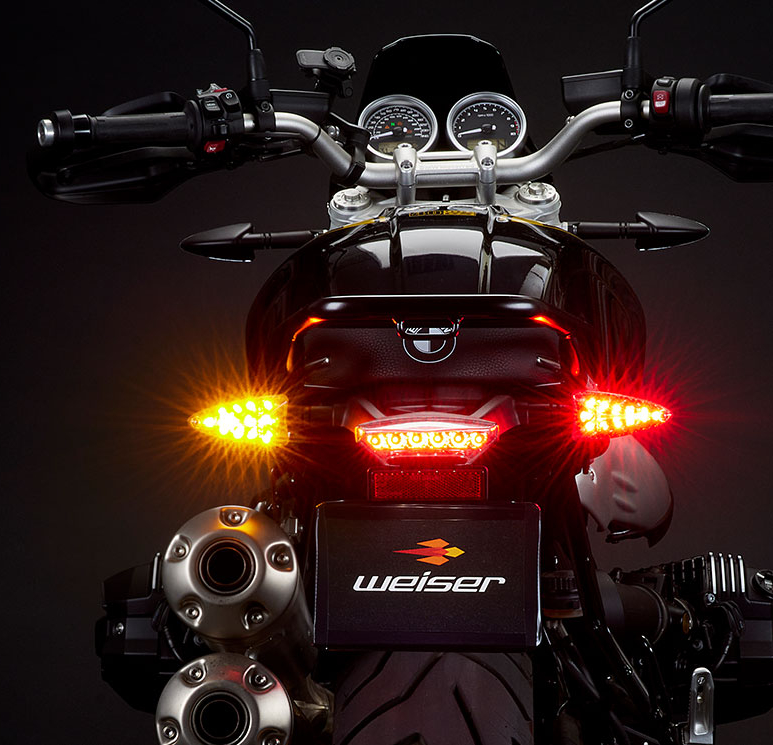 Fit the Weiser Technik upgrade, and the rear indicators become additional red rear (tail) lights for everyday riding. When you brake, the red rear indicators dramatically increase in intensity to grab people’s attention.
Cars get a high-intensity third brake light, so why not have the same safety enhancement for motorcycles?
And naturally, when you turn on the indicator, the high visibility rear lights change into an equally visible turn signal.
What Next?
Different manufacturers using the same indicator housing isn’t as common as it once was. However, a manufacturer using the same indicator across their range remains standard practice.
Suzuki and Honda are perhaps the most prolific at reusing the same indicator housing. The turn signals on the Honda NT1100 are the same ones used on the Africa Twin, CB1000R, CB650R, CB125R and the new Honda Hornet, to name but a few from Honda’s range.
Yet when the design of the indicator isn’t perhaps as good as it could be, the same shortcoming is repeated on several models.
The dull orange riding lights used by Honda, for example. Or Yamaha’s single LED and moulded plastic indicator body fitted to the Tracer series. Both offer problems Weiser Technik are keen to solve.
Then there is Weiser Technik’s love of older BMWs and the upgrade kits – single or multi-function – for Beemers going back to 1969, which are available from Weiser Technik’s website.
A Thousand Words
But returning to more recent BMWs, Weiser Technik has begun manufacturing a direct replacement for some of the pencil-thin indicators that are now appearing.
The later BMW indicators and some KTM units might be LED, but the visibility problem is only getting worse as the indicators get smaller.
The indicators will, of course, meet all the legal requirements for a turn signal, yet they can become practically invisible once you move a few degrees on either side of head-on.
Words can only go so far when describing the benefits of the Weiser Technik upgrades, and if at this point you are still undecided, take a look at the review and installation guide the Just The Way It Is Youtube channel created.
As the saying goes, a picture paints a thousand words.