
I knew the job was going too well. Any time a motorcycle project starts with the phrase “This’ll only take an hour,” you can be sure you’re about to lose a weekend, a chunk of your sanity, and increase your collection of swear words.
In my case, all I wanted to do was remove eight cylinder head bolts so I could fit a complete Delkevic exhaust system. Eight bolts. A child could count them. At some point in the bike’s murky past, someone had replaced these bolts with stainless‑steel Allen bolts.
Stainless steel, of course, is lovely stuff for kitchen sinks, cutlery, and the sort of jewellery worn by people who say “bro”.
On a motorcycle engine, stainless steel threaded into aluminium is a relationship doomed from the start.
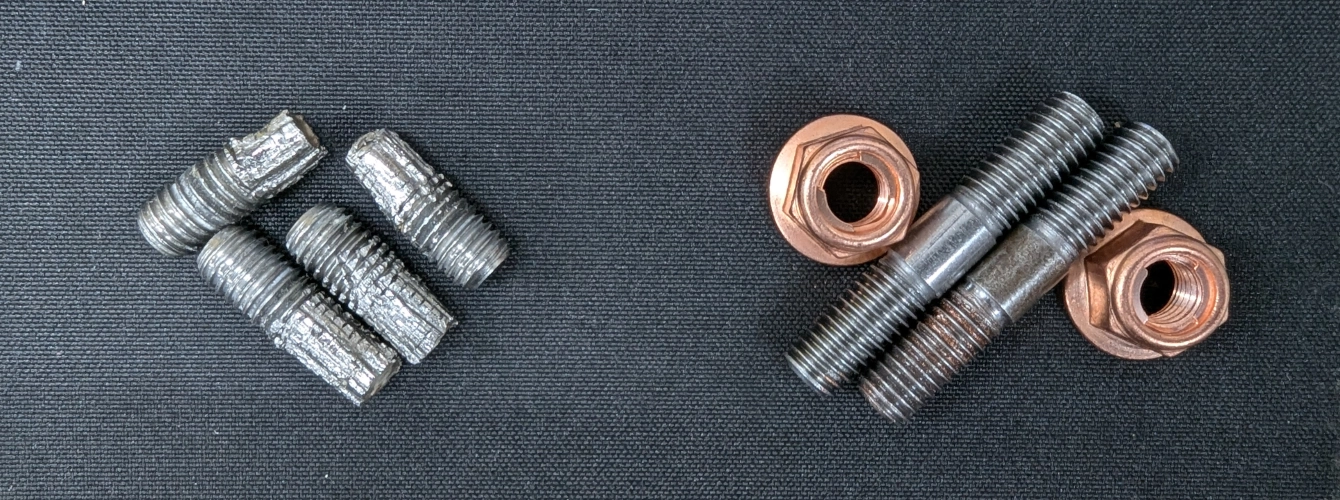
Aluminium expands more with heat than stainless steel, and the two metals spend their lives clamping, shrinking, fretting, and generally behaving like a couple who should never have moved in together.
Add heat cycles, moisture, and a decade of benign neglect, and you end up with a chemical romance that borders on fusion.
So, armed with optimism and a fresh mug of tea, I set about removing the eight bolts.
Two came out.
Two. Out of eight. The remaining six behaved like they were auditioning for a Greek tragedy.
Five snapped after giving me the distinct impression they were loosening—just enough rotation to make me think I was winning, followed by that sickening, buttery “plink” as the bolt snapped.
And so began the Great Stud Extraction Odyssey.
Technique #1: The Spiral Grip Extractor
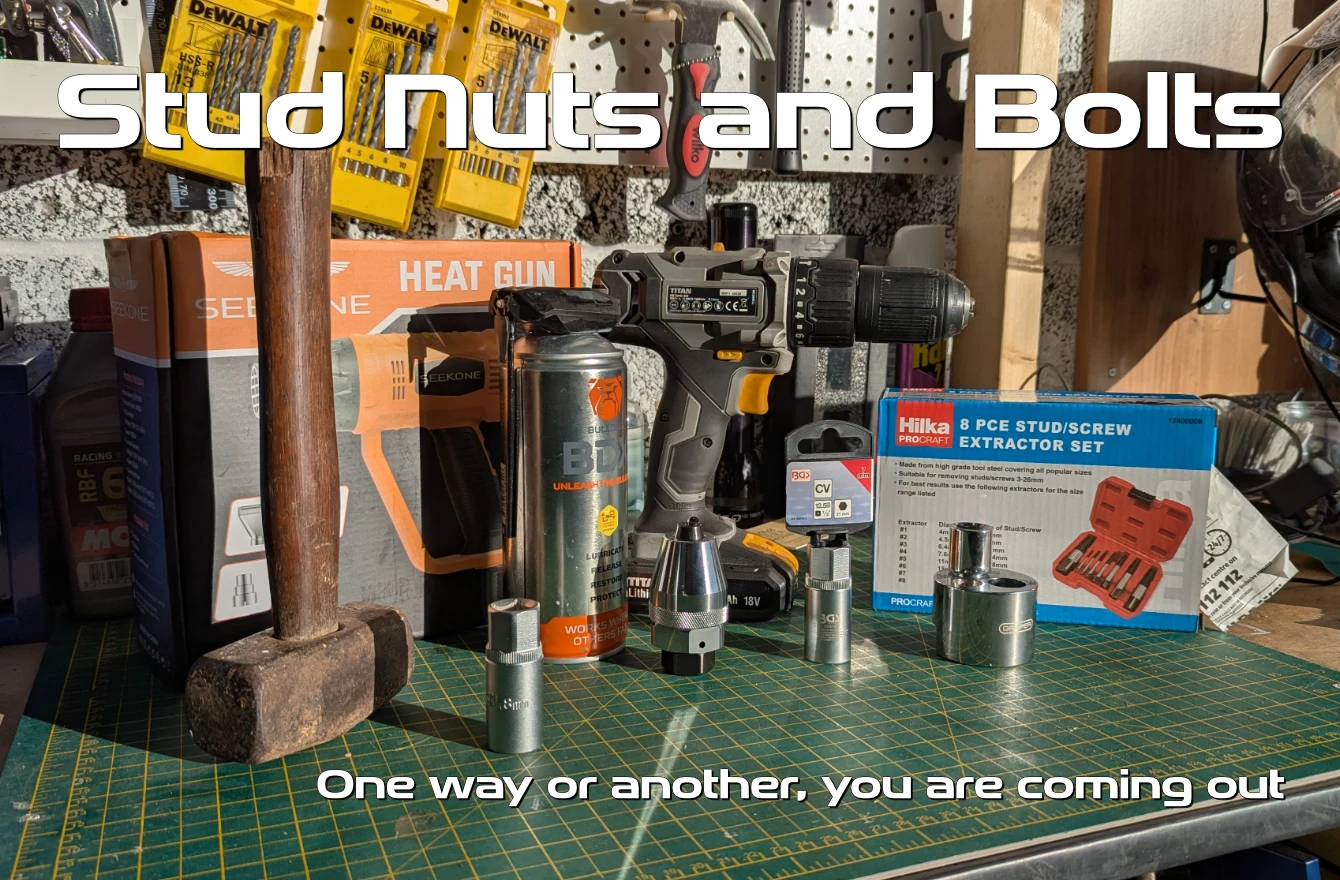
Various types of stud extractors tighten their grip as you apply force—cam‑style, collet‑style, spiral‑style. I tried them all.
Each one promised engineering elegance and delivered only frustration. The spiral extractor, in particular, seemed determined to impersonate a medieval torture device. It gripped beautifully until I applied torque, then let go and tried to remove the skin from my knuckles instead.
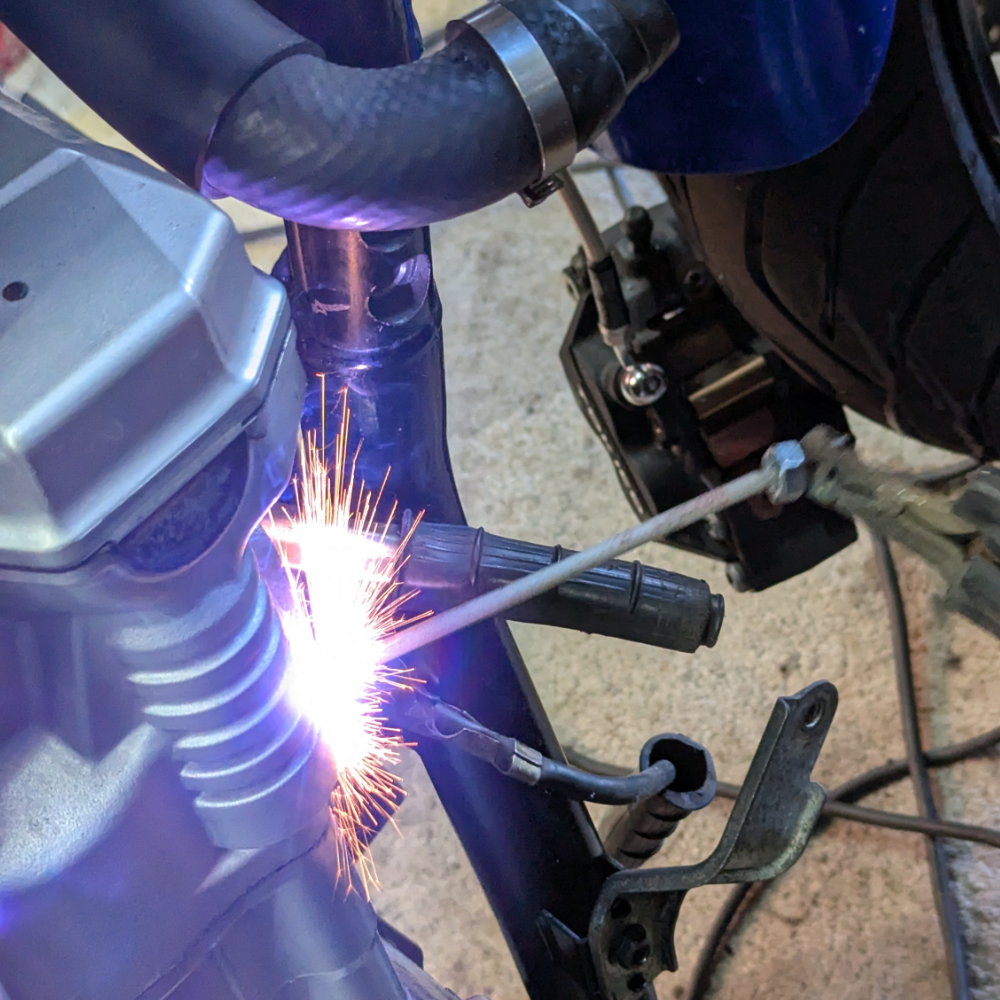
The frame kept getting in the way. I continued to swear. The studs continued to mock me.
Technique #2: Welding an Oversize Nut
This works in all the YouTube videos, but here is the catch: my bolts are made of stainless steel. Getting a solid weld between stainless steel and a typical nut is difficult.
I tried it, and the nut got very hot. I hoped the heat would also help break the seal, but the only thing that broke was the nut when it came off the stud.
Maybe a specialist welding technique will come up in the comments.
For me, it was on to attempt number three.
Technique #3: The Stud Extractor Crimp
Now this was progress. This is the sort of tool that grips tighter the more you try to undo the stud—like a terrier on a trouser leg.
And, miracle of miracles, five of the studs actually surrendered. The extractor bit down, I applied torque, and the stud came out with a noise best described as “metallic regret.” I celebrated this victory with another mug of tea and a smug walk around the garage.
You definitely need to eat three Shredded Wheat for breakfast to make this work.
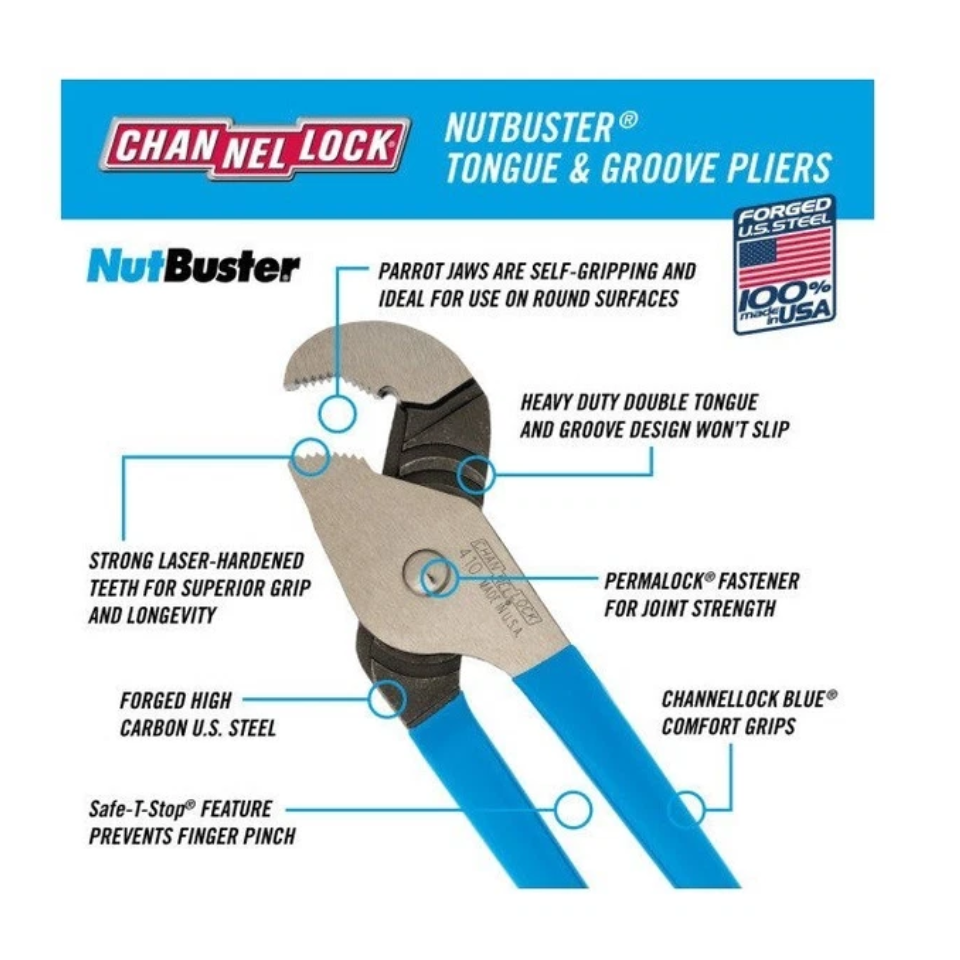
You need to squeeze the pliers hard to get the teeth in the jaws to catch onto the stud. When they do, you keep squeezing, and as you try to rotate the extractor, it cuts deeper into the stud.
Add a lot of heat from a hot air gun – a lot – and all but one of the remaining studs came out.
Excessive quantities of tea, and pink sprinkled doughnuts played a major part in the success.
Why Such a Problem?
By now, you may have noticed a common thread to this tale of woe: stainless steel.
The problem begins with simple chemistry. The aluminium cylinder head, engine heat, stainless steel bolt/stud, and a little water (rain!) result in galvanic corrosion.
Aluminium oxide, which forms from the chemical reaction, is the particularly nasty part because it occupies more volume than the original metal. Think of it like swelling.
This fills the gaps around the threads and effectively welds the stainless-steel bolt into the head.
Drill Them Out
Yeah… right. Stainless steel is hard to drill, cut or machine because of a combination of its alloy composition, work-hardening behaviour and poor heat conductivity.
The really irritating part is that trying to drill them out can make the studs/bolts even harder to work with, particularly with common austenitic stainless steels such as 304 and 316.
Austenitic refers to the way the stainless steel is made, resulting in three particularly relevant characteristics:
- Excellent corrosion resistance — thanks primarily to chromium, which forms a thin protective oxide layer, and is the reason we like them. They look good.
- Good ductility — they can bend and deform considerably without breaking. Unless “welded” into an aluminium cylinder head.
- Pronounced work-hardening — deforming the metal can make it progressively harder, which is why drilling it incorrectly can become frustrating.
And so … with all of that in mind, we get to Stud Removal attempt number 4.
Technique #4: Drill It Out
For those of you keeping score, I’m down to the last remaining stud. Thankfully, it is the outer stud on cylinder number 4.
Nothing will shift it, and this was the stud that I tried to weld a nut to. I’m down to a few millimetres of exposed stud, and so out came the angle grinder to get it flush with the head, centre punch the middle of the bolt and start drilling.
Thankfully my colleague Richard (aka Doughnuts) has a set of cobalt-tipped drills. So, I’m expecting great things to happen.
They didn’t.
After an hour or more of drilling – slowly, as is necessary to prevent work-hardening – there was enough to try an Easy-Out. It went in and locked, but it bent as I applied as much pressure as I dared.
The very last thing I needed was a broken stud extractor in the hole I’d just spent an hour or more drilling.
White Flag
This was the moment we waved the white flag. I say we because, throughout this attempt to change the laws of physics and chemistry, my colleagues have closely supervised me and occasionally mocked me.
Mostly mocked me.
Humbled by the last of the studs, the next course of action is to call a local specialist. Drilling the bolt out with carbide-tipped drills and a Helicoil sounds like the way forward, but I’ll not tell the expert what needs to happen – that would be dumb.
The Ironic Conclusion
So now, after hours of drilling, grinding, welding, swearing, and generally behaving like a man who shouldn’t be left unsupervised with tools, all eight cylinder-head bolts are out.
Needless to say, stainless steel bolts will NOT be used to fit the Delkevic exhaust. I have proper studs and copper nuts, and that’s the secret.
Copper nuts resist seizure at high temperatures, reduce the chance of thread galling, and are often easier to remove after years of heat cycles and exposure to rain and salt.
They can even come with a self-locking mechanism that is easy to overcome when removing them.
And yet—because irony is never far away in motorcycling—there’s a chance all this work might get me into trouble at the MOT.
The UK Government’s proposed new rules suggest that motorcycles may soon need to remain unmodified unless the modification maintains the original specification. Which means my shiny, painstakingly installed exhaust system could, in the eyes of officialdom, be considered a mechanical crime.
That said – Life is too short. When is the next track day?