
Zen and the Art of Motorcycle Maintenance was a surprise hit book. Published in 1974, it is about the idea that caring deeply about how things work, and taking the time to understand and do things properly, is a route to both better motorcycles and a better life. [Dude; break out the joss sticks we are getting trippy ~ Ed.]
Granted, given what we normally write about, this is all a bit deep, but having owned bikes since … well, let’s not go there … it did strike me that a lot has changed. 1980 is closer to the millennium than we are today.
 So, following Robert M. Pirsig’s basic theme, but not nearly as well, are we as attached to our motorcycles today as we were then?
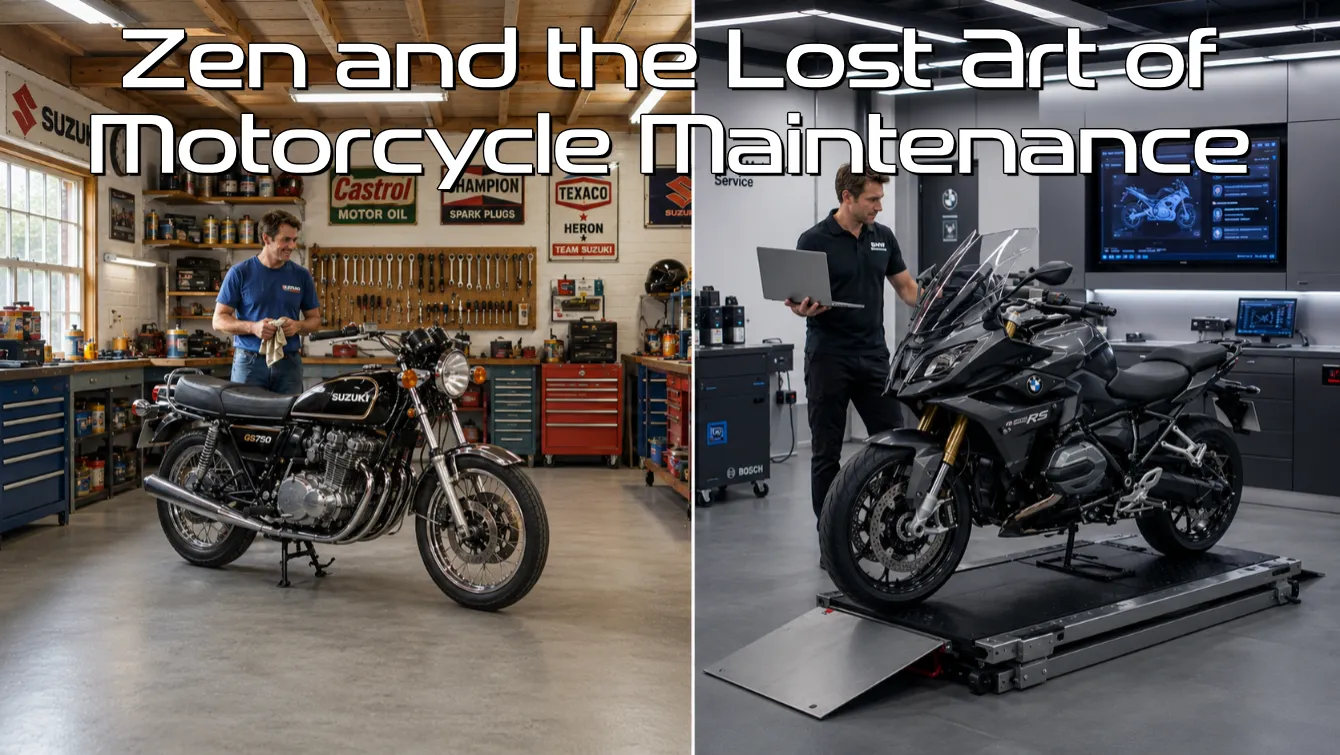
Zen and the Lost Art
Ask a motorcyclist what they ride, and you will rarely get a simple answer.
Nobody says, “A BMW R1250RS.” And stops there.
No. You’ll get the model, the modifications, where it’s been, what tyres it wears, what luggage it has and, within about three minutes, probably a story about the one thing that has annoyed them since the day they bought it.
Motorcyclists form relationships with their machines. Always have.
But that relationship has changed.
Modern motorcycles are, by almost every measurable standard, vastly better than the bikes that came before them. They’re faster, cleaner, safer, more efficient and so reliable that a breakdown on a modern machine now feels less like an inconvenience and more like a personal betrayal.
Yet, somewhere along the way, something has quietly disappeared.
The expectation that the rider actually knows how the bloody thing works.
Part-Time Mechanics
For anyone riding in the 1960s, 70s or even well into the 80s, maintenance wasn’t an optional hobby. It was simply part of owning a motorcycle.
Spark plugs needed cleaning. Carburettors needed fiddling with. Chains stretched. Cables snapped. Points required adjustment, and the electrical systems developed a habit of failing precisely when the heavens opened.
Going on a long trip often meant packing a toolkit, spare bulbs, cable ties, insulating tape and enough random bits to open a bike spares shop.
We accepted this as part of motorcycling life. It was what we signed up for.
I can still remember the sense of impending doom when I decoked my moped.
For the benefit of younger readers, “decoking” is a ritual part of owning a two-stroke and involves removing the cylinder head and scraping carbon deposits from the top of the piston and the cylinder head.
In reality, on my little 50cc machine, this meant removing four nuts – Four.
To a mechanically bewildered 16-year-old, however, it felt like being asked to perform open-heart surgery. But you learned. You learned because you had to.
Older motorcycles were constantly teaching you something, usually through the medium of inconvenience. A strange hesitation might mean ignition trouble. An uneven idle could send you towards the carburettors. A new vibration might be serious.
Or it might just be Tuesday.
Gradually, you got to know your bike.
Not just how fast it went or how it handled, but its habits. The bolt that always seized. The electrical connector that needed cleaning every winter. The strange noise that sounded catastrophic but had been doing exactly the same thing for the last 20,000 miles.
The motorcycle became less of a product and more of a slightly unreliable friend.

Rose Tinted
Nostalgia is a wonderful thing.
It allows us to remember rebuilding an engine in a weekend while conveniently forgetting that we only had to rebuild it because the bloody thing had exploded.
Older motorcycles could be wonderful, but they could also be spectacularly inconvenient. Oil leaks were often considered more of a feature than a fault.
Cold-starting procedures sometimes resembled an ancient religious ceremony involving choke levers, throttle positions, and blind optimism. Lucas electrics earned their reputation for good reason, and many of us have stood at the roadside in the rain wondering whether hitting something would make it work again, call a priest, or both.
Modern motorcycles have largely removed all of this nonsense.
Press the starter and the engine rumbles into life. Usually first time. Fuel injection quietly gets on with adjusting the mixture. Engine management systems monitor everything. Service intervals have stretched to distances that would once have seemed like science fiction.
A modern touring bike can cross Europe without requiring the rider to carry half a workshop under the seat, and frankly, that’s brilliant.
Most of us would rather be riding through the Alps than sitting in a French lay-by trying to remember which wire is supposed to be connected to the battery.
The Lost Art
The problem, if that’s the right word, is that modern reliability has come with complexity.
ABS, traction control, riding modes, electronic suspension, cruise control and cornering safety systems have made motorcycles safer and more capable than ever before.
But when something goes wrong, the solution isn’t always a screwdriver and a bit of common sense.
Once upon a time, a fault could often be traced logically.
Today, the same problem might involve a sensor, a control module, a CANbus, a software fault or an electronic component hidden somewhere beneath three layers of bodywork.
Take the Hex Innovate GS911. Never mind the spanners, this is what you want in your tool kit on a BMW. Plug it in and the bike will tell you what is wrong with it.
The modern motorcycle is less a mechanical device and more a computer that you can ride.
The Zen Bit
A rider who once balanced their own carburettors may now be staring at a warning light that can only be properly interrogated with specialist diagnostic equipment.
You haven’t necessarily lost the ability to fix the problem. You’ve just been locked out of the conversation.
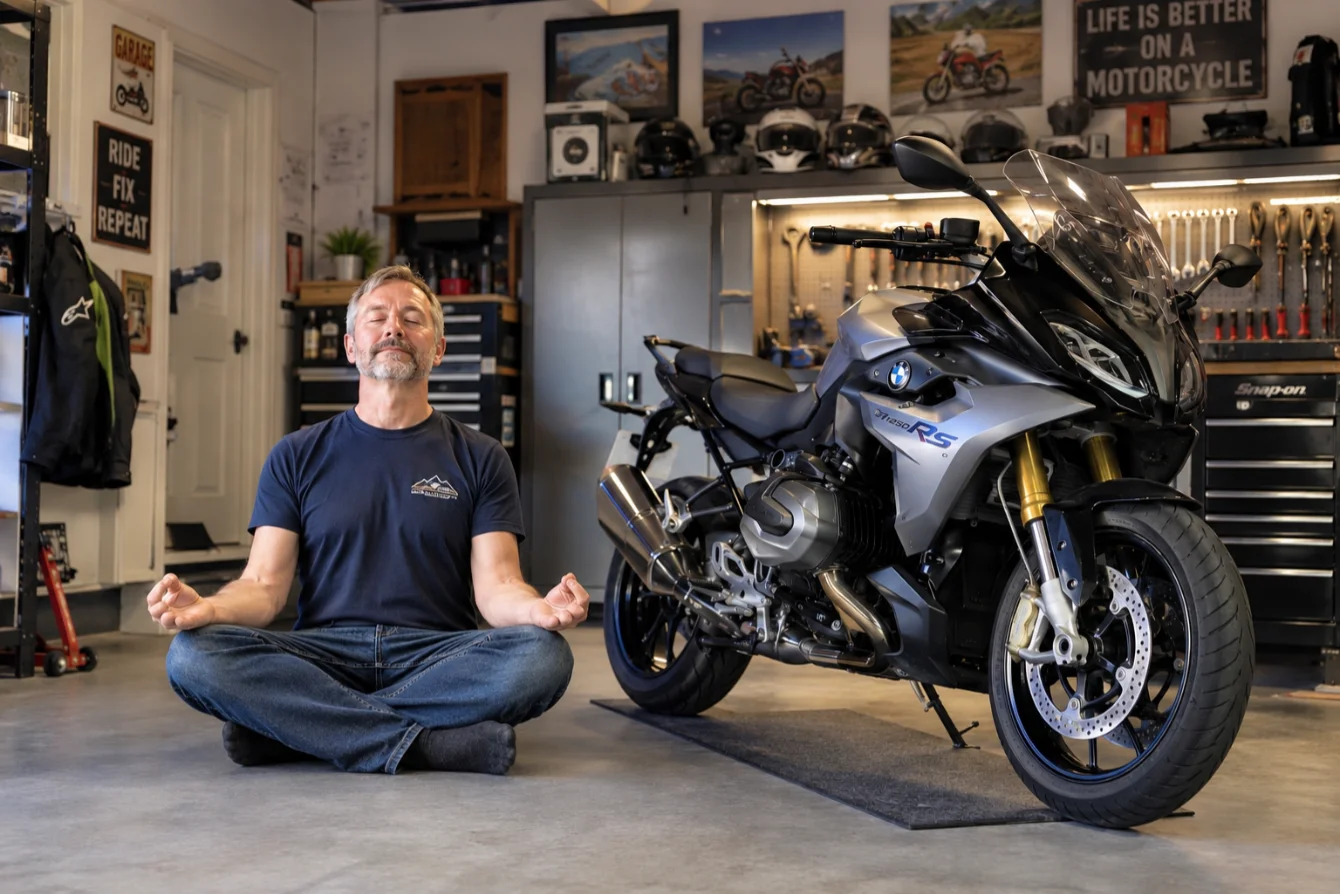
There is something uniquely satisfying about repairing your own motorcycle. A bond develops. Replace a clutch, rebuild the forks, adjust the valves or spend an entire Sunday tracing an electrical fault and you develop a different relationship with the machine.
You might invent new swear words, shed a little blood and spend three hours in the garage on a ten-minute job, yet when you finally solve the problem, you haven’t simply repaired the bike – you have saved it and in doing so become invested in it.
Some of the best motorcycle stories aren’t about the perfect ride where nothing went wrong. They’re about broken cables in the middle of nowhere, improvised repairs using borrowed tools and the random stranger who stopped to help because they happened to have a large collection of 3/8 and 7/16 sockets (10mm in old money).
Mechanical unreliability was frustrating, inconvenient and occasionally expensive.
But it also created stories, and modern motorcycles are far less likely to provide them.
Have We Lost Something?
Possibly. But let’s not pretend we’d all swap our modern motorcycles for a machine that required a tune-up every other Thursday.
Given the choice between a bike that starts every morning and one that requires regular offerings to the God of Carburettors, I know which one I’d choose.
Modern motorcycles allow people to travel further, more safely and with far less mechanical knowledge. That has made motorcycling more accessible, and that’s no bad thing.
Not everyone wants to rebuild an engine. Some people simply want to ride. And perhaps that’s the real difference.
In the past, understanding your motorcycle was often a requirement of ownership. Today, you have a choice.
You can still learn to service your own bike. You can still spend weekends in the garage surrounded by tools, manuals and mysterious leftover bolts. Classic motorcycles, restorations and home workshops are still hugely popular because plenty of us enjoy getting our hands dirty.
The difference is that your modern motorcycle doesn’t force you to do it.
And the future may be even more complicated, but things are unlikely to go backwards.

Volts Not Petrol
Electric motorcycles have fewer moving parts but rely even more on electronics and software. Future bikes may receive updates in the same way our phones do today.
Imagine it – “Your motorcycle requires an update. Please do not switch off the ignition.”
Meanwhile, somewhere in the garage, an old bloke will be looking lovingly at a 1970s carburettor and thinking, at least I understood you.
But perhaps that’s simply evolution.
The relationship between rider and motorcycle isn’t disappearing. It’s changing.
For some, the motorcycle is all about the road, the journey and the destination.
For others, the machine is part of the experience. They want to understand it, maintain it and occasionally threaten it with a hammer when it refuses to cooperate.
Motorcycles have always been more than just transport. They’re freedom, identity, adventure and, occasionally, an expensive collection of problems attached to two wheels.
The grease-covered hands may be less common than they once were. The diagnostic laptop may be replacing the feeler gauge. Future generations may never experience the particular joy of stripping a carburettor on the kitchen table or being shouted at by your Mother for washing bike parts in the kitchen sink, while Dad has that “I’m off to the pub” look on his face.
But the bond between rider and machine is still there.
It’s just that these days, instead of asking whether you’ve checked the points, your motorcycle may simply flash a warning light and refuse to tell you what’s wrong. Unless you own a BMW and a GS911, that is.