
There is something almost magical about fitting a new set of tyres to your motorcycle, and thanks to Mobile Bike Tyres (naff website but a legend in my part of the world), I am revelling in the delight of a pair of Dunlop RoadSmart IV GTs.
Even if the old ones hadn’t quite reached the point where the MOT tester was asking if they were racing slicks, new tyres always make the bike feel alive again.
The steering becomes quicker, the bike has regained its eagerness to change direction and, strangely, roads I have ridden a hundred times have acquired extra corners, mostly because I’m exaggerating them and rolling in wider than I should be.
The Dunlop Mutants on my Honda NT1100 had developed that familiar squared-off profile after a considerable amount of mileage. The rear in particular had lost a lot of its original curvature, and while there was still usable tread, the tyre wasn’t exactly volunteering to lean into corners.
After around 1,000 miles in a weekend on the RoadSmart IV GTs, I’m glad I chose the GT over the SP. So why?
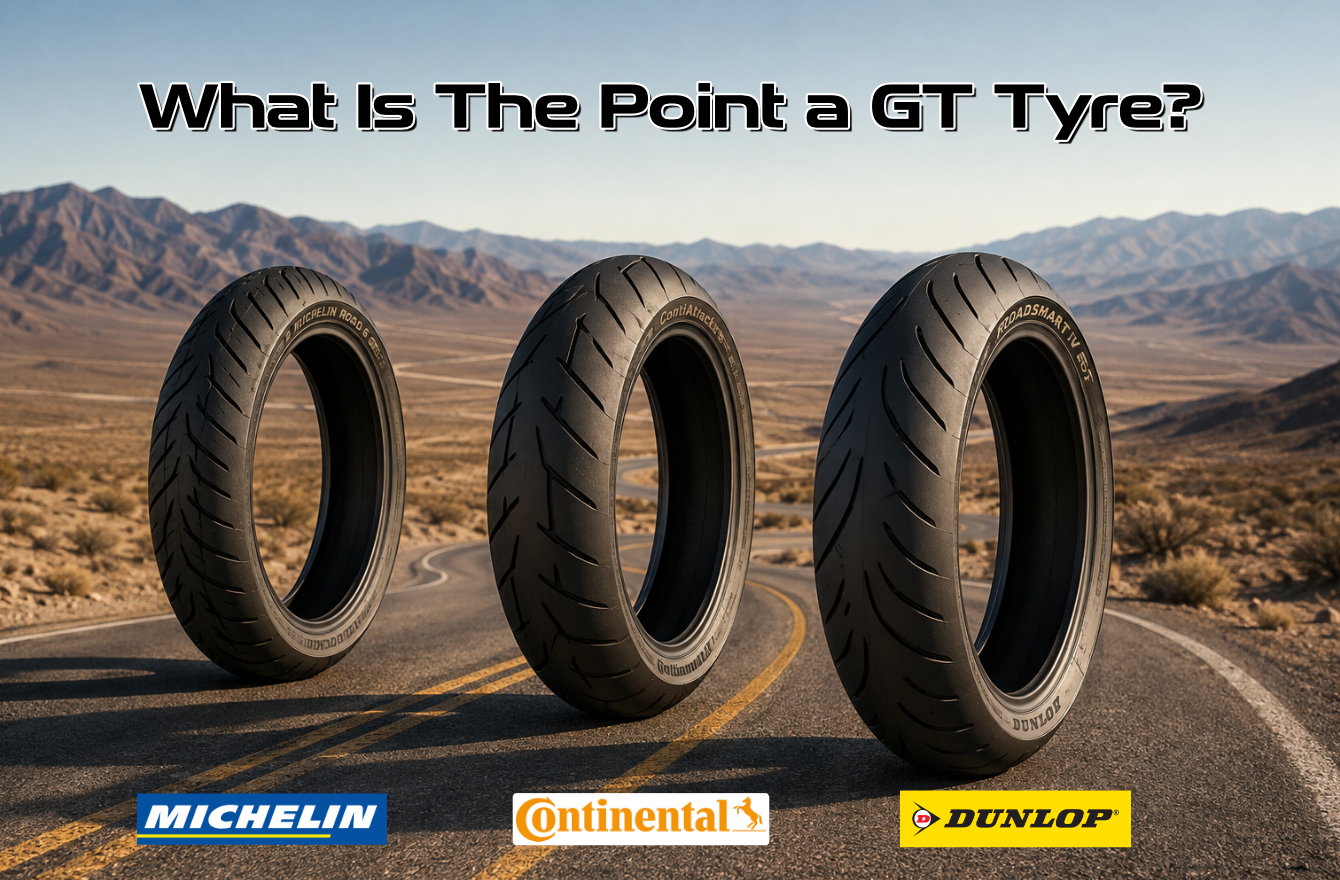
What’s The Point of a GT Tyre?
This all started with me wondering what defined a “heavy bike”. At 230 kg, the NT1100 isn’t what you would call a lard bucket, but, as with most things involving motorcycles, it isn’t quite that simple.
None of the manufacturers quote a weight above which you should abandon the SP or standard tyre and fit a GT. The reason is simple: there isn’t a one-size-fits-all answer.
Neither Dunlop, Michelin nor Continental list a specific weight figure; rather, they allude to using the appropriate version according to the motorcycle and its fitment.
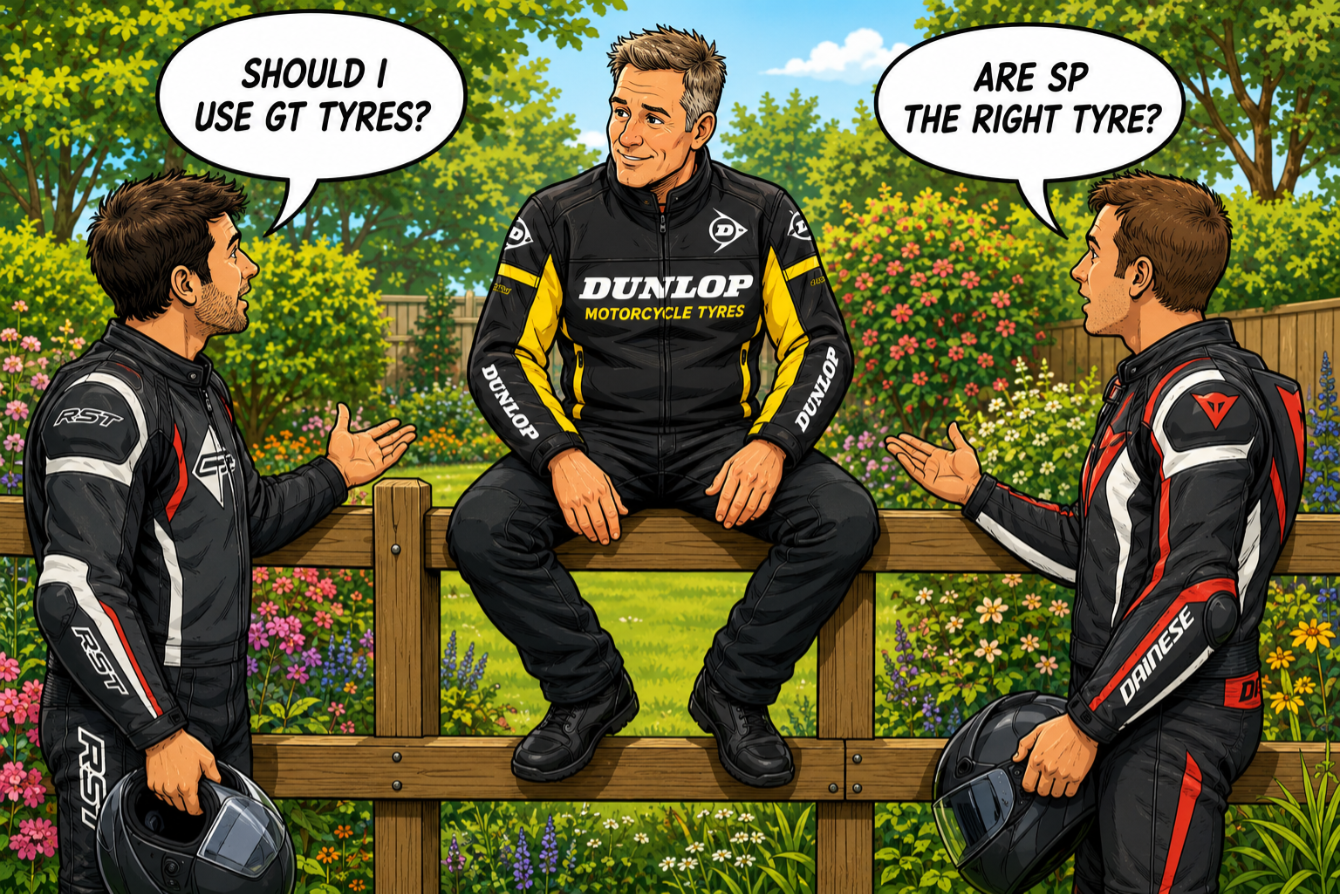
Dunlop describes the RoadSmart IV GT as being tuned for heavier touring bikes, while the SP version is aimed at lighter, sportier machines. And, to confirm Dunlop’s place firmly on the fence, they advise the rider to consult the fitment guide for the recommended specification for your motorcycle.
However, in every motorcycle manual I’ve read, they talk about a specific tyre; I remember my KTM 1090 being something obscure that was no longer made.
Fitting what is listed in the manual isn’t always the best option, especially if the tyre has been superseded – See Life of A Tyre.
The other big factor is that the relevant number isn’t necessarily the weight of the motorcycle sitting in the showroom. It is the total loaded weight.
My Honda NT1100, with me at 105 kg in my riding gear, plus whatever crap I have in the top box, plus the engine bars, may also be accompanied by panniers, a roll bag, and enough supplies to survive the coming zombie apocalypse or a week in Scotland.
Suddenly the figure that matters to the tyres bears very little resemblance to the weight the manufacturer has printed in the brochure.
Weight Distribution
Imagine two NT1100s, both weighing exactly the same when loaded.
On the first, the rider – a heavy chap – is alone with a modest amount of luggage distributed sensibly between the panniers and the top box.
On the second, there’s a lighter rider with a pillion passenger and a top box full of stuff.
Both motorcycles have the same all-up weight, but quite different load distribution.
Adding a passenger behind the rider and over the rear of the motorcycle disproportionately changes the load carried by the rear tyre and alters the suspension geometry as the rear will sit lower.
The tyre is also being asked to deal with greater forces as the motorcycle accelerates, brakes and corners.
This is why simply saying “my bike weighs 230kg, therefore I don’t need a GT specification tyre” is missing part of the picture.
One of the people I occasionally ride with will not use a top box, as the weight is carried beyond the rear axle, and he dislikes how that makes the bike feel. It is an interesting thought.
Is a GT Just Harder?
There is another common assumption about GT tyres; they have harder rubber.
However, that is more fiction than fact, no doubt started by “that bloke” at the tea stop on the latest edition race replica, who is fast in a straight line and brakes 10 minutes before the corner.
In the case of the RoadSmart IV, it uses Dunlop’s Multi-Tread technology, with multiple compounds positioned across the tread. All the benefits of durability, wear resistance, grip and stability found in the SP tyre are present in the GT.
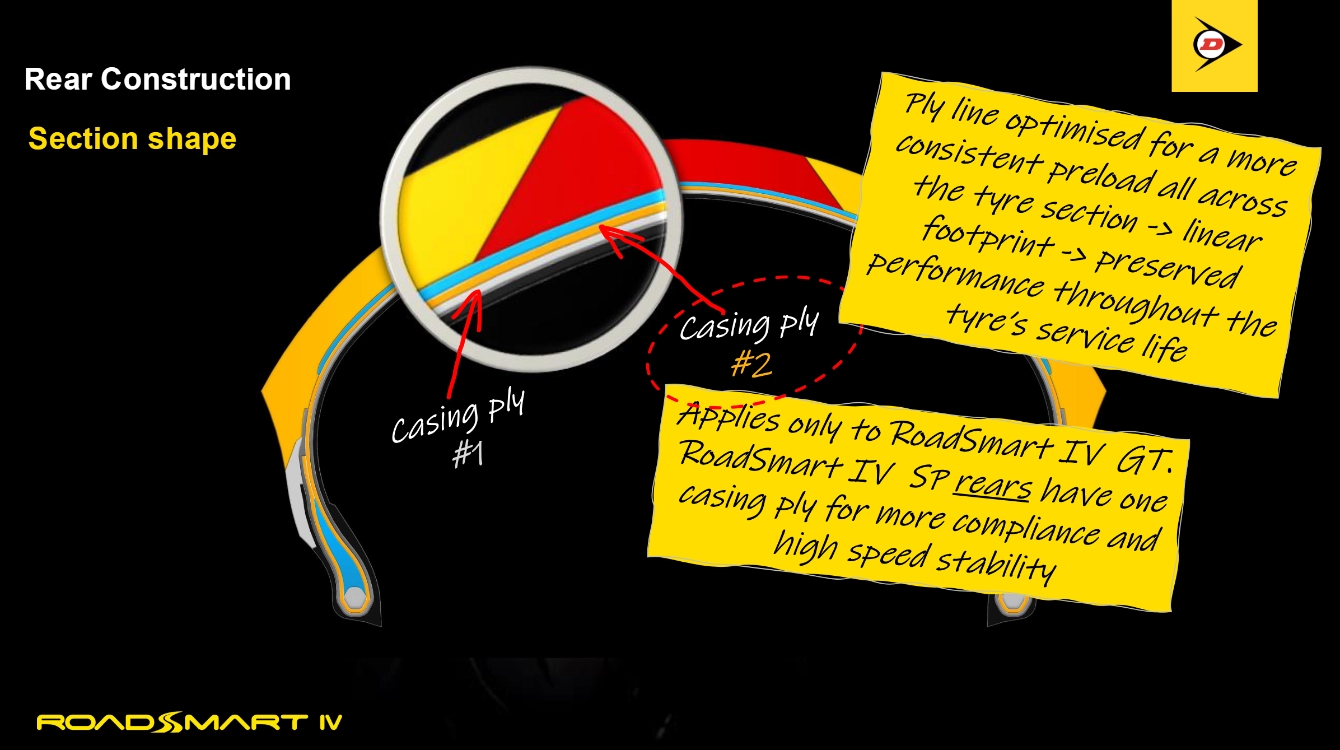
The significant difference is in the tyre’s carcass construction and the way that construction has been tuned for the motorcycle.
Dunlop calls it the Carcass Tension Control System [someone in Marketing had a triple espresso that morning ~ Ed.] which controls the distribution of stress through the casing, while its Dynamic Front Formula [WTF ~ Ed.] is used to optimise the profile and section shape.
The result is a tyre designed to maintain a more controlled shape when subjected to the greater loads associated with whatever defines a “heavier” motorcycle.
Does Being Stiff Matter?
Imagine rolling into a corner at speed. The motorcycle leans, the suspension moves, and the tyre deforms. That’s perfectly normal. A motorcycle tyre isn’t a solid rubber hoop; its carcass flexes and the contact patch changes shape as forces are applied.
Now put more weight on the motorcycle. The forces increase, and the weight distribution typically shifts towards the rear, giving the rear tyre more work to do.
A construction designed around that additional load can resist unwanted deformation more effectively and maintain a more consistent dynamic footprint.
This is something I have noticed over the last 1,000 miles, and I wasn’t really expecting it.
But let’s not get overly excited just yet.
New Tyre Syndrome
My previous rear tyre – a Dunlop Mutant – was squared off. Simply replacing that with a correctly profiled new tyre was bound to make the steering feel more willing, but I think there is more to it than that.
My impression is that the GT’s stiffer construction is helping the tyre retain its intended profile when the NT1100 is loaded, leaned over and I’m getting on the herbs.
Less deformation means less change in the shape of the tyre underneath the motorcycle. And that seems to translate into a quicker roll in and out of corners.
It isn’t a dramatic transformation. The NT1100 hasn’t suddenly developed clip-ons and an urge to attack the Nürburgring, but the steering feels faster and more immediate.
You might expect “heavier-duty” to mean “heavier steering”, but Dunlop’s marketing department says that the GT is tuned for enhanced agility and reduced steering effort on heavier bikes, and – as much as it pains me to say so – the marketing department might actually be right.
How Many Miles?
I haven’t got a clue. Neither does anyone else. It is all down to the type of miles you ride and how you ride them.
Someone might have a number they quote. But whether I’ll achieve it is another matter. Our colleague Billy can coax more miles out of a tyre than any of us, mostly because he has more brain cells than we do, but that proves the point.
Tyre life depends on weight, throttle use, road surface, temperature, tyre pressure, luggage, passenger, riding style and the general enthusiasm with which the rider attacks the right-hand grip.
A rider who spends his life touring Scotland at sensible speeds is going to get rather different mileage from someone who treats every roundabout as an audition for the TT.
The practical benefit of the GT construction isn’t necessarily that it will last a specified number of miles longer. It is that the tyre should remain more consistent as the motorcycle’s load increases.
And that’s important because wear isn’t just about tread depth.
A tyre can have plenty of legal tread remaining while its profile has become decidedly less enthusiastic about cornering. That squared-off rear tyre is the perfect example.
I’m hoping to get a minimum of 4K miles touring; would be delighted with 6K and puzzled if I get more than that, but really hoping that the tyre holds its profile longer.
Michelin and Continental
Dunlop certainly isn’t the only manufacturer taking this approach.
Michelin has the Road 6 GT, specifically developed for grand touring machines. Michelin describes it as a dedicated GT version alongside the standard Road 6 range, with its own optimised tyre architecture.
Continental has the ContiRoadAttack 4 GT, following the same basic principle: a GT construction aimed at motorcycles where the additional mass and touring load place greater demands on the tyre.
The important point is that these manufacturers aren’t simply saying: “This tyre is for motorcycles over X kilograms.”
The correct fitment depends on the motorcycle, its tyre size, its chassis characteristics and the intended load.
Which is why their fitment guides are more useful than an arbitrary weight cut-off.
RoadSmart IV GT – Worth It?
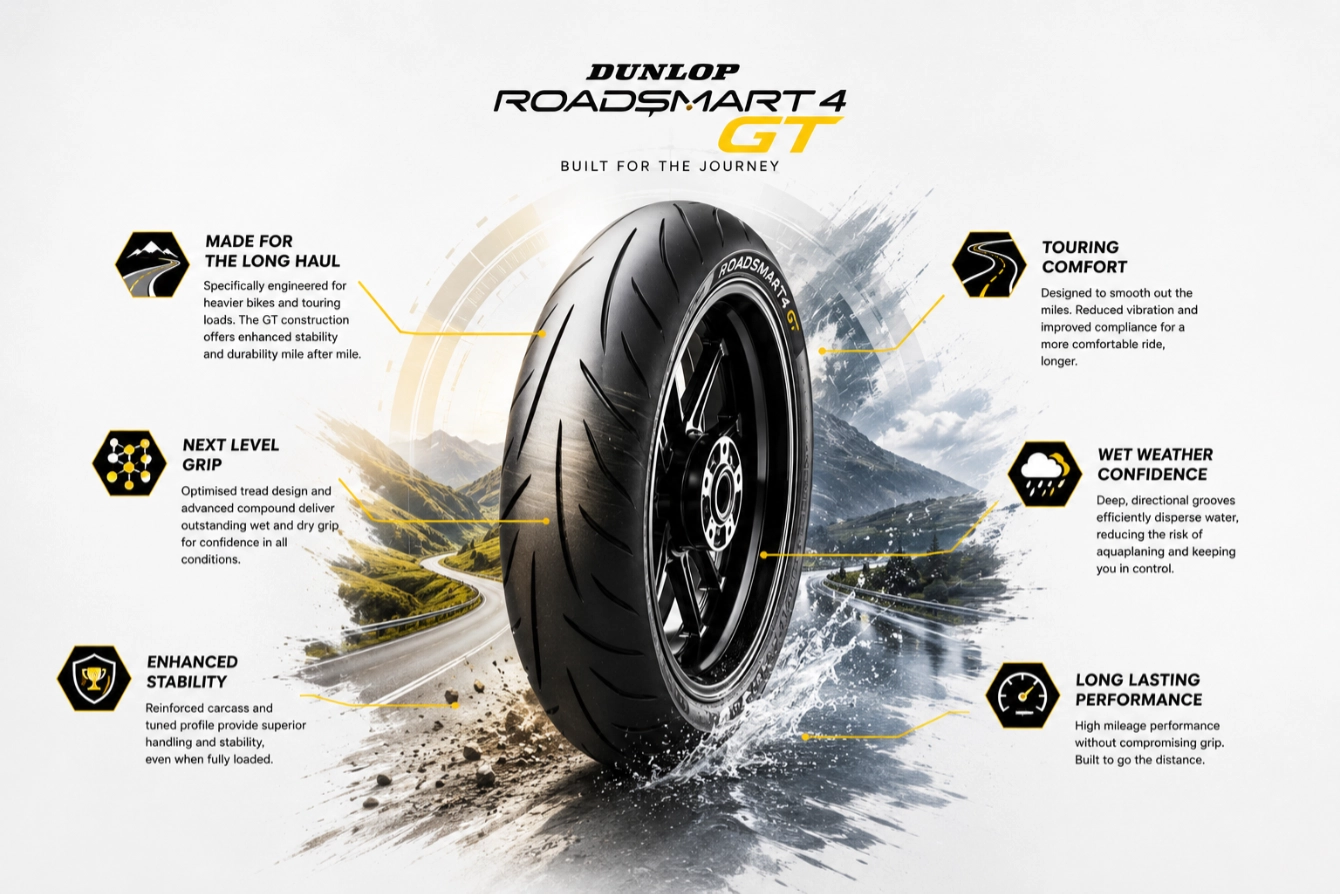
For me, on the NT1100, yes. After 1,000 miles, the tyres have proved predictable, confidence-inspiring and, most importantly, they suit the way I use the bike.
The biggest surprise has been the way the bike steers. It is much more intuitive and requires less input when I spot the twisties approaching. More float and roll than having to load up the outside bar to get the change of direction.
Some of that is undoubtedly the simple joy of replacing tyres that had become noticeably squared off. But the difference I’ve noticed in the RoadSmart IV GT goes beyond that.
The tyre feels as though it is holding its shape better as the bike is loaded and leaned over. Less carcass deformation means the profile remains more consistent, and that seems to translate into the quicker roll-in I can feel through the bars.
It’s subtle – but motorcycles are made of subtle things.
And if you’re riding a relatively heavy motorcycle, regularly loading it with luggage or taking a passenger on tour, that subtle difference can become rather more significant.
Bottom Line
GT does not equal better. GT may not equal more miles. GT equals a choice. And that choice isn’t determined solely by the number on the motorcycle’s specification sheet.
It’s determined by the motorcycle, the rider, the passenger, the luggage and where all that weight ends up.
And having thought about all of that and bought the GTs, discovering the bike turns into corners a little faster, well… That’s a bonus.