Before getting into the story of being nicked for a tinted visor, let me clear up two important points.
Firstly, I’m not legally trained, so this isn’t legal advice. And, perhaps just as importantly, I’m not arguing with what happened; this is my experience, and from my point of view.
I’ll leave you to draw your own conclusions. Right. On with it.
Criminal Intent
It was one of those rare, perfect Sunday mornings. Clear blue sky, bright sunshine, dry roads, if ever there was a morning for a tinted visor, this was it.
What traffic there was had clearly decided there wasn’t any urgency to their tasks and consequently was not bothering the speed limit.
They were shuffling along with the enthusiasm of a post office queue, leaving plenty of space between them and the car in front.
And so I did what we do, and started hopscotching my way past them. Gently. Respectfully. I was the very definition of decisive and well‑planned, easing past one vehicle at a time, barely crossing the white line – if at all – and keeping everything neat and tidy.
Up ahead, there was a junction on the right, so I timed things appropriately—all very textbook.

Did You See Me?
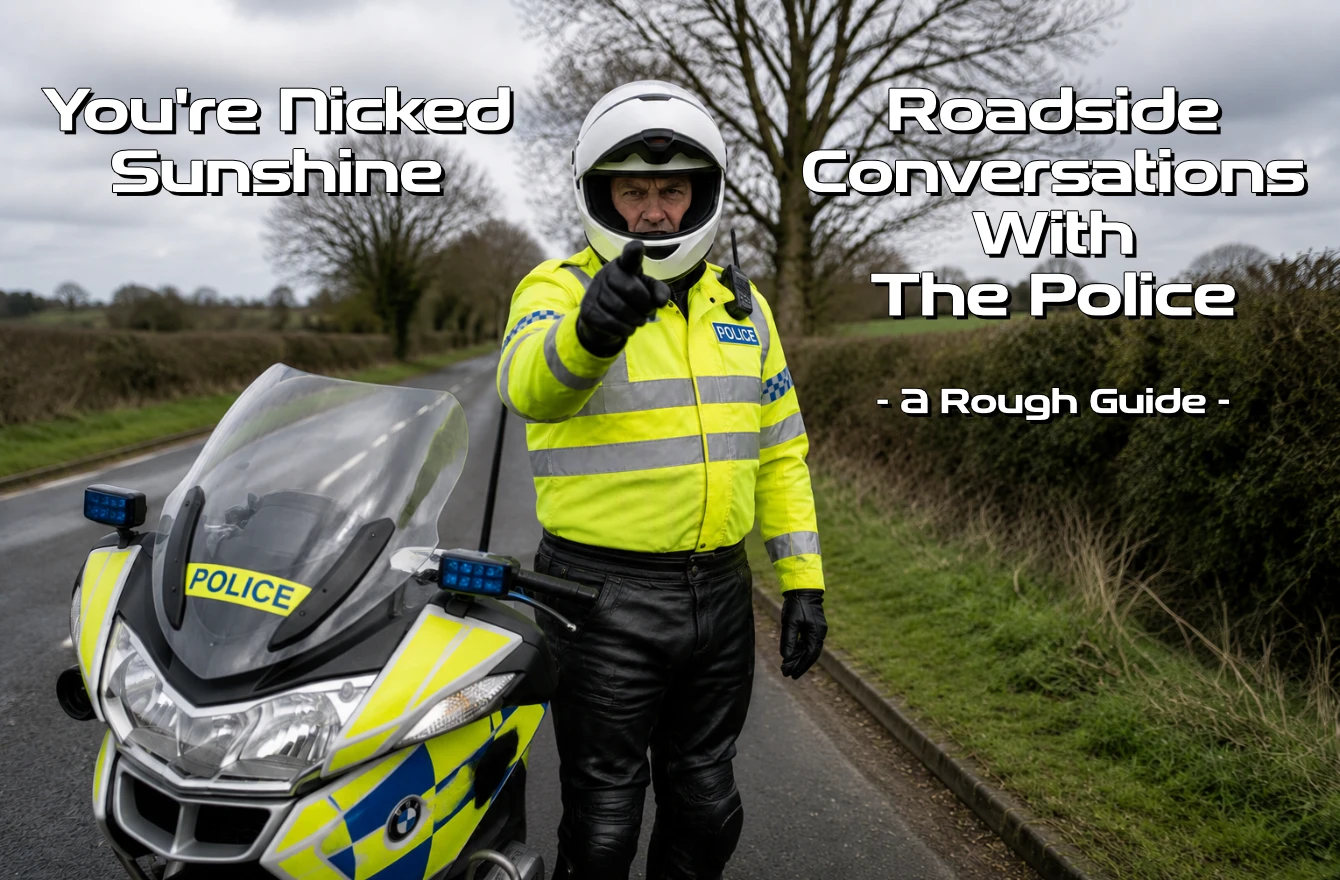
At that junction, tucked away like a sniper in the bushes, set back from the give way line, concealed by trees, tight to the kerb, sat a Policeman on a BMW, surveying the traffic with that watchful stillness that suggests someone’s morning (mine!) was about to become significantly more … err … administrative.
A few miles passed before the inevitable happened. He slid past me, pretty much in the same way I had just been doing to the cars, and the “FOLLOW ME” sign lit up. A mile or so later, we peeled off down a side road for the inevitable “chat.”
The chat, as expected, was more of a lecture—a thorough one. Overtaking was the main theme, and it came with an impressive list of hypothetical offences I could have been charged with, if he so chose.
The tone, although friendly, started with the usual “Why do you think I stopped you?” fishing expedition, and soon shifted to suggesting that (with some creativity) my “offences” could easily include the assassination of President Kennedy and starting the First Opium War in 1839.
But after a while, it became clear — to both of us, I think — that none of that was really going anywhere concrete. The riding itself, while perhaps not to his liking, wasn’t wrong; it just wasn’t what he would have done, and I’m a bit too long in the tooth for horror stories that won’t stick.
He had a few good points, and I had a few equally good counters, but there is no point in arguing; he could charge me with whatever he wanted and leave me with the problem of proving him wrong.
And then came the pivot – “Can I check your tinted visor?” Now we were onto something far more specific — and, as it turns out, far more enforceable.
The Legality of Visors

Motorcycle visors in the UK aren’t just bits of tinted plastic we choose based on how cool we think we look in petrol station windows. They’re regulated safety equipment, and the rules around them are surprisingly precise.
To be legal for road use, a visor must meet an approved standard. Traditionally, this meant compliance with the British Standard BS 4110, complete with a BSI Kitemark, but your visor would have to be 20 to 30 years old to bear such a mark.
Since around 1999, most visors have been subject to European standards, specifically UNECE Regulation 22.05 or the newer 22.06. If that’s the case, the visor will carry an E-mark — a small circle or rectangle with an “E” and a code for the country that granted the approval. The code 11 refers to the UK.
The full text of the requirement can be found here: The Motor Cycles (Eye Protectors) Regulations 1999. It is a riveting read.
That marking isn’t a suggestion or a nice-to-have. It has to be physically present on the visor itself. If it isn’t there, then it doesn’t matter how good the visor is, how much it costs, or whether it came straight out of the box with your helmet — it’s not considered road legal.
Then there’s the issue of tint. This is where many riders, knowingly or not, drift outside the lines.
For a tinted visor, UK rules require it to allow at least 50% of visible light through.
Anything darker than that — the deep smoke finishes, mirrored coatings, iridium effects that make you look like a budget sci-fi villain — may well fall below that threshold. If they do, they aren’t considered suitable for road use.

At the same time, under modern ECE 22.06 rules, E-marked visors intended for daytime use can stop between 35% and 80% of light, provided they are marked “Daytime Use Only.”
It is unlikely these would carry an E11 (UK) mark, but such a visor could be legitimately bought elsewhere in Europe. But if your visor has an “E” marking but fails the 50% light rule, it isn’t legal in the UK.
In simple terms, clear visors are always safe from a legal standpoint, provided they have the “E” or BSI mark. Light-tinted visors can be fine, provided they meet the standard and carry the correct markings. But once you get into darker visor territory, the opportunity to contribute to the Government coffers may well be coming your way.
The Offence
My actual offence, it seems, wasn’t having a cool-looking tinted visor, but ties back to the broader requirement for appropriate and approved eye protection under the Construction and Use regulations.
If your visor isn’t compliant — either because it lacks approval markings or because it’s too dark — then technically you’re riding without suitable protective equipment.
The penalties aren’t usually headline-grabbing. Mine was a £50 fixed penalty, and it’s mostly non-endorsable, so no points on my license.
However, it can escalate. If visibility is deemed significantly impaired, or if it’s linked to riding that’s considered careless or dangerous, then you could find yourself facing points and a more serious penalty.
That door, the policeman had already opened, with words like careless, dangerous and reckless, if I decided to get lippy or contest it.
Incorrect Assumptions
There’s a common assumption that if a visor comes from a well-known manufacturer, it must automatically be road-legal. Not always.
Another popular belief is that “slightly tinted” is fine, without ever checking how much light it actually lets through or if it has the E mark.
Then there’s the classic fallback that “everyone uses them,” which, while undeniably true, doesn’t carry much weight when you’re standing at the side of the road having your morning deconstructed.

So there I was, having successfully navigated a lecture that briefly wandered into what felt like being accused of crimes against humanity, only to ultimately be pulled up for something far simpler: a tinted visor.
And to be absolutely clear, my visor wasn’t legal, and I didn’t know half the things I’ve consequently discovered.
And should you be using one, you too may find that your smooth, uneventful Sunday ride suddenly comes with a large helping of standing around at the roadside, politely listening to a lecture.
Ironic Endings
And the final irony in all of this. Having parked his BMW on the centre stand and turned towards me, he flipped up the drop-down sun visor on his P & J approved Schuberth.
When a helmet is approved for both open-face and full-face use, it is commonly referred to as “P/J rated” (dual homologated).
I’ve got one of those helmets, and there isn’t an “E” or BSI mark on the drop-down sun visor. It seems that, because it is internal to the helmet, it relies on the helmet’s overall approval to be legal.
And .. exactly how much light does that drop-down sun visor block out … IDFK … Time to move on, albeit £50 poorer.