
Originally, this article was going to be called “Getting Trolleyed with …”; however, it seems there’s a certain absurdity in the modern world when you can buy a perfectly good Trolley Dolly, use it, enjoy it, and even want to tell people about it… but you can’t mention where you bought it because someone, somewhere, wants to approve the content before we publish it.
That isn’t going to happen. Editorial control, for an article on a motorcycle dolly? Seriously?
We are not launching a political manifesto, writing a royal biography, or sharing the nuclear launch codes. We are writing about a wheeled steel platform designed to help you shuffle a bike around the garage.
But here we are. So, let’s talk about a motorcycle Trolley Dolly — a rather good one — without mentioning where I bought it (yes, with my own cash money), because saying good things puts too much pressure on someone’s corporate chakra unless they are in control.
The Trolley Dolly
The problem it solves is one familiar to anyone with a garage that is technically big enough for two bikes, much like a budget airline seat is technically big enough for an adult human.
Yes, I can fit two bikes side by side. No, I can’t do anything once they’re in there.
If I want to work on one, the other has to be wheeled out, shuffled around, or half of the bike I’m working on has to be hanging out the garage door. Not too bad in summer, but chuffing cold in winter.
The Concept
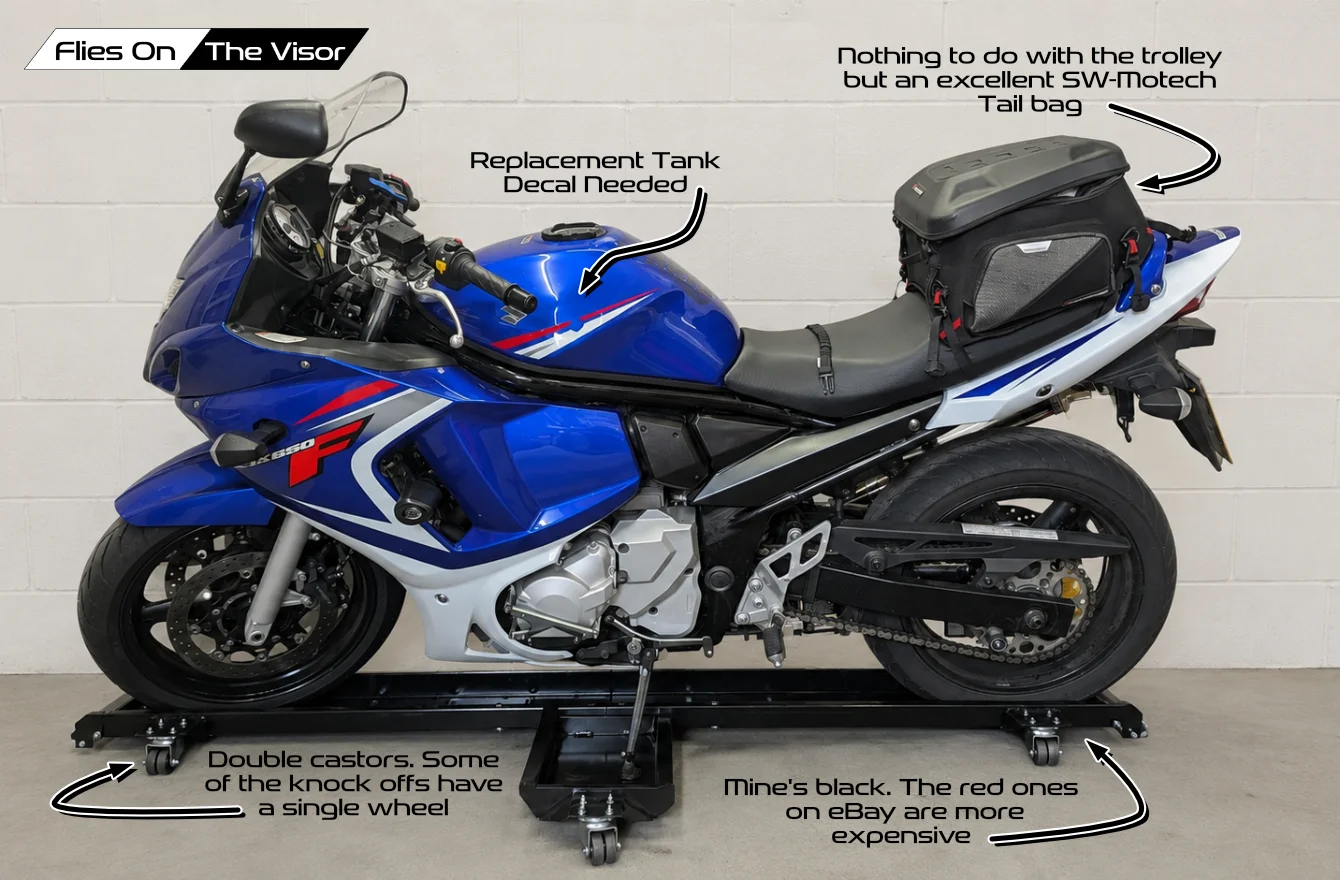
The idea is beautifully simple: put the bike on a narrow trolley dolly, a little wider than the tyres, that has a stub for the side stand to rest on.
Once on, I can push the bike sideways, backwards, diagonally, or spin it more easily than the revolving door on No10 [Political humour ~ Ed.]
And if I park one of the two bikes against the back wall, I can keep both bikes in the garage and still have enough room around the one I’m using to work on it, even when the garage door is shut.
I could do the same thing without the trolley dolly, but I’d have to do a thirty-three‑point turn, shuffle, swear, and inevitably realise I’ve trapped myself in the corner with the spiders.
The Heft
The first thing I noticed is that the dolly is heavier than expected. It’s not “ ‘kin heck” heavy (30 kg), but reassuringly solid. It is rated for a 530-kilo load, which rules out the Honda Gold Wing GL1800 and some Harley-Davidsons.
The steel frame is thick; the welds look like they were done by someone who actually cares. The doubled wheel castors – the important bit – glide surprisingly well, but that is going to depend on your garage floor.
The Floor
The floor in my garage isn’t anything special. The builders left an oddly rough concrete finish, on which I put an off-cut of hard-wearing nylon carpet. On this, the castor wheels glide. Not as easily as they would on a polished floor, but easily enough.
A while back I did invest in some of the hard foam tiles that fit together like jigsaw puzzle pieces. I ended up throwing them out because the bike’s side and centre stands left dents in the spongy floor tiles.
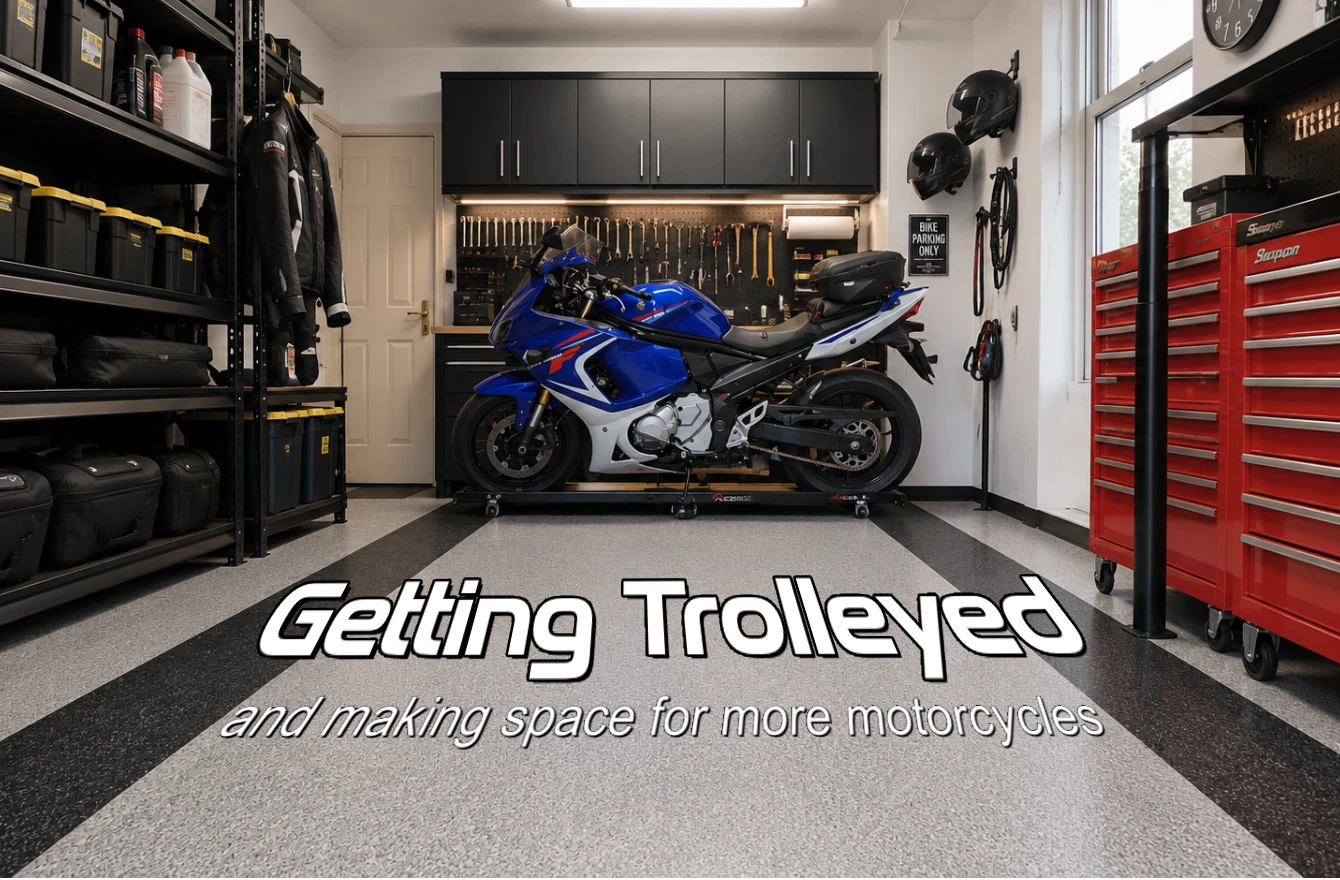
I would imagine that a thin carpet is about as much as the wheels would deal with. And yes, the garage in the picture isn’t mine.
The Mounting
Getting the bike onto the trolley-dolly is straightforward. Roll the empty dolly into position, and drop the front and rear ramps. The ramps all but lift the castors from the floor and stop the ramp moving while you walk the bike on.
Once it’s on, you can stop the bike rolling with the locking pins, although I wonder where the bike thinks it might be going; most importantly though, your motorcycle now has all the directional stability of a shopping trolley.
If you’ve never pushed a motorcycle sideways before, it’s a strangely liberating experience.
Bikes aren’t meant to move sideways, unless your name is Casey Stoner and you are spinning the rear of your Ducati.
The Bonus
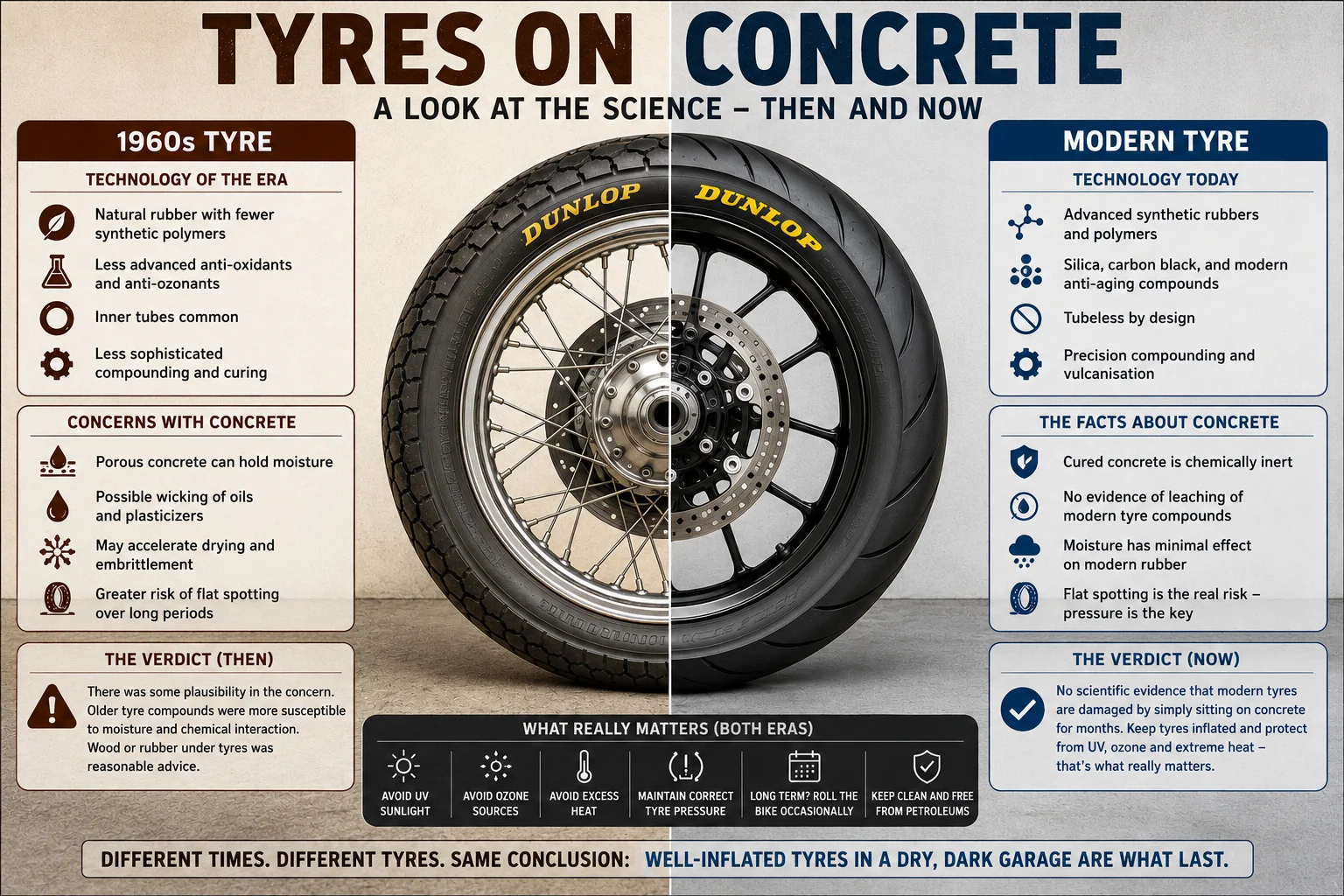
There’s a long‑running debate about whether tyres should sit on cold concrete during the winter months. Some say it’s fine. Some say it’s not. Some say it depends on the tyre. Some say it depends on the concrete.
With modern tyres, it doesn’t seem necessary, but with the dolly you no longer have this issue. The tyres sit on the dolly’s steel platform, not the floor, and you can tuck the bike neatly into a corner without having to wrestle it into position, or listen to someone giving you an earache about tyres and concrete all winter.
If you want to get to the toolbox behind the bike, you can. If you want to rearrange things because you’ve convinced yourself that this winter you will finally build that workbench, you can. The dolly makes the bike part of the garage rather than an immovable obstacle.
Bottom Line
Is it perfect? No. Nothing is. Is it good at what it is designed to do? Yes, very.
A little consideration is needed when loading the bike. Remember that while the trolley dolly makes the bike easier to move, it does not magically make it lighter.
Momentum is still a thing. Gravity is still a thing. The laws of physics have not been suspended for your convenience, and the trolley dolly has no brakes.
But as a practical bit of kit for anyone with more bikes than space, it is a solid, stable, easy-to-use, and genuinely transformative way to manage your garage layout.
If only I could tell you where I bought it, brand new for £99.99 and £17 for next-day shipping. Cheaper than the ones on eBay, comes with a year’s warranty, and double-wheeled castors, unlike the knock-off copies.
If only I were allowed to tell you where I got it …