
When I bought my 2008 Suzuki GSX650F, I knew nothing about the oil inside it. Not what type it was, how many miles it had covered, or even how old it was. It could have been fresh out of the bottle or old enough to remember the financial crash.
Over the past year, I’ve covered 3,000 miles on the GSX650F, mostly on track days, spending an unhealthy amount of time at full throttle exploring the upper reaches of the rev counter.
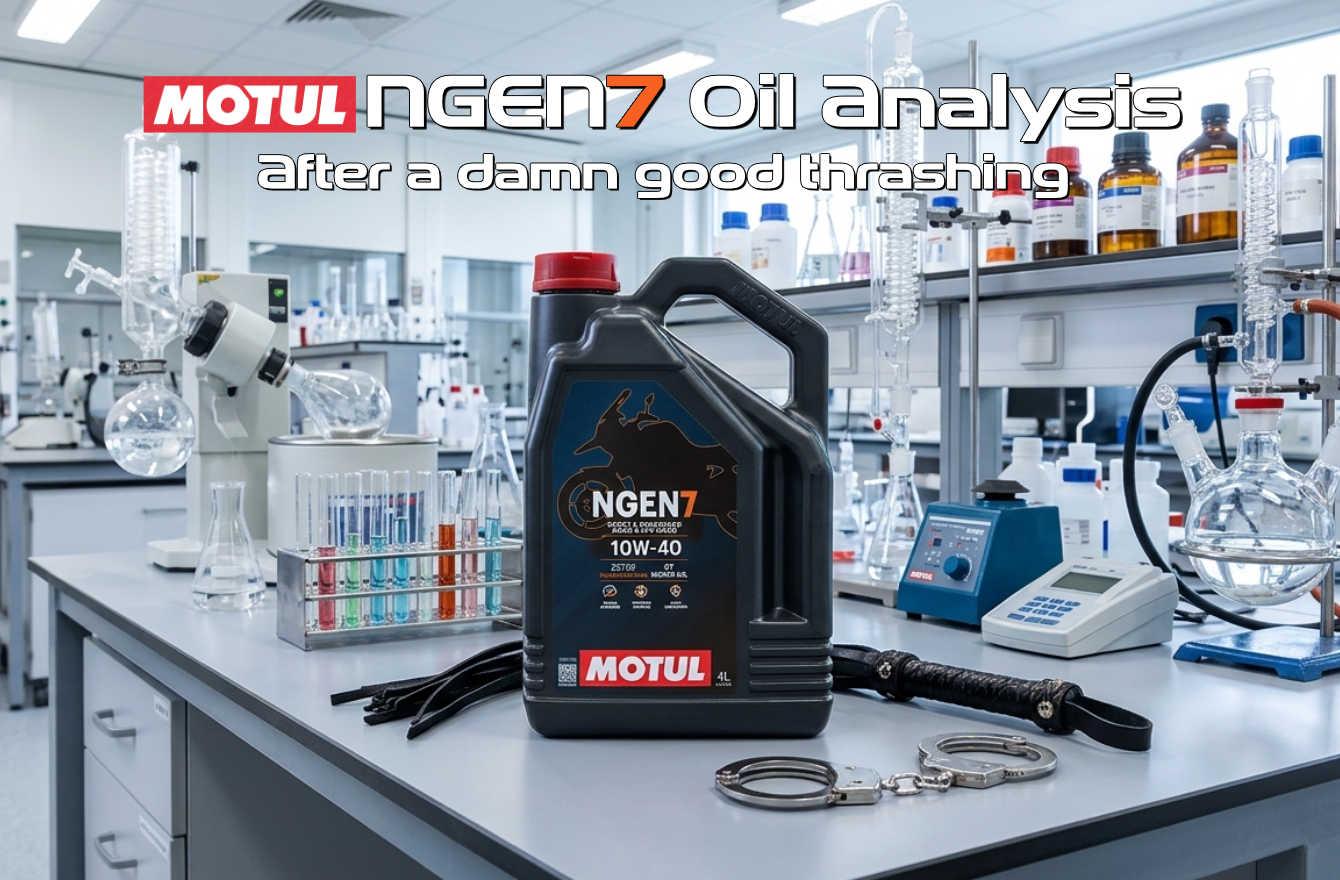
So, as part of the winter workover, I decided to see what was going on inside and sent a sample of the used Motul NGEN7 10W-40 oil for laboratory analysis.
Why Bother?
Oil analysis examines viscosity, contamination, chemical deterioration and tiny amounts of metal shed by engine components. It can help identify emerging problems, show how well oil has survived its workload and establish trends when samples are taken over time.
It isn’t a crystal ball, and one sample won’t diagnose every mechanical ailment. But it can offer a useful glimpse into how the engine is taking the thrashing and – perhaps more importantly – how good the oil is that I’m putting in the bike.
That and I’m a geek. I like this stuff.
Why Motul NGEN7?
NGEN7 uses a blend of high-quality regenerated base oils, virgin base oils, and additives. Regenerating oil means recovering and reprocessing used lubricant into a high-quality base stock, rather than starting entirely with newly refined material.
If this were whiskey, we’d be telling the world it is double distilled for a smoother flavour.
To finish the process, the oil still needs to meet the right formulation and performance characteristics. There is a detailed breakdown here
NGEN7 is a 10W-40 motorcycle oil, and its additive package is designed to do the hard work of lubricating, cleaning and protecting the engine.
Have I imagined smoother gear changes, easy starts, and crisp running, or will the oil analysis tell a different tale?
Motul NGEN 7 Oil Analysis
The laboratory compared the sample with whatever was in the bike last year.
One of the first things I do when I buy a bike is change the oil. Maybe I’m crazy, but that way I know what’s in the engine and how long it’s been there.
When comparing the NGEN7 sample with the previous oil, differences in additive chemistry will partly reflect a change in oil brand rather than necessarily indicating deterioration or improvement.
The best news is that the laboratory’s overall verdict was reassuring: Nothing to worry about, but there are a few indications to monitor. Comparing the next sample to a known composition (NGEN 7) will provide more meaningful results.
Geek Level Analysis
This is the part where I get excited, and the rest of the office falls asleep.
Keep in mind that although 3,000 miles of road riding is around half-life for most oils, I’ve been heavy on the herbs almost continuously.
The comparison sample – taken from whatever was in the bike when I bought it – may have covered only enough miles to look used. Sadly, I’ve no way of knowing.
Viscosity at 100°C:
Up slightly to 12.0 cSt, previously 11.6 cSt.
The oil has become marginally thicker at operating temperature. That isn’t automatically bad; oxidation and contamination can contribute to thickening. Crucially, the change is small, and the laboratory hasn’t flagged it as a problem.
Viscosity at 40°C:
Unchanged 70.7 cSt, previously 70.7 cSt.
No change in the measured viscosity at this temperature. That’s reassuring, suggesting no obvious shift in this aspect of the oil’s behaviour.
Viscosity index:
Up to 167, previously 159.
A higher viscosity index generally means the oil’s viscosity changes less with temperature. This is encouraging, although the different oil formulations make direct comparisons less meaningful.
Oxidation:
Up significantly, from 9 to 21.
Oxidation increases as oil reacts with oxygen, particularly under heat. Repeated high-temperature track running could help explain the rise. It’s worth watching in the next sample, but the figure alone doesn’t establish that the oil has reached the end of its useful life.
If I needed a push to flush the cooling system, this was it. I had noticed the fans tended to kick in when sitting in traffic.
Nitration:
Up slightly, from 5 to 4.
Nitration is associated with combustion by-products entering the oil. The increase is small and not, on its own, a reason to panic.
Sulphation:
Up to 23, previously 15.
Another indication of chemical change within the lubricant. Hard use and combustion by-products may contribute, but the laboratory hasn’t identified this as an immediate concern.

Petrol In Oil:
Fuel dilution can reduce effective viscosity and lubrication. Some fuel can enter the crankcase during normal operation, but 2.2% is worth monitoring given the bike’s track use. If the figure rises, fuelling and engine operating conditions deserve investigation.
A rolling-road session is planned for early in the new year (the 93 days of January) to ensure the fuelling is correct after the exhaust change. This will remove bad fuelling as a possible cause.
Water and Glycol:
The current water test is negative, compared with a previous trace result. That’s good news. The glycol index has risen from 0.00 to 0.44. Worth checking again next time.
Silicon:
Down considerably, 26 ppm, previously 49 ppm.
A welcome improvement. Silicon can indicate dirt entering through the air intake, although other sources are possible. A better-sealed air filter or simply different contamination conditions might explain the change. Either way, the laboratory specifically notes that the silicon level is much better this time.
Aluminium:
Up significantly, 13 ppm, previously 2 ppm.
This is one figure to watch. Aluminium can originate from components such as pistons and engine housings, but the result doesn’t identify a particular source or prove excessive wear. A further sample should help establish whether this is a developing trend or a one-off difference.
Iron:
Up 17 ppm, previously 12 ppm.
Iron can come from ferrous engine components, including gears and shafts. The increase is worth noting, especially alongside the aluminium result, but it isn’t enough to diagnose a mechanical problem.
Other Wear Metals:
Copper has fallen from 7 to 5 ppm, lead remains unchanged at 1 ppm, and nickel has declined from 1.5 to 0.6 ppm. Chromium remains negligible, while tin has increased from zero to 1 ppm.
Most of the other wear-metal readings are low or have fallen, but aluminium and iron have increased. Those two deserve another look in the next sample.
Particle Quantity Index:
Up slightly, to 9 from 7.
The PQI helps indicate ferrous wear debris. The rise is modest, but it supports monitoring the wear-metal results rather than dismissing them.
Additives:
The two samples have different chemical fingerprints, so I can’t know what oil was in there before.
Calcium has risen from 990 to 2,123 ppm, phosphorus from 744 to 1,030 ppm, zinc from 726 to 1,060 ppm, and molybdenum from 4 to 25 ppm. Magnesium has fallen from 90 to 39 ppm.
These changes are consistent with the laboratory’s conclusion that the oil type has changed. Calcium, zinc, and phosphorus support various detergent and anti-wear functions, while molybdenum can be used in friction-modifying chemistry.
More individual additives don’t automatically mean better protection. The important point is that NGEN 7 has a noticeably different chemical fingerprint from the unknown oil used previously.
Will The Patient Live?
The encouraging news is that the oil’s viscosity measurements remain broadly stable, silicon contamination has improved, and the laboratory isn’t overly concerned.
The caveats are the increases in oxidation, sulphation, aluminium and iron, alongside the 2.2% fuel dilution. None of these proves that something is wrong, but together they give us a useful list of things to monitor.
The laboratory wants another sample before drawing firmer conclusions. That’s precisely where oil analysis becomes most valuable: not in declaring an engine immortal after one report, but in spotting changes over time.
I’ll confirm the overall mileage with the laboratory, keep the records straight and arrange another analysis at the next suitable interval.
Then it’s time to finish the winter refresh and then back to the track, where the GSX650F can continue trying to convince me that a nearly two-decade-old Suzuki is perfectly happy being ridden as if it owes me money.