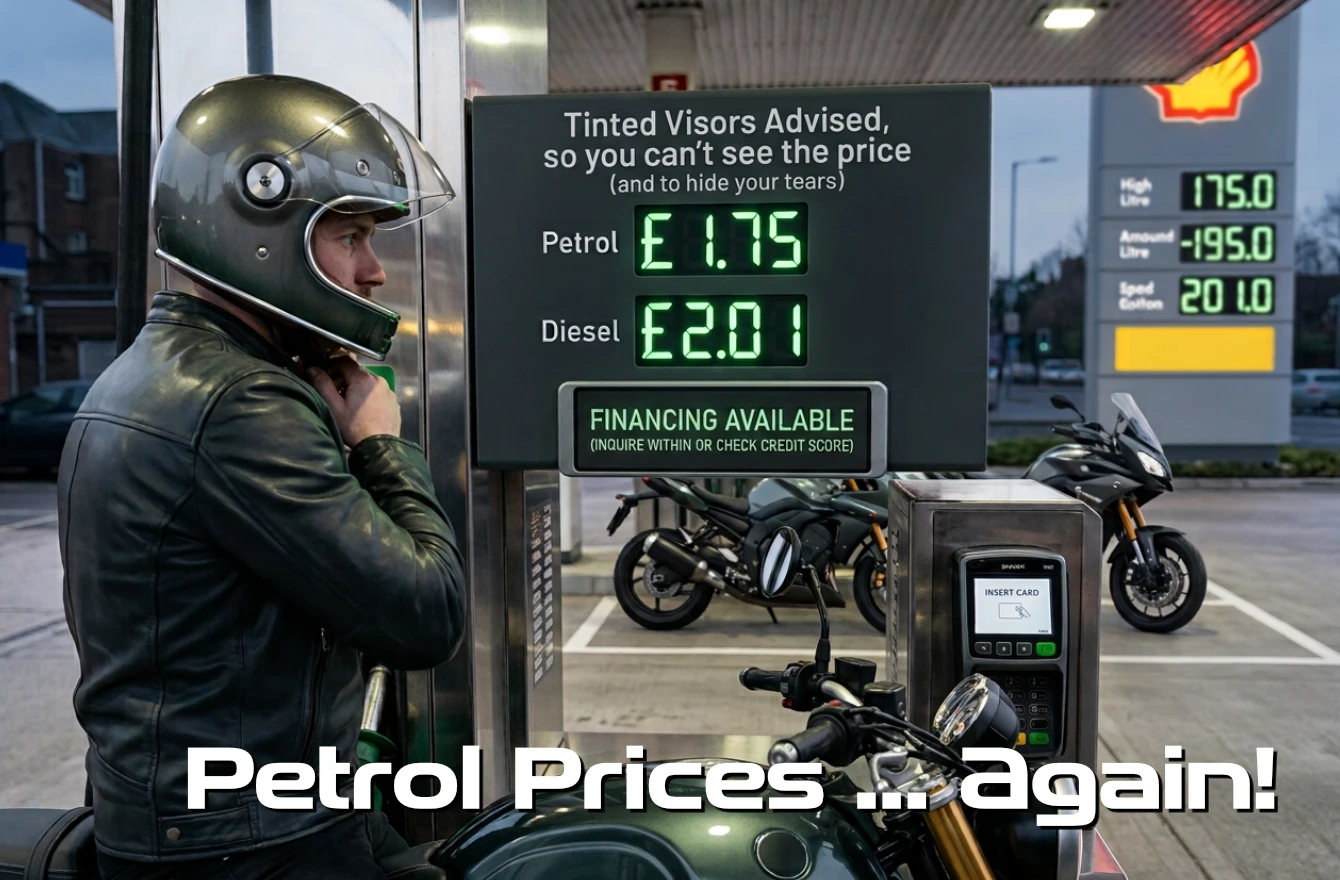

Something rather odd is going on at Britain’s petrol pumps. If you haven’t noticed how light your wallet feels after filling up, the petrol price memes all over social media are asking, WTF is going on.
So we went digging, and the first thing we ran into was the normal exclamation about the price of a barrel of oil. Yet the price of a litre of petrol doesn’t seem as connected to the oil price as we had hoped.
The price for a litre of petrol seems to have developed a financial life of its own.
Let’s take a comparison that should make even the most economically challenged Treasury official sit up and spill their complimentary latte.
Looking back to the last time oil was around $109 a barrel (2009), petrol cost about £1.19 a litre. Today, a barrel of Brent Crude Oil – the benchmark price everyone uses – is once again $109 a barrel, yet we’re being asked to cough up £1.75 a litre.
That’s a difference of 56p. And before somebody from the oil industry starts explaining that everything costs more these days, let’s do a little maths.
After allowing for inflation, the weaker pound, changes in fuel duty, higher wages, transport, energy, refining, and all those other legitimate expenses, my maths comes up with an equivalent price for today of around £1.43 a litre.
That’s not a precise scientific calculation, but it’s a sensible benchmark based on the figures available.
Which leaves us with a rather interesting question: where did the additional 32p come from, and where is it going? OK, that is two questions.
Petrol Prices
The exchange rate: the first excuse in the queue
The oil companies aren’t entirely responsible for the difference. When oil costs $109 a barrel, the exchange rate matters enormously.
If the pound buys $1.60, that barrel costs us about £68. If the pound only buys $1.30, the very same barrel costs us roughly £84.
That’s a 24% increase in the sterling cost of the crude, and I factored this into my calculation.
Then there’s inflation. Refineries, tanker drivers, electricity bills, insurance and distribution networks. They all have 17 years of inflation to account for in today’s charges.
Fuel duty has also changed, although the current 52.95p rate is actually 5p lower than the old 57.95p rate in our comparison, or it will be until the end of 2026, when the Government puts it back on.
Add everything together, including the VAT on those increased costs, and that is how I got to the estimated £1.43 benchmark price.
But £1.75?
That’s where the explanations start to look a little thin.

The Government’s VAT Windfall
Now, here’s where things get particularly interesting.
VAT on petrol is charged at 20%. Because the pump price already includes VAT, one-sixth of the price we pay goes straight to the Treasury, along with the other taxes various Governments have stuck us with.
At £1.43 a litre, the VAT element is about 23.8p. At £1.75, it’s 29.2p.
That’s an additional 5.3p in VAT on every litre compared with our reasonable-price benchmark.
Fill a 15-litre tank and the Treasury collects around an additional 80p more in VAT. Fill a 50-litre tank, and that’s £2.67 extra.
Multiply that across millions of motorists, filling up week after week, and we’re talking about a substantial amount of additional tax revenue.
How much more? Well, you had better sit down. The RAC Foundation estimates that we use 50 million litres of petrol (just petrol, not diesel) every day. That works out to the Government getting £2,650,000 extra in VAT each day. Not total – just the extra VAT the higher price brings.
Annually, that is about a billion pounds (a thousand million)
Of course, the Government will point out that it doesn’t set the global price of oil, but we have shown it isn’t the only thing driving up the price.
But when petrol prices rise, VAT receipts rise with them. Funny how the Treasury never seems quite as enthusiastic about investigating that particular financial incentive as it is about telling motorists that we’re all in this together.
One might almost suspect that the Government would rather not look too closely at precisely why prices are so high. After all, the more expensive the petrol, the bigger its VAT take.
How terribly convenient.
Follow the money
And what about the oil companies?
Shell reported worldwide profits attributable to shareholders of approximately $17.8 billion in 2025. BP reported underlying replacement-cost profits of $7.5 billion for the same year. Those are enormous sums of money. They are also global figures, covering far more than petrol sold in Britain, so they cannot simply be presented as profits made from British motorists.
Nevertheless, the question of margins deserves proper scrutiny.
The Competition and Markets Authority has already found that UK fuel retail margins remain above historical levels. Its 2025 monitoring found average margins of 9.6p per litre at supermarket forecourts and 11.1p at non-supermarket retailers. The CMA also said operating costs alone didn’t explain the higher margins.
That’s not proof that every extra penny is being trousered by greedy oil executives. Refining, wholesale supply and retailing are separate businesses, and shortages or refinery problems can push up costs even when crude oil prices remain unchanged.
But it does mean that asking questions about margins isn’t some conspiracy theory cooked up by a bloke in a pub.
It’s a question the competition watchdog itself has been asking.
The Blame Game
And what will our politicians do about it?
The current Government will explain that this is all the previous Government’s fault. The previous Government will remind us that it inherited the problem from the Government before that. And the Government before that will presumably blame the one before them.
Give it long enough, and we’ll arrive at a Cabinet meeting in 1979, with somebody blaming the winter of discontent.
Meanwhile, motorists will continue paying £1.75 a litre, because apparently the one thing Westminster can agree on is that motorcyclists and motorists make an excellent cash machine.
Nobody wants to take responsibility. Nobody wants to upset the oil companies. And nobody seems particularly keen to explain why a barrel of oil costing $109 can translate into such wildly different prices at the pump.

So Who Is Getting The Extra 32p?
Let’s be clear: some of the price increase since oil last cost this much is legitimate. The weaker pound, inflation, refining costs, and distribution all play a part.
But our reasonable benchmark is around £1.43. We’re paying £1.75.
That’s 32p a litre that needs explaining.
How much is additional tax? How much is going to refiners? How much are wholesalers and retailers taking? And how much represents margins that have quietly grown while we have had little choice but to pay?
It would be wonderful if the Government published the numbers and the oil companies explained their margins, and we all know that is never going to happen. Meanwhile, it seems our power is limited to asking awkward questions.
We aren’t asking for free petrol; we’re asking for a straightforward explanation of why we’re paying so much more than the underlying costs appear to justify.
And if everyone involved is entirely confident that there’s nothing untoward going on, surely they won’t mind showing us the figures.
Yea … Right. Dream on.