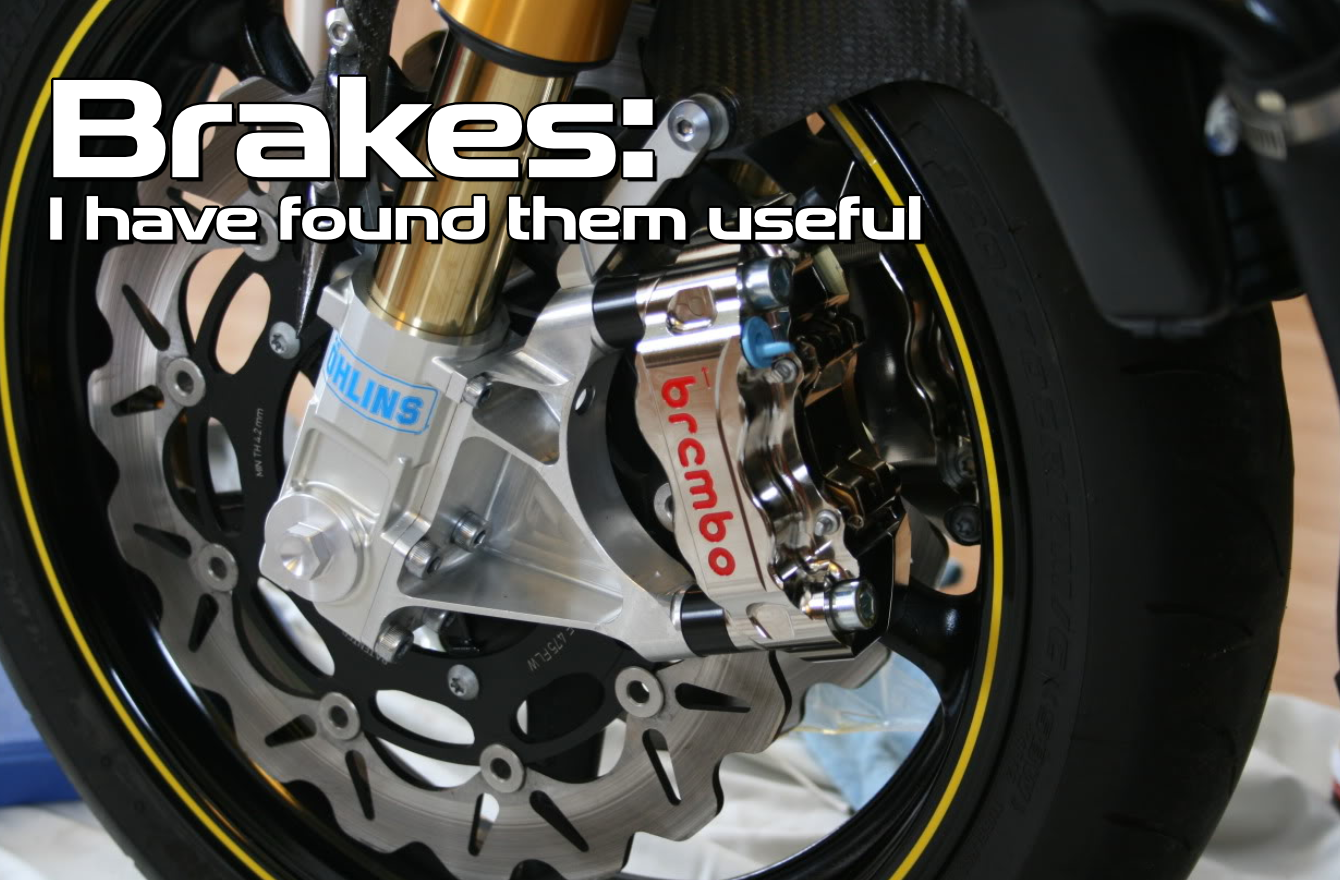

Few things are more satisfying than squeezing the brake lever as you slide up the inside of someone, and beat them to the apex.
Few things are more alarming than pulling that same lever and thinking: Oh look … Here comes the corner.
That was the problem with the brakes on my 2008 Suzuki GSX650F. The lever wasn’t the most inspiring. Venhill braided lines, decent fluid, and EBC HH pads all helped, but the brakes were never telling me, “Relax, we’ve got this.”
After swimming in the deep end of how brakes work, I’ve learned there’s so much more to it than squeezing the lever a bit harder.
The Science Bit
I can remember being taught about hydraulics at school. Pull the lever, move fluid, and the pads rub on the discs. Easy.
Yet it seems I wasn’t listening that hard in school, as I needed to consider piston diameters, hydraulic ratios, fluid displacement, and lever ratios if I wanted to improve on the brakes Mr Suzuki fitted.
Thankfully, I didn’t have to consider ABS, which is a whole different headache.
Eventually the Editor told me it was time to stop playing on the internet and write something, and so here is the short version.
I fitted a Nissin master cylinder from a late-model Kawasaki, with a 17.46mm diameter piston, to Screamer.
And now for the longer version
Talk To The Hand
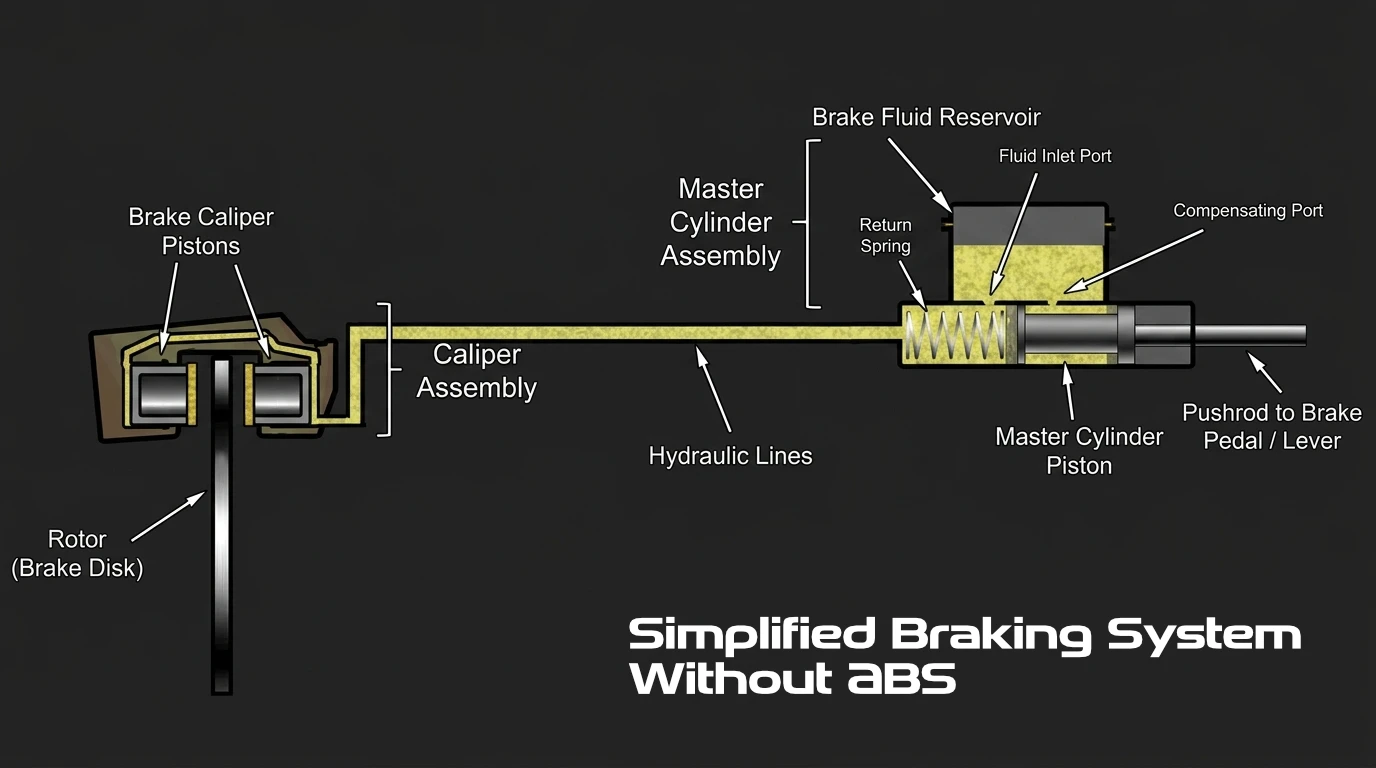
The easiest way to understand a motorcycle’s braking system is to imagine a syringe.
Push the plunger, and the fluid comes out. Push harder, and you create more pressure – the fluid comes out of the syringe with more force.
The brake master cylinder does essentially the same job, except instead of your thumb pushing a syringe, your hand is operating a lever.
That hydraulic pressure pushes fluid down the brake hoses, which in turn pushes the pistons in the callipers. The calliper pistons then push the pads against the discs.
The master cylinder has a relatively small piston pushing fluid into much larger callipers. That difference gives you hydraulic leverage: a modest force at your hand can produce a considerable force at the brake pads.
Simple – This is the bit I remember from school.
Go Big Then
It is tempting to look at a larger master cylinder and think bigger piston, therefore better brakes. Unfortunately, brakes don’t work like exhausts or air filters. Bigger isn’t automatically better.
The size of the master-cylinder piston determines two important things: how much pressure it can generate at the pads for the same hand force (squeeze), and how much brake fluid is pushed.
Those two things are related, but they pull in opposite directions.
A smaller piston gives you greater hydraulic leverage. Squeezing the lever with the same force generates more pressure in the brake system.
The downside is that the piston must travel farther to move the same amount of fluid the bigger piston moves, so the brakes can feel soggy.
A larger piston is the opposite. It moves more fluid for each millimetre it travels, but it requires more force from your hand to generate the same hydraulic pressure.
And then we need to add in the lever ratio, but I’ll get to that in a moment.
Nissin
The piston in the Nissin master cylinder is 17.46 mm in diameter, which is why Nissin calls it a BMT17.
The original GSX650F master cylinder uses a 15.5mm piston, which gives a better hydraulic-ratio pressure than the 17.46mm one I settled on.
Increasing the piston size from 15.5mm to 17.46mm increases the piston area by roughly 27 per cent, so I’m moving 27% more fluid for the same piston movement.
But – and it is a huge but – for the same lever force (squeeze) and assuming the lever mechanism itself is unchanged, the larger piston produces less hydraulic pressure.
So, why fit a master cylinder with a bigger piston? Because I’m not only interested in maximum pressure. I’m after an improved relationship between lever movement, fluid movement, pressure and feel.
Lever Ratios
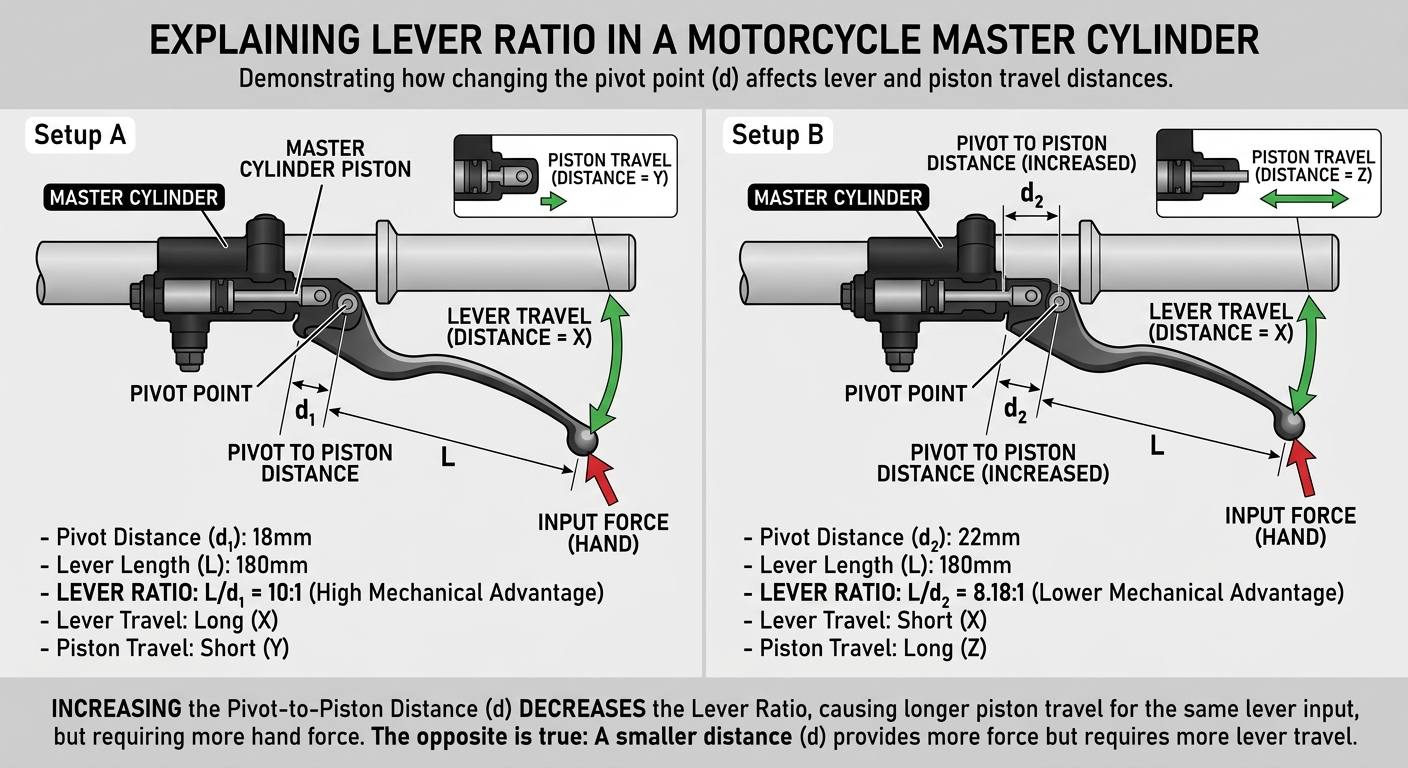
There is another piece of the puzzle hiding between your fingers and the master-cylinder piston: the brake lever itself.
We pull on the lever, and thanks to the pivot near the master cylinder, it pushes the piston.
This is the same idea as using a lever to move something big. We pull on one end of the lever, and the big, heavy object moves.
Change the pivot point in that setup, and you change the lever ratio. And you do not have to move it far to make a significant change in feel.
This is why expensive aftermarket master cylinders often include different lever-ratio settings. Brembo’s MCS master cylinder is one example.
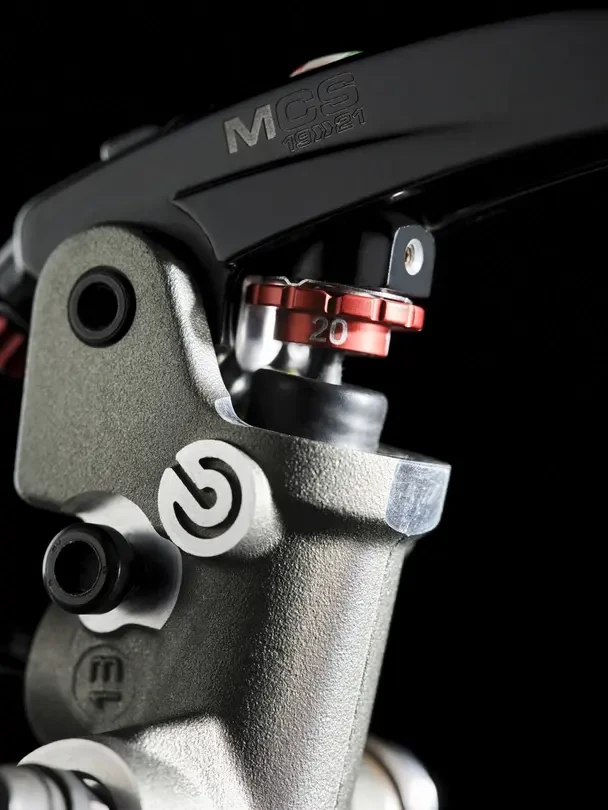
In easy terms, more mechanical leverage makes your hand’s job easier, but the lever has to move farther.
Less leverage means more hand effort but a shorter, more immediate movement, because you are pushing more fluid thanks to the bigger piston.
Anyone who tries to tell you “a 19mm master cylinder is more powerful than a 16mm one” is saying “you make better soup with a bigger spoon.”
Fluid, Force and Feel
This is the bit that took my brain a while to accept. The larger Nissin piston moves more brake fluid, but that doesn’t mean the brakes automatically become more powerful.
The calliper pistons need a certain amount of fluid to move from their resting position until the pads contact the discs. Once the pads are against the discs, additional master-cylinder movement is principally about increasing pressure.
A larger master cylinder gets the initial volume of fluid there with less piston travel.
Think of filling a bucket with a cup versus a pint glass.
The pint glass doesn’t contain more pressure. It simply gets the required volume into the bucket with fewer trips.
The result at the lever is a firmer, shorter lever movement.
With the smaller master cylinder, the piston has to move farther to deliver the fluid needed to move the pads onto the discs, giving a softer, more progressive sensation that can feel spongy.
Go larger, and the lever generally moves less, giving the brakes a firmer and more immediate feel.
But — and this is important — a firmer feel isn’t necessarily the same as more powerful.
A larger master cylinder can make a brake feel sharper simply because the lever doesn’t travel as far before the pads touch the discs.
Conversely, a smaller master cylinder can provide more lever travel and can give you greater sensitivity to what’s happening at the tyre.
That is why we all have strong opinions about brake feel. One rider’s beautifully progressive brake is another rider’s why does this thing feel like squeezing a dead badger?
The ideal is a system that gives you enough initial response to slow the bike decisively, while still letting you control braking pressure accurately.
And ..?
So does all of this result in better brakes? Not necessarily. And this is the slightly awkward conclusion after all that lovely hydraulic theory.
If I keep the same callipers, discs, pads and lever geometry, fitting the 17.46mm Nissin does not magically create more hydraulic pressure for the same hand effort.
In fact, compared with a smaller piston, it requires more hand force to achieve the same hydraulic pressure. Thankfully, grip pressure has never been the problem.
What I get is more fluid displacement per millimetre of piston movement and, consequently, shorter lever travel for a given amount of calliper piston travel.
That will make the brake feel considerably more positive at the initial bite.
Whether it actually stops Screamer more effectively depends on how hard I’m prepared to pull the lever, the available tyre grip, pad/disc performance, calliper condition and the rest of the hydraulic system.
As I’ve changed the hydraulic ratio …
- More lever force required: Because I have lowered the hydraulic ratio, I must apply more force at the lever to generate the same pressure at the callipers.
- Less pressure rise per mm of lever movement: A bigger master cylinder moves more fluid per mm of lever travel, but because the piston area is larger, it generates less pressure per unit of lever force.
- More feel: This is the change I wanted. With a lower ratio, the system becomes less sensitive — small lever movements don’t create big pressure spikes. That gives me better “feel”.
- Shorter lever travel: Because I’m displacing more fluid per mm of lever movement, the lever feels firmer, faster, and I can increase the squeeze more progressively.
That is the theory, and after all this waffle, it had bloody well better be right.
The Fabulous Venhill

After all that thinking, reading, science, and general self-confusion, I finally got to the good bit: time in the garage fitting the newly acquired master cylinder.
The original Suzuki master cylinder feeds the brake lines from the side. The Nissin arrangement feeds them from underneath.
Which is fine, and I was certain it wouldn’t be an issue. You’d not think that such a minor detail would require new brake lines, but what do I know.
When I first bought Screamer, I replaced the ageing rubber brake lines with Venhill’s Suzuki Front Brake 2 Hose Kit – the “race” version with two full-length brake lines.
They are brilliant, and I’ve fitted them to several other Bandits and 650Fs for friends over the past year.
What makes me celebrate Venhill more than just admiring their engineering skills is the fact that I could pick the same kit again and tick the box that said I need them 50mm longer (other sizes available).
And just like that, I have all the correct fittings, brake lines with the correct rubber blocks installed so they don’t chafe on the guides, and a little extra length to ensure they fit correctly.
Bottom Line
The Nissin master cylinder isn’t going to revolutionise anything, but if I’m anywhere near right, this will cure the soggy badger feeling the standard set-up gives.
What I’m hoping for is a brake lever that behaves differently: less movement, a firmer, more immediate bite, and a more progressive, consistent braking response.
And after spending an unreasonable amount of time learning that a 17.46mm circle contains 27 per cent more area than a 15.5mm one, I’m rather hoping the next thing I discover is that the stainless steel exhaust bolts come out of the head without breaking.
What could possibly go wrong?