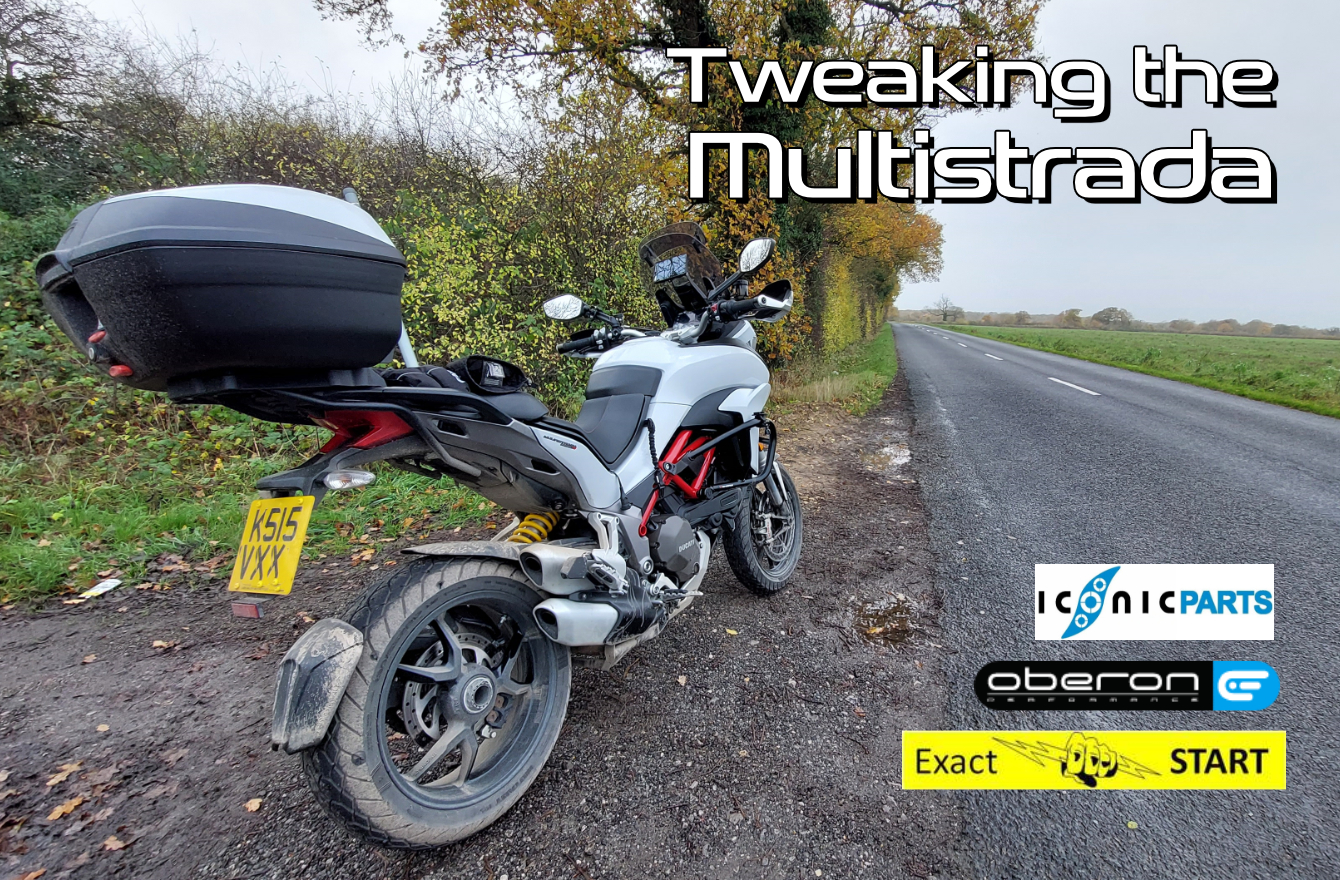
This all started when I went looking for a winter project bike and returned with a 2015 Ducati Multistrada 1200S DVT Touring.
The Multistrada wasn’t what I was looking for, but in terms of the amount of motorcycle for your money, they are excellent value.
Yes, it was seven years old and had 23,575 miles on it, yet it came with a full service history, no signs of dealer touch-ups, and was loaded with fancy technology.
Standard features include semi-active suspension, a six-axis IMU, cruise control, heated grips, LED lights, TFT display, and full (but crap) factory luggage.
I added SW-Motech crash bars and a Scottoiler – which, on a single-sided swinging arm, isn’t a good idea – paid Chris Walker Ducati £7,495 and promptly set about using up the 11,000 miles before the next Desmo Service was due.
As the miles went by, I made a few tweaks, changes, and enhancements to the Multistrada. Nothing financially significant, but they all need to be counted when adding up how much it has cost me to refresh my 2015 Multistrada.
Brakes
Only the Italians would put a rear brake fluid reservoir close to the catalytic converter, which gets so hot, the heat radiates into the rear brake reservoir.
Next, just for the fun of it, Ducati mounted the rear brake calliper upside down so that the calliper bleed nipple is at the bottom.
 Combine these two things, and you end up with a high-maintenance rear brake system and why the brake fluid needed changing to Motul RBF600 or RBF660.
To bleed the rear brake, the calliper has to come off and be turned the right way up with the bleed nipple to the top. As the rear calliper is loose, it is a good idea to raise it above the level of the rear master cylinder so any air in the system floats into the calliper.
I’ve tried numerous other methods but have not found another way of bleeding the rear brake effectively.
It was a pain in the arse the first time I did it. By the time I did it for the fourth time, it was just one of those things that goes with owning a Multistrada.
Battery Cables
Twin pot, 1200 and 1260 Multistradas are known for their slow turnover when starting. If you have never experienced it, you might think the battery needed charging or replacing.
Given time, you either accept it or do what I did and fit the Exact Start battery and starter cables.
 It was a simple enough job and did make a difference. A Multistrada will never spin like a four-pot, but at least I knew that the power to turn the starter motor wasn’t getting lost thanks to tin foil wiring.
I did also change the battery, but this was paranoia rather than something that needed doing. I was heading off across Europe for a month, and for the £50 a new Yuasa battery cost, it was one less thing to worry about.
Air Filter
Changing the air filter on most modern motorcycles is a long job. Since the arrival of pressurised airboxes, a simple tin can that holds the air filter in place has been replaced by intricate air box designs that pressurise and force-feed air through the induction system.
The increase in performance is most welcome. Having to strip the bike down to perform a relatively simple maintenance task … not so welcome.
Although the Multistrada came with a full-service history, I’m paranoid and, after a few thousand miles, decided to change the air filter for a K&N filter and the oil and associated filters, simply so I knew they had been done.
Oberon Clutch Slave
Another thing 1200 & 1260 Multistradas are famous for is leaking clutch slave cylinders. It isn’t a question of if it will leak, be assured that the standard Ducati clutch slave cylinder will, at some point, start leaking.
Mine started one damp December day, and thankfully I wasn’t too far from home. Clutchless gear changes to save what fluid I had left for when I couldn’t avoid stopping, and next-day delivery from Oberon Performance, had me back on the road.
Had I known about the problem upfront, I’d have changed the clutch slave before it failed. It is a simple job, and the chances are that the clutch fluid is cooked and in need of changing anyway.
From memory, the whole job took less than twenty minutes to complete. A small job that brings peace of mind.
The Last 4,000 Miles
All of the above I did during the first six months and six thousand miles of ownership as a build-up to spending a month on the road.
I swapped out the useless factory panniers for SW-Motech Trax ADV panniers, dug out my Givi “shipping container” top box and took off on a four-thousand-mile tour. [Stories below]

When I arrived home, I’d chewed through the excellent Dunlop RoadSmart IV tyres, having racked up 5,200 miles on them, the chain was knackered, and the Desmo service was due. It was decision time. Do I invest in the bike or sell it to a dealer and move on?
I was going to get a reasonably low trade-in value as the Desmo service was due, but the service would cost a dealer less when the summer rush was over and the pressure on the workshop reduced than it would cost me, so perhaps there was a deal to be done.
Multistrada Refresh
Short of replacing every component, I wasn’t going to return my Multistrada to “Factory Fresh”, yet having decided I was keeping the bike and having a few weeks before a slot at Cornerspeed Ducati would open up for the Desmo service, I opted to go a little crazy and refresh as many of the serviceable parts as I could.
Rear Hub Service
The rear hub service is a simple enough task once you get the rear axle nuts undone. Keep methodical notes and an excessive number of photos to help with reassembly, but if I can do it, I’m guessing just about anyone can.
Nothing particularly technical is involved, but it is an intricate design that needs a little consideration when reassembling. As the rear hub is part of the Desmo Service, doing it myself saved a little on the upcoming bill.
The same is true for the brake and clutch fluids. They are easy enough to change, and the pesky rear brake calliper needed to come off for the rear hub service, so two jobs in one rainy day in the garage.
Chain and Sprockets
I bought my replacements from Ducati Mondo and opted for the 15:42 sprocket sizes rather than the standard 15:40.
Going up two teeth on the rear makes the Multistrada easier to ride in town and in traffic. It also does a decent enough job of overcoming the emissions flat spot around 4,500rpm, but to overcome it entirely, an ECU Flash is required – more on that in a while.
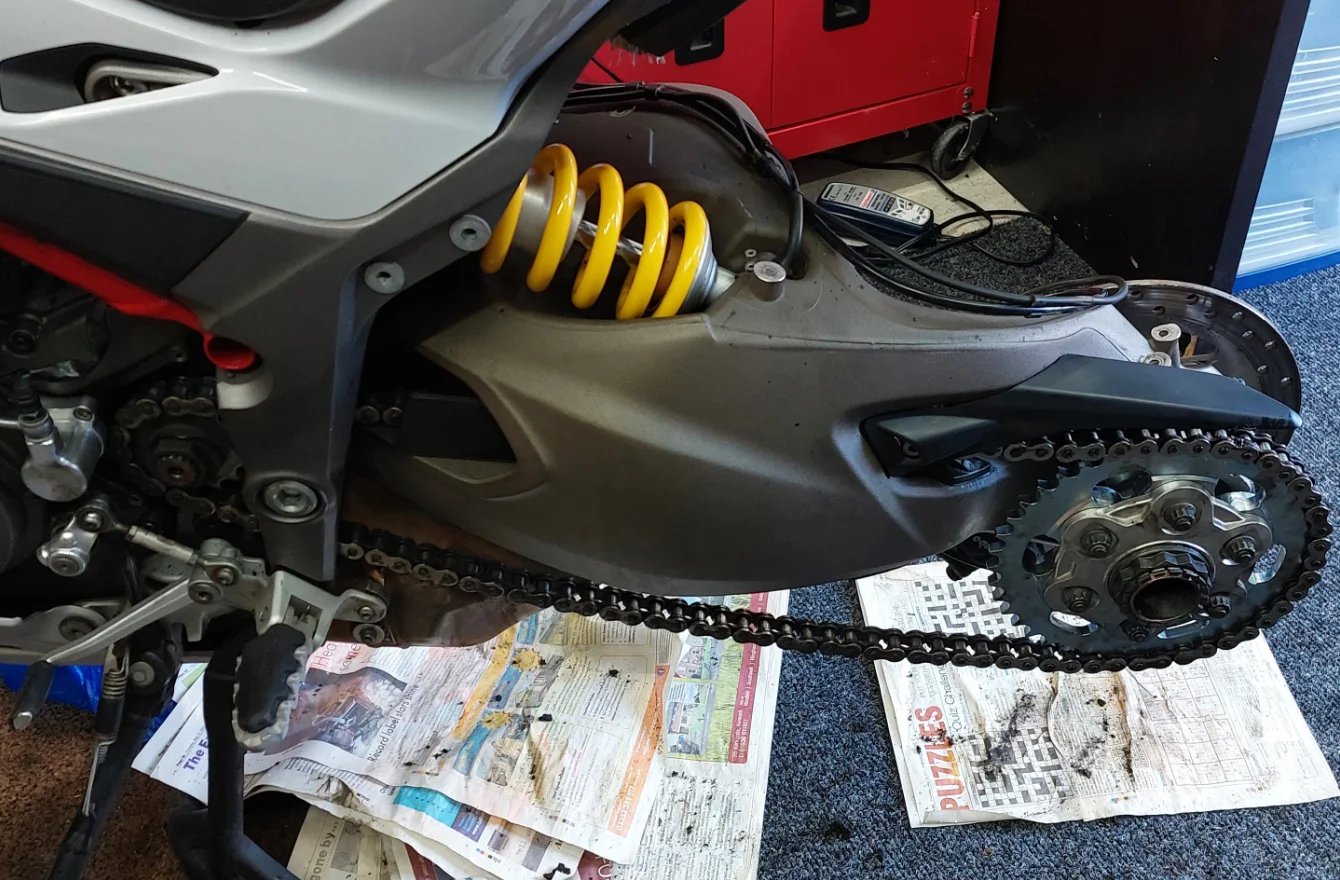 Some people opt to reduce the gearbox sprocket by one tooth (15 down to 14), but this increases wear and load on the front sprocket.
Standard gearing (15:40) is a ratio of 2.66. Dropping one tooth on the front (14:40) gives a 2.85 ratio, and going up two on the rear (15:42) gives a 2.8 ratio.
As the ratio differences between changing the front or the rear sprockets are minimal, I went for the rear to save myself the extra work of changing the front sprocket sooner than needed. The only thing to remember if you decide to do the same thing is to buy a chain two links longer. The kit from Ducati Mondo took all of that into account.
Desmo Service
Having cleaned what felt like ten kilos of dirt, road grime and old chain grease from the bike, rebuilt the rear hub, fitted some new Dunlop SportSmart3 tyres, and changed the chain and sprockets, I decided not to try the Desmo service myself.
The opportunity to make a costly mistake looked all too easy, so I opted to give the Multistrada to a specialist – CornerSpeed Ducati in Mansfield.
None of the shims needed replacing, which I always take as a sign of a good engine. My logic is that if the engine is bedded in and there is no undue wear, the shims shouldn’t need changing.
Suspension Overhaul
The need to overhaul the suspension became evident as soon as I loaded the Multistrada for a month on the road.
The things I’d packed for the trip weighed perhaps 40Kgs in total and not nearly enough to require that I set the Skyhook semi-active suspension for two-up riding.
Without setting it that way, the front wasn’t connected to the road enough to allow for an enjoyable ride, and my alternative was four thousand miles waiting for the front to come around so I could open the throttle.
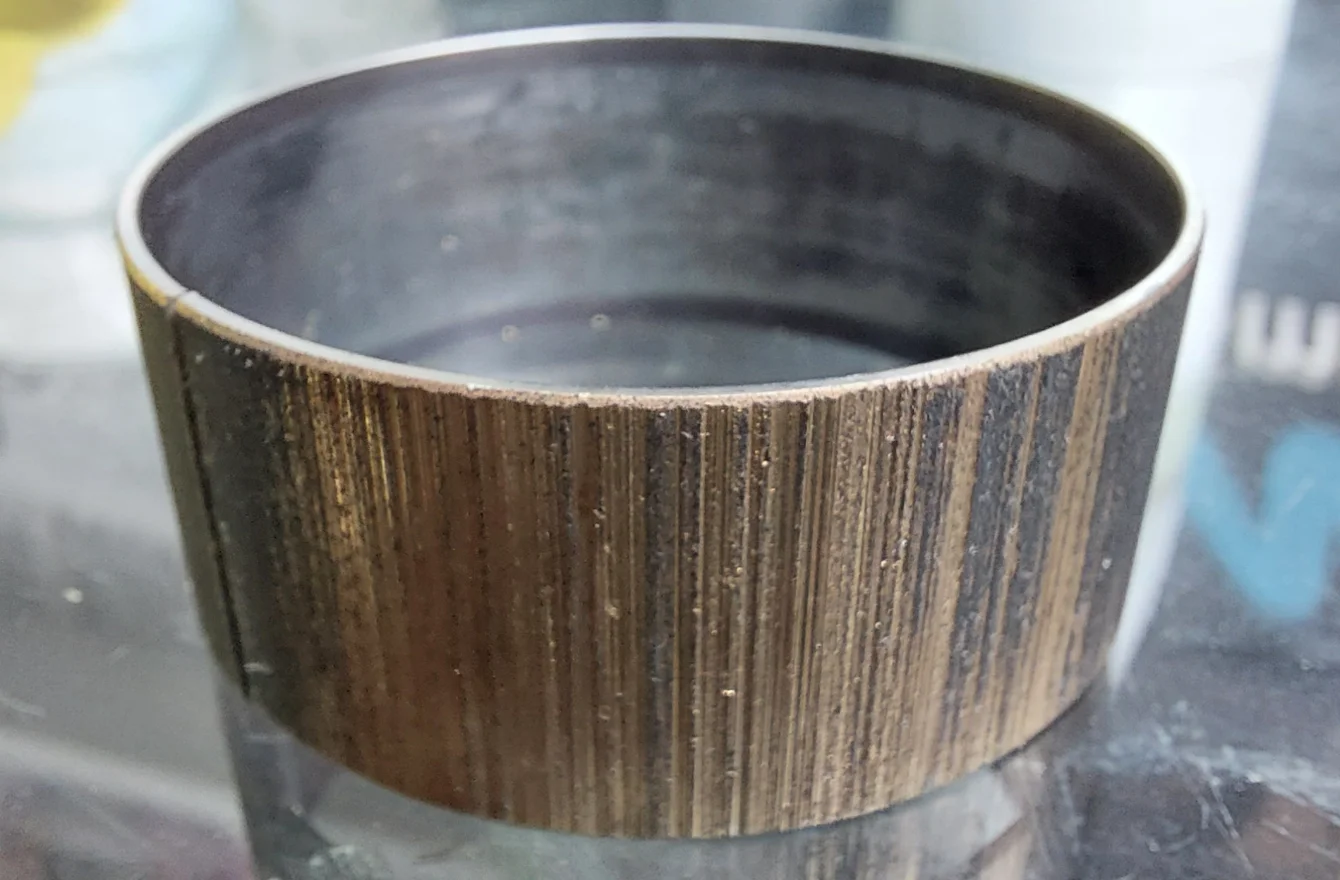 If past experiences are anything to judge by, the suspension won’t have been serviced in the past eight years.
There is nothing in the service history to suggest it had been done, and when Terry at Parkitt Motorcycles opened up the forks, black treacle ran out, and the bushes were heavily worn.
The front and rear suspension might be labelled Ducati Skyhook, but they are Sachs Suspension units. The front forks are a relatively standard setup, although the cartridges can only be cleaned, not opened.
According to Ducati, the rear suspension is a non-serviceable item. When the rear unit needs servicing, you – according to Ducati – replace it.
That is unless you know Terry at Parkitt Motorcycles. Twice recognised by Öhlins for his work with suspension, he has a simple modification he uses when working on the Ducati/Sachs units that makes them fully serviceable.
Damn Bolt
The Multistrada, however – and I’m told other Ducatis are the same – had one final irritation to work around, the lower rear shock attachment bolt.
The bolt goes into a captive nut on the inside of the swinging arm. The bolt is made of steel, and the swinging arm from aluminium.
If you were riding Japanese motorcycles in the 1980s, you would remember the chemical reaction between the crankcase covers and the associated screws that resulted in the sale of many an impact driver.
Forty years later, the chemistry hasn’t changed, and Ducati doesn’t copper grease the bolt at the factory to stop it from seizing itself into the nut.
The problem with the Multistrada is that the retaining nut the bolt is seized into is inside the swinging arm and is most likely the weakest point of the assembly. It is a 50-50 bet as to whether the bolt moves or the welds holding the nut break, and you need a replacement swinging arm.
Thankfully for me, Tony at Parkitt Motorcycles could service and recharge the Sachs/Ducati rear shock unit by releasing the top mount (and a lot of the subframe). I now have a serviced rear shock, just not as complete a job as Tony would have liked.
The ECU
My original plan was to have the ECU reprogrammed on the rolling road by Parkitt, as they had smoothed out my V-Strom a few years ago.
The V-Strom had a full custom map that eliminated all of the emissions flaws, smoothed the throttle response and delivered more torque and punch in the mid-range rather than outright power.
BHP was increased across the rev range, just less than a full power map would have achieved.
 A more cost-effective option for the Multistrada would be to use SRS Performance in Wales which has a large selection of bench maps available, especially for the 1200S DVT Multistrada. Steve, the owner of SRS Performance, rides a DVT himself and is heavily involved in the DVT forum on Facebook.
Parkitt Motorcycles would give me a bespoke map specifically for my Multistrada and SRS Performance, a custom map based on a broad range of Multistradas in the same way as the factory does.
Although tempted by both options, changing the gearing made a noticeable difference to how the bike rode, and checking with my insurance company, the ECU remap would have to be referred to the underwriters for their approval.
Ironically, some insurance companies pre-approve air filter changes, and the fitting of a slip-on end can, but if you want to tune the bike to ensure that the modifications are functioning harmoniously, you need to refer to the underwriter for their approval.
I’ve opted to skip over the ECU reprogramming until I know I need it.
How Much
New tyres, chain sprockets, fully serviced suspension services and all the known (hopefully) issues taken care of. Cleaned, polished and as close to factory fresh as a motorcycle with 34,000 miles on it can be, how much did all this cost me?
Click on an item for the supplier:
Was It Worth It?
Good question. Comparing my 2015 1200S DVT Touring to a brand-new standard Ducati V4 (£16,950) is a slightly far-fetched comparison, and there is still the cost of the luggage to add on to the base V4 price. The V4 is also missing the semi-active suspension. Regardless it is too much of a leap in technology and development to be a good comparison.
I have more power and options than the Ducati V2 (£12,995), so by the same measure, that is too easy a comparison to win, and again there is the cost of the luggage and the lack of semi-active suspension, which would take the price of the V2S in Travel specification to £16,595.
If I use a midway point between the base model V4 and V2 Multistrada (£14,975) – no luggage and standard suspension – I’ve saved more than £5,000 by finding a well-maintained starting point and investing in the refresh.
Then I can add on the cost of the factory luggage and the depreciation hit I’d take as I rode a new Multistrada – or any other motorcycle – out of the showroom, and that figure lands somewhere north of £8,000.

Look at it from the cost per mile perspective, and the last 11,000 miles have cost £2,265 or 20p per mile in servicing and refresh costs.
The other advantage of a good second-hand Multistrada is that they often come with numerous other fitted accessories. Mine came with my preferred MRA screen and a complete set of EvoTech radiator, oil cooler and downpipe guards. There is also an Iconic Parts GPS holder. It isn’t a fortune saved, but the cost of the accessories all adds to the value case for a refreshed Multistrada.
It is 18,000 miles to the next Desmo service with, according to the maintenance schedule, an interim oil and filter change at the halfway point. If I know myself, I’ll do oil and filter changes earlier that required – six-thousand-mile intervals – because I’m paranoid or perhaps fastidious is a better word.
But the bigger question is, having done all of the work, refreshing the Multistrada, and thoroughly enjoying the time in the garage doing it, do I keep the Multistrada or sell it?
What would you do, and if you were to consider selling it, how much would you advertise a refreshed Multistrada for?