

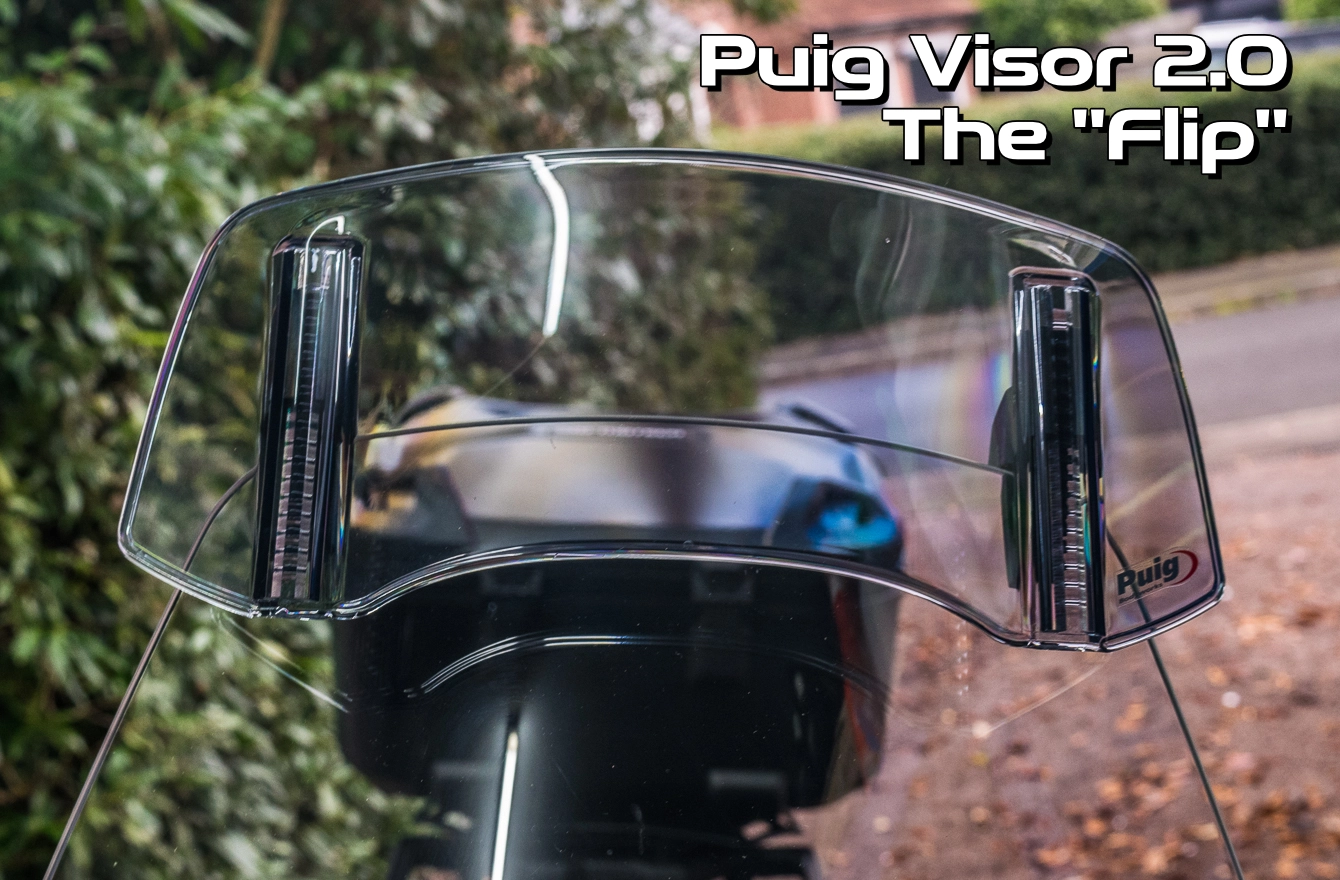

Screens. Motorcycle Screens to be precise. Just like tyres, they can be a very individual preference … sort of.
When a screen is bad (Hello Yamaha Tracer), finding the answer to the problem typically starts on the forums and usually ends up costing £150 to see if the forum’s solution works for you.
There are some advantages to going to eBay or Facebook Marketplace to see if someone is selling a screen that might fix your problem, but mostly, people are selling the ones they bought that didn’t work.
This is why Puig developed the Puig Visor, a universal “Flip” that clamps to the top of your current screen. No need to drill holes or make other modifications. Do up the clamps and you are good to go.
After Market Screens
Perhaps the most prominent reputation in the after-market screen business is MRA, famous for the screens with the flip visor at the top – the Vario Flip.
Givi might contest that MRA was the first to use this concept as the ugly as sin, but utterly brilliant Givi Airflow had been around for many years.
I had an Airflow on my first DL1000 V-Strom and rode countless miles behind it, enjoying the absence of any buffeting or wind roar. The only problem was that it was so serene behind the Airflow screen that sometimes the rain wouldn’t blow off my visor unless I stuck my head out into the diverted air.
You can buy Puig, Givi and MRA aftermarket screens with and without the flip. Still, as the flip plays a vital part in how the screen manages the turbulent air, I wanted to know if the clamp on Puig Visor could easily be retrofitted to a standard screen and give me the flip advantages without a complete screen replacement.
Road test time, but first, some science.

The Science Bit
An aeroplane wing flies because the air going over the top of the wing is at a lower pressure than the air underneath. The high-pressure air below the wing wants to push into the lower-pressure area, and the plane lifts off. If you are interested in deep-diving the complications of Bernoulli’s principle, there is a link in the red box below.
The concept of the Givi Airflow and the MRA flip is similar. As well as making the screen taller and pushing the air over our helmets, it also creates a lower-pressure area into which the air behind the screen wants to flow.
This pressure difference isn’t at the same level as aeroplanes, but the concept is similar. The outward flow of air from behind the screen makes the air in front of the rider more stable, but there are limits.
A 60mph blast of air will easily overcome any pressure difference, which is why some standard screens are good up to a certain speed. Fitting the Puig Visor diverts air away and increases the range at which a screen’s aerodynamics remain effective.
Or that is the theory, anyway. Now, it is definitely time for some road tests.
Test Mules
We have three screens to test and will add the Puig Flip 2.0 to each one. The test route is a motivated dual carriageway ride with and without the flip.
The first two screens are the standard Suzuki V-Strom 800RE screen and the Puig Touring screen I have for the ‘Strom. The third screen is the standard one fitted to the Voge DS900X the Editor is road testing.
The standard V-Strom screen is excellent, up to around 60 mph. Beyond this – for me – the air becomes turbulent. The buffeting is tolerable but would be tiring on a long run.
I switched the screen on the V-Strom 800RE for the Puig touring screen and fitted Oxford Mirror Extenders, both of which improved the smoothness of the airflow around my helmet.
Other V-Strom 800RE riders have recommended moving the standard screen to the lowest level to remove the buffeting, if not the wind noise.
The Voge DS900X has a shorter screen with two positions, which does a pretty good job. In the lower setting, the Editor reports that the wind is fully in his face but smooth enough. In the upper setting, there is mild buffeting but less noise. You make your choice on which you prefer.
Where Can I Find …
- Puig Visor 2.0 – Available from Pyramid Plastics
- MRA Screens – Available from HPS
- Givi Airflow – Current Models
- How Wings Work – Wikipedia on lift generation
- Honda NT1100 – Why the Editor Bought one
The Target
The MRA Screen with a flip fitted to our NT1100 is the benchmark we are aiming to achieve. Behind that screen, you can ride all day, day after day, without any buffeting or post-ride ringing in your ears.
This is how good it can be, although it did take the Editor a few attempts to get it tuned to his liking. But once you know how good it can be, why settle for anything less if you are going to put some miles on your bike?
The Puig Visor 2.0
Not all motorcycle screens are the same design. Looking down from the top, there are the almost flat ones, those with a distinct bubble in the middle, those that are curved and those that couldn’t make their mind up and went for a mix-and-match solution.
Given the numerous screen shapes, the clever design work Puig put into the flip’s attachment clamps is ingenious, simple but ingenious.
To grip the screen, the Puig Visor clamps twist to ensure they get a solid grip. Once lined up, tighten the screws; the clamps grip the screen and lock themselves into place. It is simple and oh so very effective. To remove the flip, loosen the screws. There is no drilling or marks left behind. A squirt of screen cleaner and you are back to standard.
Once clamped on, my OCD had to move it three times until I finally got out the tape measure to ensure it was in the middle. But adjusting the mounting position or transferring it from bike to bike is as simple as releasing the screws.
Once fitted, no tools are required to adjust the flip. It has 100 mm of vertical adjustment and four different deflection angles to choose from.
So, it is easy to fit, shift to another bike, and has lots of adjustment—excellent. But how did the test rides go?
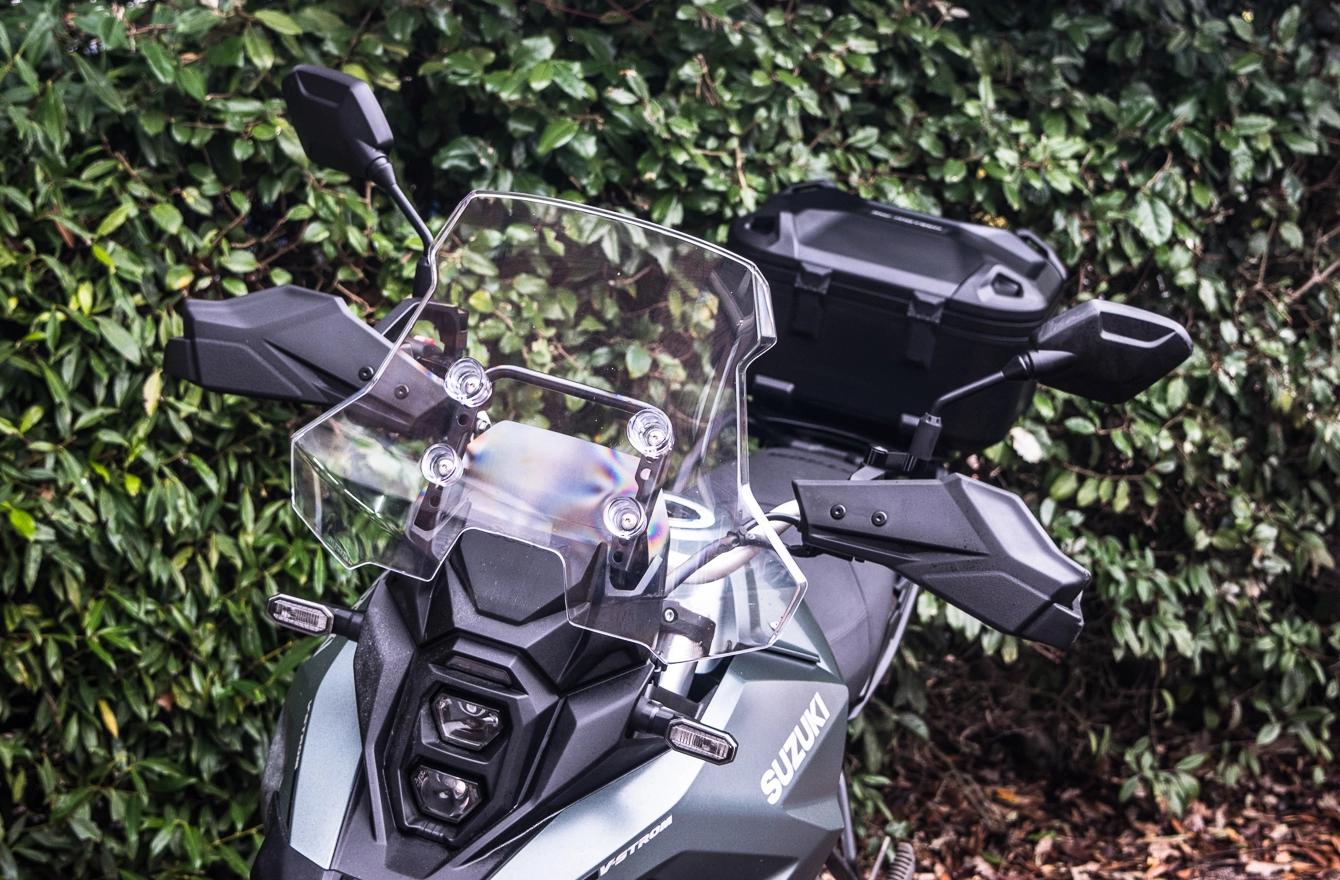
V-Strom 800RE – Standard Screen
The first run was with the standard V-Strom 800RE screen fitted in the high position so we could understand how much of an improvement – if any – the Puig Flip would make.
The standard screen has been the least comfortable for riders. It’s not bad by any measure, but it’s the least comfortable of all the configurations we are testing. Anything over 65 MPH and the buffeting, a slap on either side of the helmet was back. Stay under 60MPH, and it is fine, but that isn’t likely to happen.
Don’t tell Puig, but their XL Visor 2.0 fixes almost all of the issues we had with the standard screen. All the helmet-slapping disappeared and stayed gone even when I pushed to higher motorway speeds.
The temptation to push on beyond an indicated 80 MPH was immense, but that is more than fast enough for a long day touring.
Riding the back roads at 45-55MPH with my visor open wasn’t an issue either. It’s an added bonus when the temperature is low, and moisture in the air starts to fog up my glasses.
V-Strom 800RE – Puig Screen
The Puig screen is an improvement over the standard factory screen, but it is still a little short of perfect. Most of the time, it is acceptable, but it does have moments that generate a high-frequency buffet on both sides of my helmet.
Not surprisingly, the Puig Visor (the flip) fits easily, and with it set one click away from me and at mid-height, it was time to see how much of an improvement the flip made.
Up to 50-60 MPH, I could ride with my visor half open without any issues. To get a sense of how much of an improvement the flip was making, I stuck my head out the side, and the wind blast closed my visor.
The wind roar is reduced, the remaining buffeting has been smoothed out, and overall, riding the V-Strom 800RE at higher motorway speeds is now peaceful and enjoyable.
As it was a dull winter day with little wind, we didn’t have the opportunity to test the Puig screen and flip in a crosswind. The flip on the Voge hasn’t been an issue in windy conditions, so I can’t see it being a problem on the 800RE.
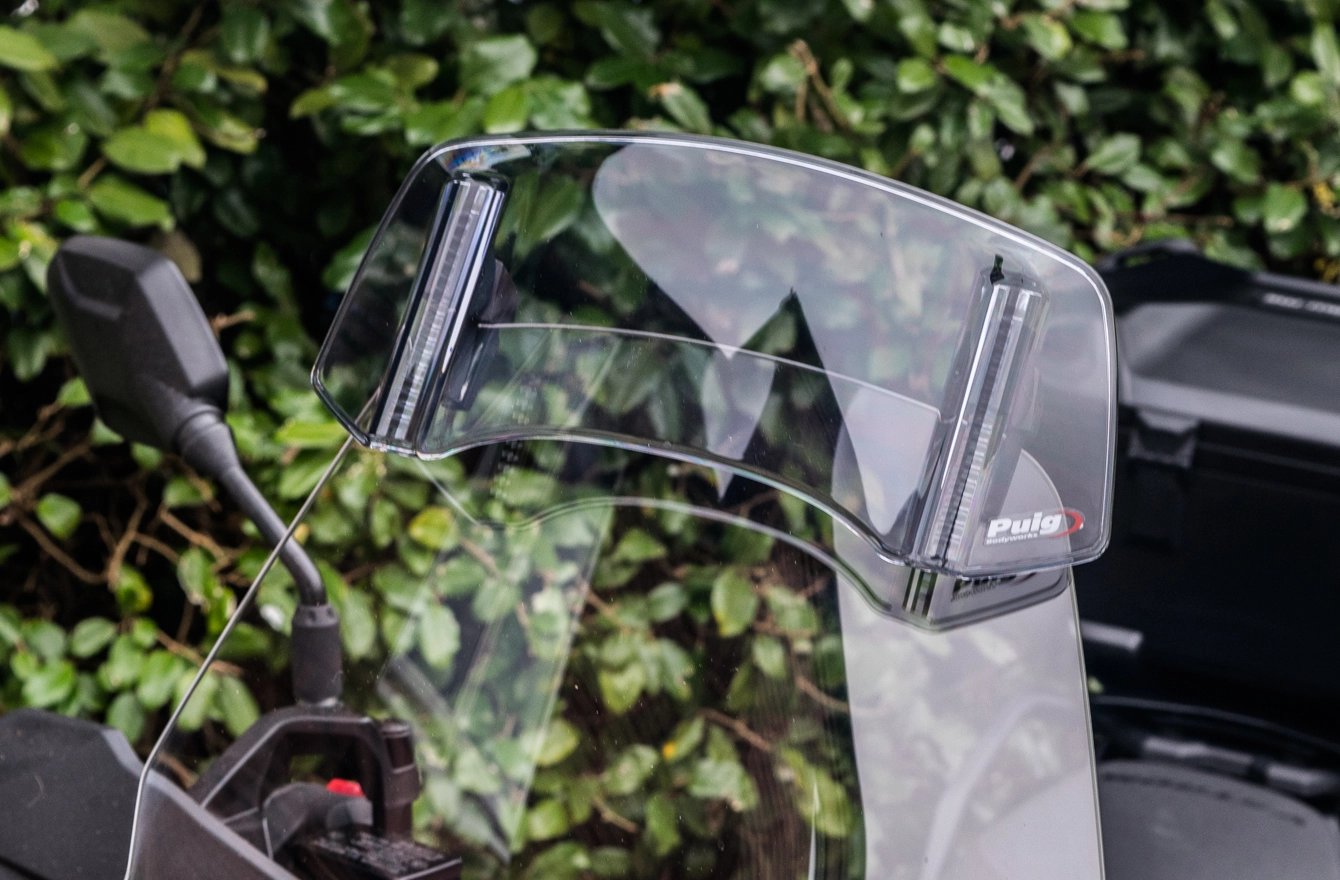
Voge DS900X
As with all other installations, the fitting time was less than five minutes. The Puig Visor (I must stop calling it “The Flip”) was easily adapted to the shape of the standard screen. It is a good idea to clean the screen and use an alcohol-based glasses wipe to remove any residue from the cleaners.
My first reaction was to put the standard screen in the higher position (the Voge only has two positions) with the flip at half height. It is an improvement, but not as dramatic as I had hoped.
Lowering the screen, with the Puig Flip still at half height, significantly improved the ride, proving that the Puig Visor is about airflow, not just putting up a windscreen.
After several miles of trial and error, the Voge screen on the lowest setting, with the Puig Visor fully extended and one click away from me, gave the optimum results.
I can hear the turn-by-turn instructions from my phone to the Sena intercom. We won’t mention the speed at which I tested this, but suffice it to say I could have heard the sirens had they been chasing me.
Puig Visor 2.0 Bottom Line
Screens are both wonderful and troublesome. Get one that works, and you’ll never appreciate how good it is until it is gone. Then you’ll wonder why other manufacturers can’t make screens that works as well.
Buying screens in an attempt to recreate that peaceful oasis of air can be expensive. At about a third of the price you pay for a replacement screen, the Puig Flip has proven to be a worthwhile investment for both the Voge and V-Strom 800RE standard screens.
Two of us were testing the Puig Visor 2.0. Dave is six feet tall, while I’m six inches shorter. We both had the same opinion on the flip.
At £50 from Pyramid Plastics, a Puig Visor 2.0 is roughly a third of the price of a new screen, and as the Flip easily transfers to your next bike, it also makes solid financial sense. If only I’d known before spending all that money on screens over the years.











One Response
Bought the MRA vario screen for my 800re. Night and day difference. Tried the Givi air flow but it’s the ugliest creation I’ve ever seen and only worked with the upper part above my eye level. Had Givi’s airflow on previous V Stroms and always found them perfect, but what they were thinking with this one is a mystery.