


In 2002 Gerard Thevenot founded Helite, the manufacturers of Helite Airvests; self-contained motorcycle airbags that are worn over any jacket or one-piece suit.
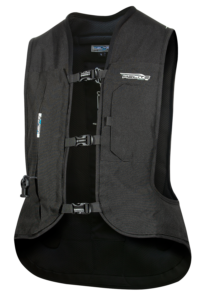 Rather than motorcycle racing, the inspiration for Helite Airvests comes from the light aircraft industry and can now be found in sports as diverse as horse riding to downhill skiing.
Airvests and airbag suits first arrived in MotoGP in 2007. The FIM made them compulsory in MotoGP in 2018 – and they had a MotoGP price tag to match.
A suit would cost well into the four-figures and if the airbag went off you needed specialist technicians to reset the suit for you.
Today, weighing in at just 1.6 kilos, the Helite Turtle 2 Airvest that I use will fully inflate in 0.094 seconds and doesn’t impede my body movement or prevent me from turning my head.
It has a full-size back protector built-in and the list of testimonials from surgeons, paramedics and the people who have benefited from wearing a Helite Airvest gets ever longer.
You can have all the benefits and protection for less than £400 and when it comes to resetting the Helite after it has deployed, you do this yourself in 10 minutes.
And if all of that isn’t enough to make you want one, there’s more …
IOM TT 2015
It is said that Barry Sheene worked with Dainese to develop a back protector that was integrated into his leathers.
I’ve worn a Forcefield L2K back protector for as long as I can remember and I’ve wrestled the smaller Forcefield Pro Lite 001 into the pocket in the back of my BKS Leathers.
Until I bought the Helite Turtle 2 Airvest, riding without a back protector was totally alien for me. It was the same as putting socks on. I didn’t think about it, I just did it.
Standing on the Glencrutchery Road in 2015, I noticed most of the riders were placing a chest protection plate in their leathers before starting. At the end of that day, I chatted with one of the medical staff at the TT and got the matter-of-fact – albeit a little gory – explanation from the Doctor about all the vital things that go on inside our chest, and hence why chest plates are a good idea.
Not having the money for a fancy airbag suit and wanting something I could use regardless of which jacket I was wearing, I ordered Forcefield’s all-in-one EX-K Chest and Back protector from SportsBikeShop.
It only took 5 minutes to work out that whereas it works well for motocross, for road riding it was too restrictive and bulky. Back to SportsBikeShop it went for a refund.
For the time being – back in 2015 – I was stuck. Yes, I could use a chest plate, but that wasn’t going to stay in place under a normal riding jacket. So I parked the idea, although it kept nagging at me.
Airbag Jackets
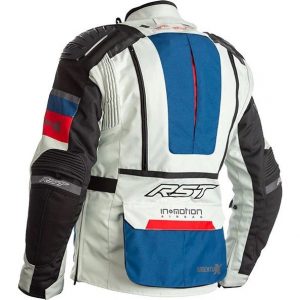
In 2018 RST released their Airbag jacket with a price tag of under £500. On the face of it, it is a low-cost airbag jacket. but there are a few additional points to consider.
The RST jacket uses the In&Motion airbag system who charge an additional £120/year to subscribe to their airbag technology service. Alternatively, you can cough up a further £399 and buy access to the service without further charge.
Assuming the jacket is going to be with me for three years, at today’s prices I’m looking at an £800 investment and that is for just one jacket.
Whereas you can replace the inflation canister in the RST jacket, if the jacket itself is damaged, then you will have to replace the whole thing. That is the same for every item of clothing, but when a jacket costs around £450 in the real world, not being able to fix it because of the airbag technology seems a little limiting.
I’ve had my RST Alpha jacket for five or more years now. It is taken a few knocks and is showing the miles, yet other than looking worn it is perfectly functional, thanks to the hot glue gun that I’ve used to repair a small tear.
I should point out that my solution isn’t RST approved.
Had this been RST or any other manufacturer’s all-in-one airbag jacket, would the same bodge have been advisable? I don’t know, but I wouldn’t be happy about it.
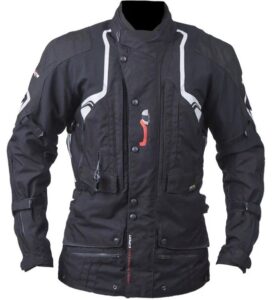 If an airbag jacket is what you are after then the Helite Touring Jacket is the better financial proposition.
The AA-rated jacket has a Humax waterproof liner, removable thermal lining, a built-in Knox back protector and of course Helite’s Airvest system that has no subscription charges other than a recommended service every two years.
Inside or Outside?
When airbags deploy they need to inflate to a size that will place a cushioned barrier between you and things that would do you harm.
If you fit an airbag under your close-fitting jacket or leathers, then when it needs to expand to protect you, the suit is going to have to move. What I’m talking about here is being given the worlds worst wedgie. We are not talking ride-up-with-wear, we’re talking… I’ll leave it up to your gender-specific imagination to work out what would end up where.
On race suits and jackets with stretch panels, this isn’t so much of a problem, but under my Weise Outlast Frontier jacket, something is going to have to give.
Then there is the fact that I’m a cold-weather-wimp and absolutely adore the Keis heated jacket I use for six-months of the year. Allowing for the Keis jacket and the Outlasts thermal liner, space is at a premium inside my jacket.
Ripcord or Electronic Release
Having decided that an independent external airvest that I can use year-round is what I need, I also want it to be reasonably priced, and not in need of a trip back to the manufacturer if it deploys.
With all of that decided, the final question is whether I was going for ripcord or electronic release or as some of the marketing department decided to call it “autonomous inflation of the wireless, electronically activated airbag”.
The electronics in the Helite E-turtle monitors the user’s movements and automatically triggers the airbag to inflate, in less an 80ms, if it detects adverse conditions.
The advantage of an electronic brain over the ripcord release method is that the Helite E-Turtle airvest will inflate in situations where you don’t separate fully from the motorcycle.
Perhaps the most common of these situations is getting smacked from behind while waiting in a queue of traffic. The sensors in the e-Turtle will do a good job of detecting the impact, and you can supplement the detection with the optional Bike Fork Sensor which communicates with the electronics in the Airvest.
It is a personal choice and I went with the ripcord Helite Turtle 2, my reasoning being that whereas the electronic version is excellent, it is another thing to have to charge. If I forget – a charge will last over 15 hours – then I’m stuck.
The ripcord release requires nothing more than me remembering to clip myself to the motorcycle.
It has been suggested that ripcord airvests will inflate if you forget to unclip yourself and walk away from the bike. All I can say is – total crap. It takes 60lbs of force to trigger the inflation of my Helite Turtle 2.
Sixty pounds isn’t a massive amount, but by the same measure, it isn’t me walking away from the bike at a petrol station.
The video below is a great demonstration of the difference between the two forces. Watch the lady running the demonstration. First, she pulls to make sure everything is connected, and when it is time to trigger the airvest, much more effort is required.







One Response
I enjoyed that very informative. Thank you