



The Energica Experia is a new electric motorcycle. I’ve ridden one, and it is rather impressive. There is so much to discuss … Grab a mug of tea.
Electric motorcycles are no longer the stuff of Sci-Fi movies. The “oh, it’s electric” novelty has faded. Performance has never been a problem. Instant power and bucket loads of torque are what we expect from electric motorcycles.
But what if you want to munch miles and tour? Is the Energica Experia the electric motorcycle that is truly an alternative to a dinosaur juice drinker?
Fast Charging
Energica’s Expedia is different. There is a new battery, motor, and charging voltage and even how the components are configured is different.
I’ll get to all that, but it is important to realise what Energica has done and why it is so significant.
Most people charge at home. 3kW or 6Kw AC chargers are the norms as the amount of power drawn has to be compatible with standard household mains electricity supply.
Energica’s Experia comes with a 3kW AC home charging, and at the 3kW charging rate, maths tells us that the 22.5kW/h battery will take 7 hours to fill.
If you are going to tour, one full battery will move you about 150 miles, after which you would typically need to endure seven hours of charging before moving on.
So Energica has fitted DC Fast Charging to the Experia as standard.
DC fast charging is a huge deal. It is the sort of technology you find in high-end electric cars. By using DC rather than AC and a much higher voltage (300 volts plus), it is possible to fully charge the Experia’s 22.5 kW/h battery in around 40 minutes.
The downside is that you are not doing this at home. You need to pull a lot of power from the national grid; most homes are not equipped for this.
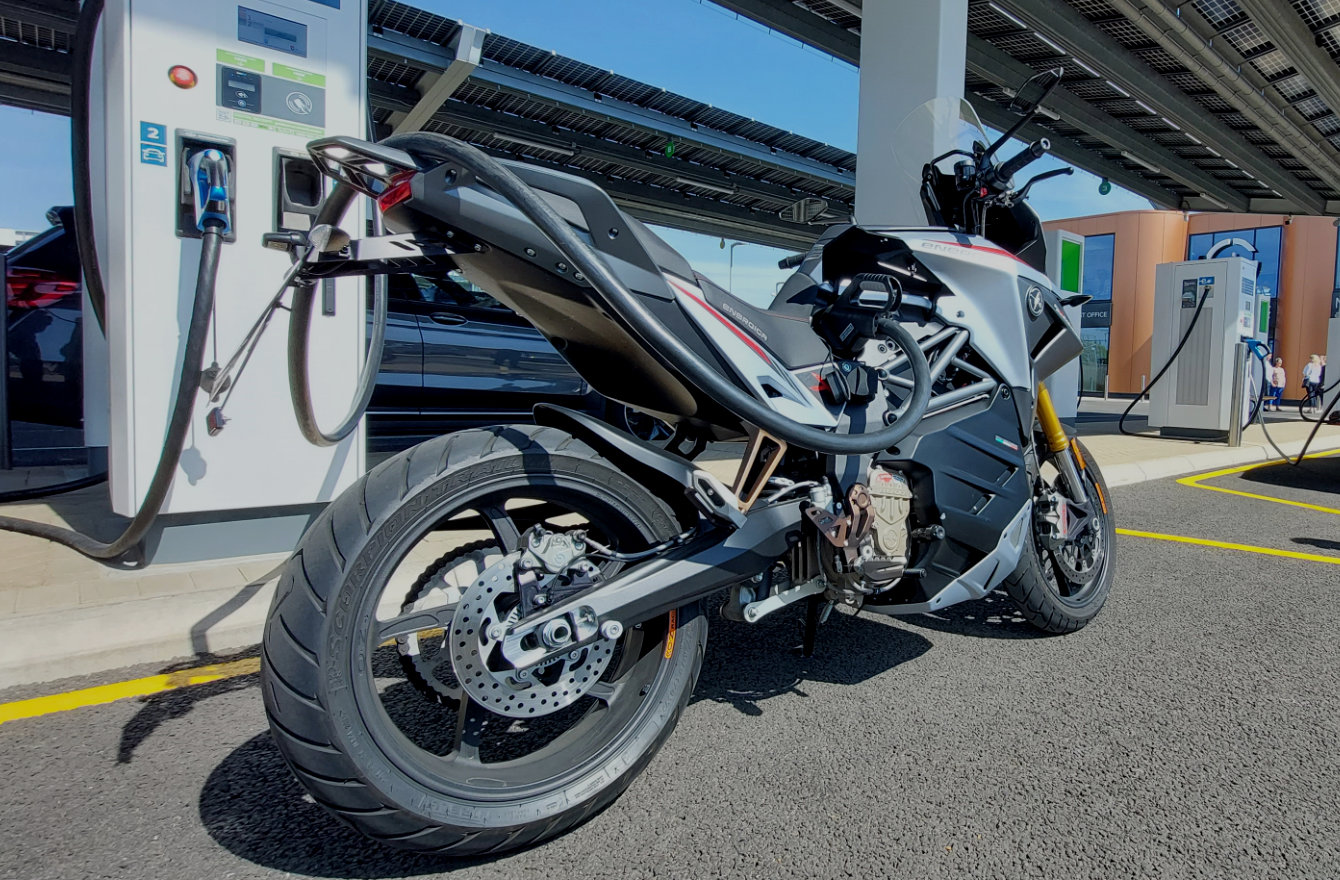
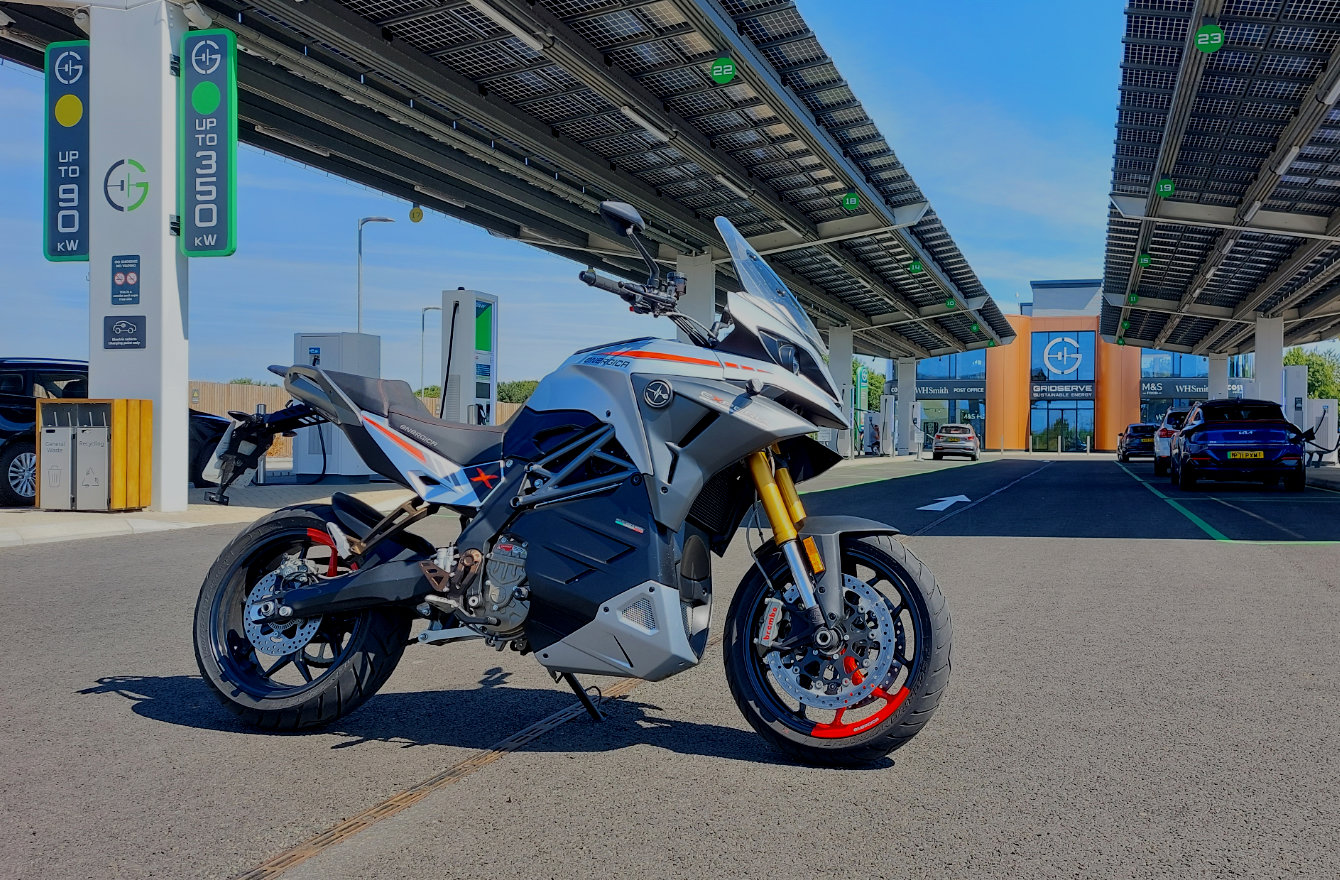
Yet, with facilities such as GridServe appearing around the UK and Europe and with DC fast chargers now available at my local McDonald’s, the reality of a 150-mile charge completing while I visit the loo and drink a mug of tea has arrived.
Power In / Power Out
With the battery fully charged comes the question of how efficiently the power can be used.
Electric motorcycles are known for high performance, no gears, and constant torque, all of which equates to mouth-watering performance. Grip it, rip it and watch the rest of the world disappear in your mirrors.
Energica’s Eva Ribelle produces 170HP and a neigh on constant 215 nM of torque, and the Ribelle isn’t the sporty Enerciga. For that, you need the Ego+ RS
Compared to the Honda CBR1000RR-R Fireblade, the Ribelle is up on weight and down on raw horsepower. Yet, to experience the Fireblade’s performance figures, you need to get the motor north of 12,500RPM. Whereas for the Ribelle, almost all of it is immediately available.
But that is all on paper. Putting those sorts of performance figures into a real-world test – under controlled conditions – we completed a 40MPH roll-on acceleration test between the Ribelle and our KTM1290. The Energica accelerates so much faster than the KTM that the braking at the end of the test became … well, let’s call it “focused”.
With such an excess of power available from electric motors, Energica has opted to use all of the advantages an electric motor brings and tune the touring-focused Experia to deliver an exhilarating ride without chasing headline power figures that don’t always tell the whole story anyway.
The Experia produces a “miserable” 80-102HP and a “lame” 115nM of torque. That guy at the tea stop, the one who always has an opinion on everything, is already scoffing.
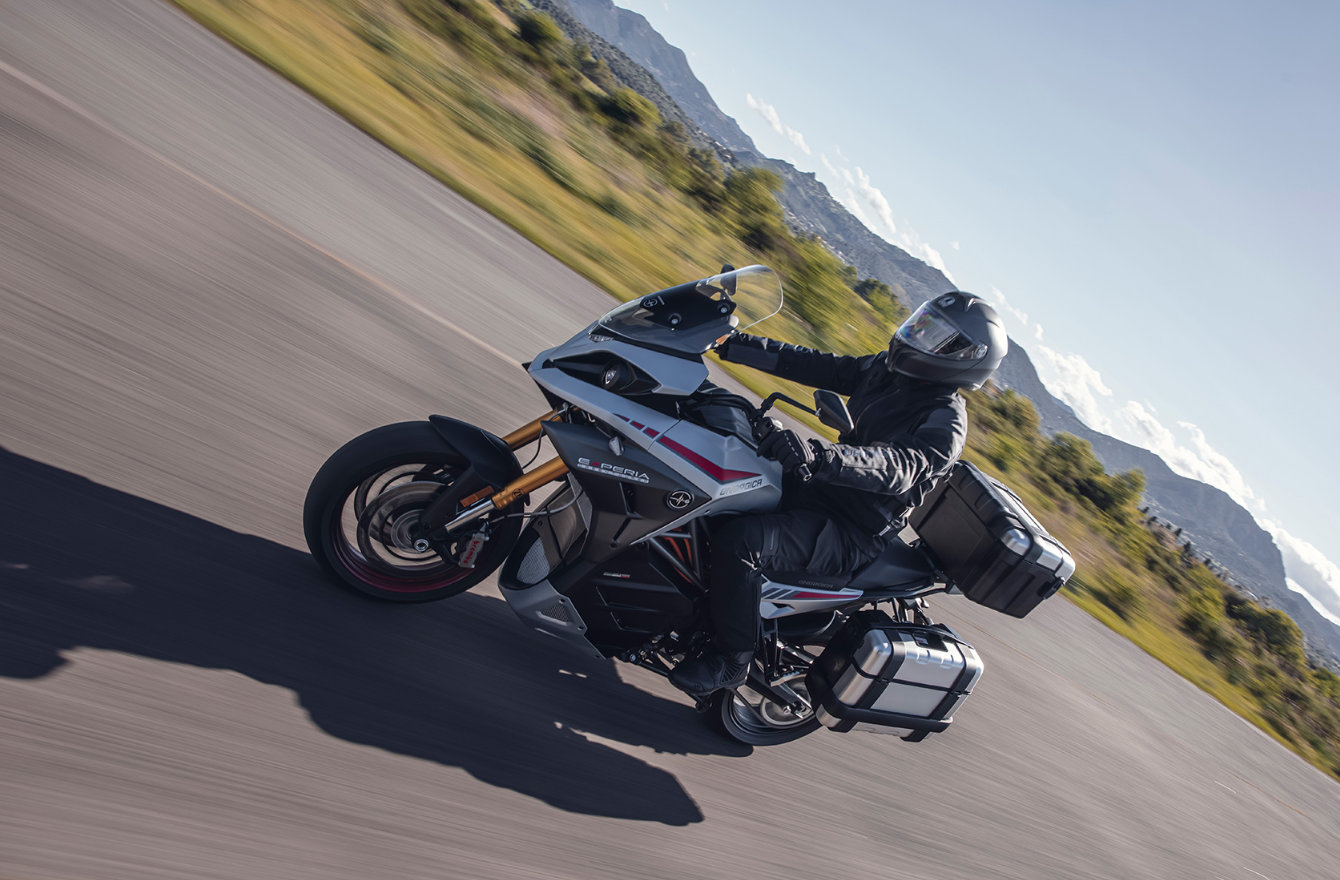
Yet despite the low headline performance figures, the Energica Experia is a very quick motorcycle and easy to ride confidently after just a few miles.
Comparing performance figures with a V-Strom 1050XT, 1100 Africa Twin or a V2 Multistrada is a waste of time. In a traffic light Grand Prix, they are all going to lose.
Quick Quick Slow
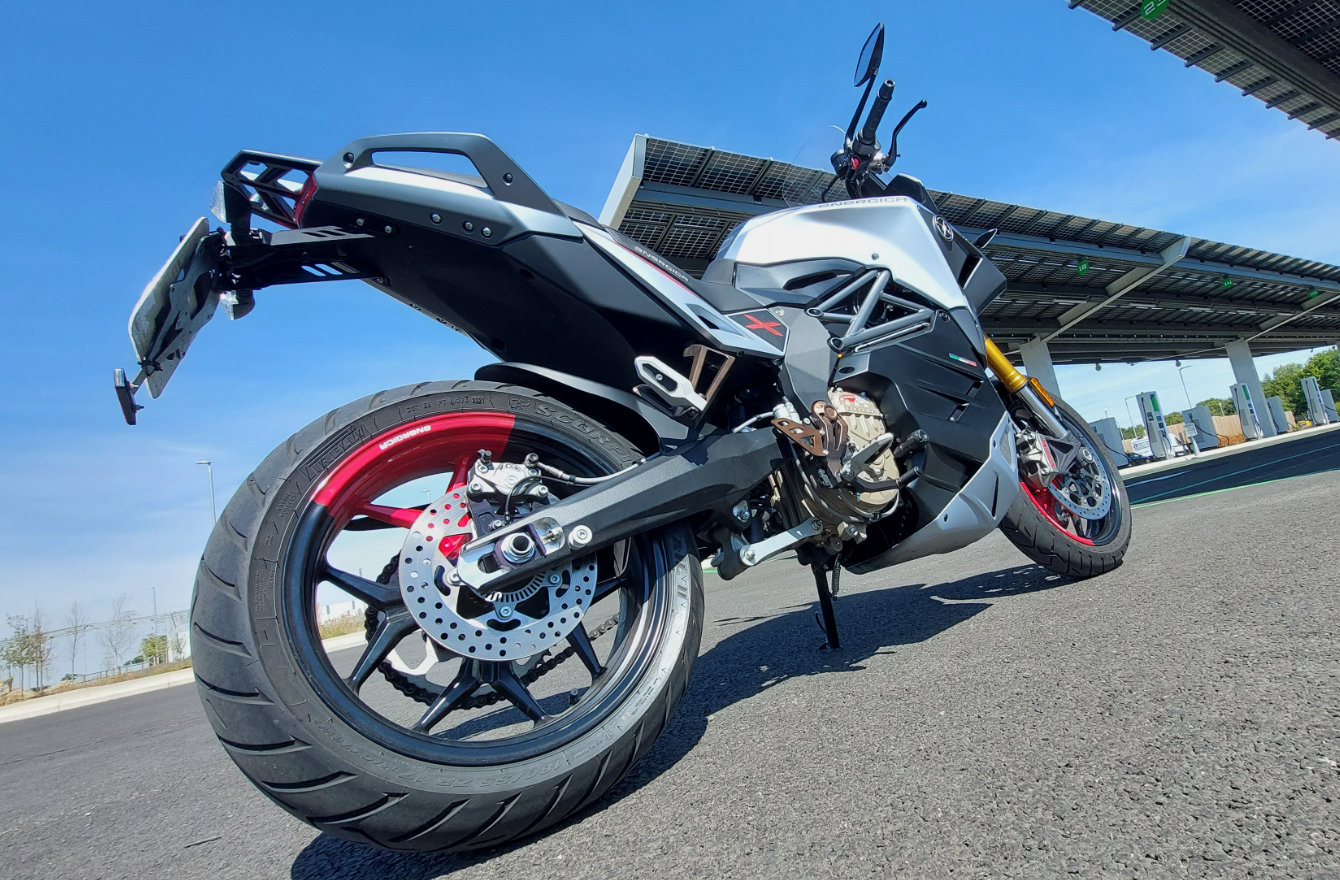
In designing the Experia, Energica carefully considered how the weight of the new battery and next-generation motor would be carried. The result is that despite tipping the scales at 260Kgs, the Experia feels significantly lighter and is a pleasure to ride at very slow speeds.
It is effortless. Lifting the bike off the side stand requires minimal input. Then breathe on the throttle and glide away.
While trying U-turns and other slow-speed manoeuvres, I did notice the speedo would only register zero or three miles an hour, even though I was riding slowly enough to be overtaken by pedestrians. No slipping of the clutch or dancing on the rear brake is required. Just relax and ride around in circles.
Tap on the throttle, though, and the Experia will swiftly propel you over the national speed limit if you’re not paying attention. There is no engine howl or gears to shift; rapid acceleration is all you experience.
The official zero to sixty mph time is 3.5 seconds, but there is a far more impressive part of the Experia’s performance to look at.
We didn’t have the equipment to measure this performance empirically but rolling along at 40 mph and then pinning the throttle – the same as the test we did with the Ribelle – is the Experia’s superpower.
The Experia’s top speed is capped at 112 MPH (180 KPH). This is a limitation of the electric motor. If not restricted, it would spin faster and faster until something failed. Whereas the Experia isn’t the fastest adventure bike, how it gets there is what is so very impressive.
Where it counts – off the line and squirting between the corners and roundabouts – there are very few motorcycles that will match the effortless performance and power delivery of the Energica.
The performance isn’t limited to straight lines either. The Experia corners gracefully and inspires confidence. There was a tendency to understeer (push wide) when taking a committed sweeping line through a roundabout, but that was the only negative to the handling and something the fully adjustable ZF Sachs suspension might allow you to dial out.
Energica Experia Ergonomics
I’m an average size. Six feet tall, and my once athletic frame has now sagged in the middle. The Energica Experia’s seat height is 847mm. To put that in context, it is +/- 10mm compared to the various seat configurations found on Suzuki V-Strom 1050XT or the Honda CRF1100 Africa Twin.
The Experia is narrow-waisted, and with a 31inch (77cm) inseam, I had no problems flat footing.
The foot peg placement and handlebar reach are just about perfect. I’d prefer a little more curve back towards me on the bars, but it is nothing ten minutes in the garage wouldn’t fix.
The screen is adjustable, and with a Schuberth C4 on my head, I found it made little difference to the noise, whether it was up or down. However, the screen smooths out the air around my upper body and makes the Experia a calm and relaxing place to sit.
No Parking Brake
Having once had the heart-pounding experience of catching my V-Strom as it started rolling away from me, I tend to park my motorcycles in gear.
As there are no gears on the Energica Experia, I wondered why they hadn’t fitted a hand brake.
The bikes we were riding are pre-production models, so perhaps there will be one fitted when they arrive in showrooms. Otherwise, you will always be looking for the uphill slope to park the bike on.
The Elephant
According to the Energica Motor Company website, the Energica Experia starts at €26,500 plus taxes.
At current conversion rates, that is £21,900 plus VAT, which comes to £26,580. I’m sure there will be additional on-the-road costs, so budget £27,000.
A BMW1250GS with heated grips, luggage and a 30,000-mile service pack retails in the region of £22,000. According to BMW’s fuel consumption figures, 30,000 miles will require 500 imperial gallons or 2,275 litres of fuel.
Assume a cost of £1.70 per litre for the fuel. Add all those figures together, and 30,000 miles on a GS will cost you £25,850 or thereabouts.
The Energica Experia doesn’t run for free. The cost for charging varies more than the price of petrol, but 50p per kW for fast charging seems average.
Assuming I add 20 kW per charge, it will cost me £10 to travel 150 miles, which works out at 200 charges to cover 30,000 miles or £2,000 in electricity (rather than £3,868 in petrol).
That same 30,000 miles on an Experia Energica will cost £29,000 compared to £26,000 on the BMW. The gap isn’t as big as you might first imagine.
Bottom Line
I’m a fan. I think electric motorcycles will continue to evolve, and when – or perhaps if – the charging infrastructure is sorted out, they will become a viable alternative.
The infrastructure, rather than the price, is perhaps what is holding electric motorcycles back. The back road twisties most motorcyclists prefer are not where you find an abundance of DC fast chargers.
Even the Isle of Man has but one DC Fast Charge point, and when I checked, it was reported as out of service.
For the cost of electric motorcycles to drop, dealers need to sell more motorcycles, and DC fast chargers need to be more prevalent.
We need a reliable charging infrastructure for those things to happen, but because we are all burning that readily available dinosaur juice, the need for an abundance of reliable charging points isn’t there. It is coming – look at Gridserve – but it isn’t there yet.
Then there is the cost of ownership. The BMW used in the cost comparison is a proven motorcycle that is pretty much future-proof. Yes, BMW will continue to refine the bike over the coming years, but plus or minus an accessory or two, it is a known quantity.
Battery technology, as the Energica Experia proves, continues to develop. In five years, will the Experia be the model no one wants because the technology has moved on dramatically?
It is an evolving science and hard to predict. Perhaps that is why PCP deals on electric motorcycles are not as attractive as those on the BMW.
Few of us have £26,000 hanging about, let alone £29,000, but £170 a month on PCP makes riding a GS 1250 possible. And should BMW make the model I’m riding obsolete, then the guaranteed future value that’s baked into the PCP deal means I can walk away without taking a bath on the residual value.
Meanwhile, the glorious Energica Expedia will do a valiant job of tempting you and me to part with our cold hard cash.
If I had the money, I wouldn’t need much persuasion.





One Response
Thank you, I’ve seen the launch videos but this is the first comprehensive review I’ve seen.
I think the early adopters will be tour companies who can (hopefully) negotiate a bulk purchase price and then offer a package tour to their guests of a bike and a tailored route.
Taking in beautiful scenery, perhaps in the Alps where the regen will help to extend the range, the low noise factor would be a asset at a time when roads are being hit with noise restrictions.
If I didn’t already have a business I’d be very tempted!