



Electric motorcycles can go fast, accelerate like a demon and cover long distances. The problem is getting them to do all three.
No matter how an electric motorcycle is configured, the battery is the key part. Bigger batteries can hold more charge but are heavier and take a long time to recharge.
Smaller batteries take less time to recharge, in the same way as a smaller petrol tank can be filled in less time than a larger one. And for those of a pedantic nature, this assumes the petrol flows at a constant rate.
The problem with the smaller battery/petrol tank is that it won’t take you as far as the larger one.
Charging Problems
As standard, even with Fast Charge, most electric motorcycles have similar specifications. You get to ride around 130 miles, and then – assuming you are using fast charge – you need 40 minutes to recharge the battery.
The more you use fast charging, the less efficient the battery becomes, and a longer, standard charge is required to overcome this.
As recharge times are not linear, you can get to 80% charge in around 60% of the time it takes to get to 100% charge, but of course, you can’t go as far on 80% charge.
Wash – Rinse – Repeat … that is the guts of the problem with current battery technology. But it looks like all that is about to change. And to get into that, we need to talk about how batteries work.
The Science Bit
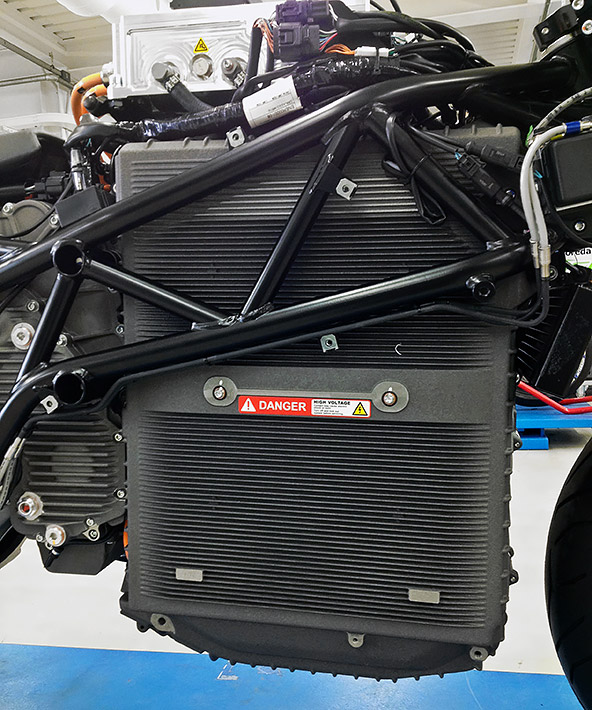 The batteries used in electric motorcycles are exceptionally clever bits of technology. There are patents galore covering emerging technologies, but all batteries work in the same fundamental way.
You need two chemical reactions, one that wants to shed electrons and one that wants to collect them.
The reaction that wants to shed them is called the anode and is the negative side of the battery. For the positive side – the cathode – we need a chemical reaction that wants to attract electrons.
Connect these two reactions together, and electrons flow from the anode (negative) to the cathode (positive). The rate at which the electrons flow is called the potential (voltage).
As the electrons pack their bags and leave the atoms they were attached to in search of a new home (anode to cathode), they leave behind positively charged Ions.
Positively charged ions don’t like being positively charged and want to return to the happy, neutral state they enjoyed when they had electrons attached. So they move through the electrolyte (the gooey stuff in batteries), searching for their departed electrons.
When the ions turn up, the electrons are having none of this getting back together, reconciliation bollards, and so we are left with the awkward situation of the electrons being happy in their new home (electrons in the cathode). In contrast, the ions keep turning up at the cathode, hoping they can get back together with their departed electrons.
When all the electrons have left the anode, and all the ions have gone in search of their ex-partners, the battery is flat.
Recharging
When we recharge a battery, it is easy to think of refilling it with electricity, in the same way as we replace the petrol we have used when we fill up. It works as a good parallel but it isn’t quite what is happening.
We have all the electrons happily living the single life in their new home, the cathode. The ions are wandering about, hoping for a reconciliation with their lost partners, but that isn’t happening. No one is getting back together, and the battery is flatter than the proverbial pancake.
The ions and their electrons need to be forced back together to recharge the battery, which takes energy. You can trickle that energy in over a long period or take the shotgun approach and “fast-charge” the reconciliation.
This is what the EV Fast-Chargers are doing. They supply the energy required to force the happily single electrons back into a relationship with the sadly neutral ions and push the (un)happy couple back into their marital home, otherwise known as the anode.
Once back where they all started, the electrons still can’t be trusted, and at the first opportunity, they are off again, looking for the single life in the cathode.
Thank you to Riley Senpai on Youtube for the video below.
Fast Charge and 80%
Rapid reconciliation or Fast Charging works, but like most jobs done quickly, it doesn’t deliver the best results.
A long slow charge is best for the overall health of the battery. Of course, a few quickies are often the answer when you need to get on with things, but there is nothing better for your battery’s overall well-being than a long slow charge.
Charging, be it fast or slow, isn’t a linear process. Getting around 80% of the ions and electrons back together happens relatively quickly. Yet, there are always holdouts that, despite all of the energy put into the reconciliation process, resist the urge to get back together.
They get there in the end, but considering the additional recharge time, it is sometimes easier to get back on the road with an 80% charge.
And this is the electric motorcycle recharge problem. It takes too long to get the battery back to 100%, even using a fast charge. Plus, constant fast charging screws the battery’s chemistry and a prolonged recharge is required to restore health.
In short – it all takes too long.
Silicon and Graphite
You may have read about Lightning Motorcycles, and their 150mph Strike Carbon model that has just completed real-world trials of the new silicon rechargeable batteries from Enevate.
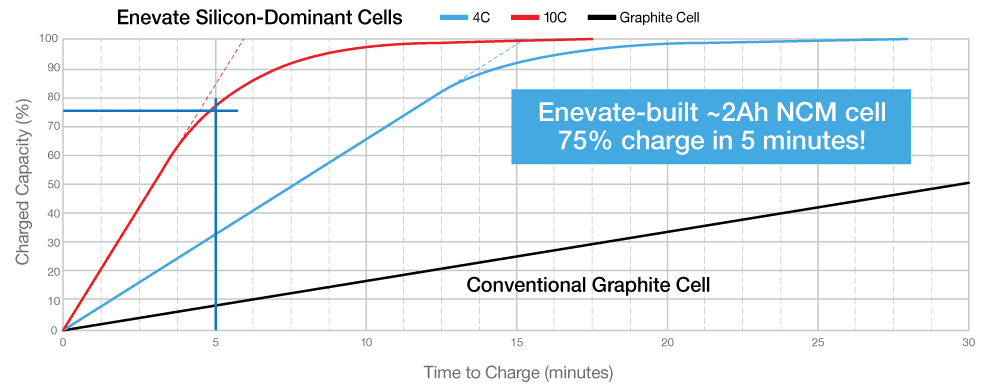
The big news was that Enevate had replaced the traditional graphite anode in the rechargeable battery with a silicon-based one. As a consequence, it became much easier to persuade the electrons to get back together with the ions resulting in a 15-minute recharge time. In the case of the Lightning Strike Carbon, sufficient charge for another 130 miles.
It seems that if you are a positively charged ion with a silicon-based anode to live in, you can get back together with an electron with a lot less effort.
The other big win for silicon-based rechargeable batteries is energy density. Silicon-based anode batteries are around 20% smaller and lighter than their graphite equivalents. More significant improvements in energy density are predicted, but 20% is the current number.
Lighter and Further
Whereas the obvious advantage is that you could ride your electric motorcycle 20% further on a battery that weighs the same, the weight reduction has a more significant benefit.
Example: The battery in the glorious Energica Experia weighs something in the region of 100 kg. However, for the same range with a silicon anode battery, the weight can be reduced to 80Kgs. That would make an Energica Experia weigh 240 kg or 10 kg LESS than a BMW R1250GS.
The double bubble advantage is that because the Energica now weighs less, it would go further on the same amount of electricity.
So, the battery has the same amount of energy but weighs less and therefore uses less energy to move it the same distance.
And when I do need to recharge, it takes less than 15 minutes. Major result. Drinks all around.
Bottom Line
After that last comment, someone somewhere is thinking that the 1250GS would go 230 miles before it needed refilling and not a mere 130 miles. This is true. My backside, however, has a 150-mile maximum range.
After 150 miles and allowing time for me to get the blood flowing again, coffee and a toilet break often occur. So, if the recharge time is 15 minutes, then I’m a happy motorcyclist.
If I can recharge an electric motorcycle in 15 minutes, the problem becomes the recharging infrastructure and where recharge stations can be found, which typically isn’t on the backroads I prefer to ride.
Solving this problem needs an increase in demand for recharging stations, which in turn requires more electric vehicles on the road.
On the flip side, a recharge time of 15 minutes would reduce the number of recharge points required. Of course, petrol is still faster at around 5 minutes a fill-up, but as we are currently looking at 40 minutes to recharge, the new battery technology is a significant improvement.
But there is a way to go before that happens. All the reports are sunshine and lollipops, so I’m waiting for the bump in the road. Maybe it is the cost or perhaps longevity. Who knows?
And then there are synthetic petrol and hydrogen to consider. Perhaps those technologies will stop electric vehicles from replacing our beloved dinosaur juice drinkers.
Yet, with low and zero cobalt batteries, silicon anodes and higher energy densities, all wrapped up in faster recharge times … electric motorcycles could quickly become a viable alternative for any motorcycle.












One Response
very good analysis. charging speed (measured in miles / min) is the most important metric for an electric bike capable of long trips.
efficiency is also super important because it impacts range and charging speed but unfortunately not a lot of room for improvements with conventional bike design and aero being the bottleneck
with current mainstream li ion batteries bike touring is not realistic with about 25% or more spent charging especially if you are loaded with luggage and/or passenger but improved chemistry or solid state might bring that number down
weight is very important for handling and fun factor too so huge batteries is not the way to go, but also bigger battery means more miles/ min with same charge rate so it’s all a compromise like on electric cars except range is more important for cars because you can comfortably make longer legs between fillips/charges, weight more important for bikes because you don’t have power steering / wide tires to hide the weight
range stays important still because charging network is not optimal and you have to deal with long stretches without fast charger, broken/slow chargers, and chargers can often add a few mile to your route that will add up on a long journey.
on the brighter side, once you get to an available/working charger with contactless identification, plugging in / out takes very little time so you’re free to do what you need/want during charging