


What do you do when company buyers tell you that your motorcycle jeans should have big patches and use loud red stitching, but you believe they are wrong and have missed what motorcyclists want?
The answer is to start Hood Motorcycle Jeans and spend the next 20 plus years quietly proving the company buyers wrong.
Having a family history in jean design and manufacturing helps. As does appreciating when a chance meeting shows you something that makes protective motorcycle jeans a reality.
And so, twenty-something years later, Hood Motorcycle Jeans has gone from strength to strength. It is an impressive story of how a husband and wife team, based in Norfolk with a passion for delivering excellent products, started one of the biggest motorcycle jean companies in operation. I’m not sure what Norfolk has to do with anything, but here is the rest of the story.
Oh yes, and their jeans outperform some well-known textile trousers, with the Hood SK11 motorcycle jeans being Triple-A CE certified to EN 17092-2:2020. That is a lot of numbers but essentially translates to the jeans having been awarded the highest protection rating possible under the new motorcycle clothing protection standards.
Motorcycle Jeans
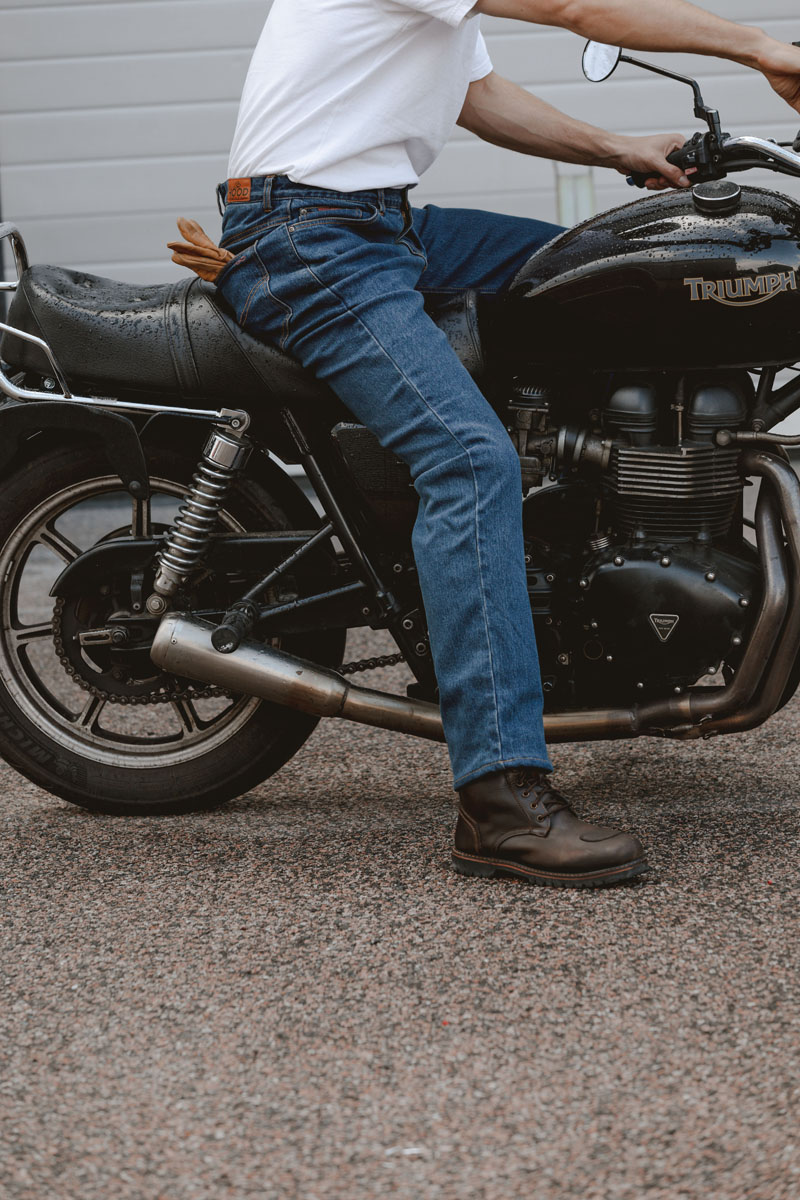
Chris and Julie Easterford, the people behind Hood Motorcycle Jeans, released their first pair of motorcycle jeans, the Hood K7, in 1998. At the time, it was the first seamless motorcycle jean on the market, with no extra tell-tale stitching on the outside. The objective for Hood Motorcycle Jeans was to produce jeans that protected the rider and yet looked like an everyday pair of regular jeans.
Nonetheless, the designs conflicted with the feedback from the motorcycle clothing industry, which wanted jeans with more stitching – preferably bright red – along with bigger, brash labels. So Hood Motorcycle Jeans turned to the internet and opened an online store, selling directly to the motorcycling community.
The rest, as the saying goes, is history. Business, as expected, was initially slow. A motorcycle jean manufacturer with a passion for protection, quality and customer service, running an online store was always going to be a tough market to succeed in. But, succeed they have.
Talking with Chris and Julie, it’s the little things they mention that indicate their passion for what they do. Chris, for example, travels to the factory in Shanghai when there is a production run, believing that although they have worked with the same factory for many years, there is no substitute for being directly involved.
Or when you call them, there is a good chance that it will be Julie, the lady who designs the jeans, you will talk with, rather than them employing a call centre somewhere that values your call so much, they make you wait and then take a message.
Or perhaps it is that a pair of Hood Motorcycle Jeans have never once failed to protect the rider in over twenty years. Naturally, there are limits, but Hood Motorcycle Jeans have always delivered the protection Chris and Julie design into their jeans. That is quite a record.
Testing Testing
But still, jeans as protective clothing. Really?
In the world of motorcycle clothing, EN 17092 is the mandatory standard that all motorcycle clothing manufacturers selling in Europe must meet.
Some manufacturers still try to swerve around the rules with carefully worded adverts, such as calling them riding jeans, but passing even the basic A-rated level of EN 17092 is necessary if you are manufacturing motorcycle clothing for Europe.


The abrasion test in EN 17092 uses a Darmstadt Abrasion Machine, replacing the Wood’s Cambridge Abrasion Machine that had been the industry standard since 1996. I’m sure the EU has its reasons for swapping testing machines, but the Darmstadt tests do not give the time when the material failed. It only provides a pass or fail result.
Although there are three levels of EN 17092 – the imaginatively entitled A, AA and AAA – the way the abrasion test is structured means that a pair of motorcycle jeans could scrape [no pun intended] through the abrasion test or provide a much greater level of protection. You can’t tell the difference.
Regulatory testing under EN 17092 is compulsory, and the Hood SK11 jeans have passed at the highest level – AAA. Yet, look on the Hood website, under the Protective Linings tab, and you will also find the abrasion test results from the Cambridge machine, which will give you a much better understanding of just how good the motorcycle jeans you are buying actually are.
Cambridge Machine Abrasion Times
When riding a motorcycle, there is always the possibility of an “unscheduled dismount”, followed by travelling along the road surface, detached from your bike.
Wet or dry, back road or high street, in a battle between what you are wearing and the road surface, the road surface will always gain the upper hand, which is why Cambridge Machine abrasion times can be very useful when selecting your motorcycle jeans.
Motorcycle jeans need to be tough, but how the manufacturer has chosen to deliver that protection is an important factor. Nylon, sometimes called polyamide, is tough when mixed with other fabrics but is not a good choice. Nylon has a low melting point, and the friction caused by rubbing on the road surface can cause the nylon to melt, turning a bad day into something even worse.
Single-layer jeans tend not to do so well on Cambridge Machine abrasion times. When the first pair came on to the market in 2010, Hood made a pair of jeans, but the fabric other manufacturers were using did not meet the minimum levels of abrasion protection that Hood have always insisted on. Hood tried again in 2015, but the single-layer jeans failed a basic drag test again despite claimed improvements in the material.
In 2019, with more single-layer jeans coming onto the market, Hood decided to take a third look at manufacturing single layer motorcycle jeans, this time sending their prototype to Satra Technology for independent testing.
The single-layer jeans achieved a Cambridge Machine abrasion time of 1.80 seconds. Compare that to the 7.2 seconds achieved by the K-tech + stretch denim construction of the Hood SK11/AAA and K7/AAA (S) Jeans.
Do, however, be cautious of “slide times”. These are actually meaningless as they lack any empirical test to arrive at the quoted time. You will slide a lot longer on ice than you would on mud, which is what makes the Cambridge Machine abrasion time such a useful measure.
Still, enough said, and Hood have no plans to revisit single layer motorcycle jeans until something fundamentally changes.
To D3O or Not D3O
Another factor you may not wish to think about is that following the unscheduled dismount from the seat of a motorcycle, gravity demands that a return to earth is inevitable. This unwanted contact with the road surface is best endured when something is protecting the parts of us that stick out.
Armour is a common feature in most motorcycle clothing, and there are varying levels of protection and efficiency. Arguably, on top of the pile is the rather impressive D3O armour.
If you are into your non-newtonian fluids, you will know that the wonder of D3O is that it is fully flexible under normal conditions. However, when hit with a sudden force, the molecules in D3O bind together to provide impact protection. Once the force of the impact has dissipated, D3O returns to its normal flexible state. And if that sounds like witchcraft, the video does a better job of explaining the science than I can.
The latest generation of D3O armour is D3O Ghost armour. It is very thin, very flexible and CE Level 1 certified. If you want to move up to CE Level 2, there is D3O® LP2 Pro armour. It is slightly thicker and not quite as flexible but still bendy enough for motorcycle jeans.
Hood Motorcycle Jeans
Accepting that Hood makes all of their motorcycle jeans in a range of colours and different styles, you now have to decide between the triple-A rated SK11 and the Double-A rated K7 motorcycle jeans.
Having made your choice, you now get to decide if you are male or female as there are Hood Motorcycle Jeans specifically cut to accommodate the female form in their women’s K7 Jean. Men’s styles are available in both their SK11 and K7 ranges.
Third comes the choice of whether you would like D3O armour or not. If not, I can only assume it is because you already have some, so there is the /B option for all of the Hood Motorcycle Jeans. Precisely the same jeans, in all the same colours, cuts and styles, simply without the armour.
We are almost there, but remember, Chris and Julie are passionate about their motorcycle jeans, and so you also have the option of free leg length alteration should the standard sizes not meet your needs.
So, What Next?
Naturally, there is the desire for the business to continue growing, and there are further improvements to the jeans planned. In 2022, for example, the Double-A rated K7 jeans will evolve and become Triple-A rated.
Whereas constant evolution is important, I think Chris and Julie would like a break from working seven days a week during the busy summer months. Yet at the heart of Hood Motorcycle Jeans is their passion and the love affair with what they do. It is a difficult balance to achieve.
As the well-known proverb tells us, “Do something you love, and you’ll never work a day in your life”.
Clarity
I don’t own a pair of motorcycle jeans, preferring my textiles or leathers over denim. Having researched Hood Motorcycle Jeans and D3O armour in writing this article, guess what I have now asked Santa to bring me? Or if you are reading this article at a different time of year – the Easter Bunny.










One Response
I do enjoy riding in a decent pair of motorcycle jeans, practical for off the bike, cafe stops and walking around tourist attractions for example while touring. Just remember to keep some waterproof overtrousers under your seat