


Once upon a time, Motorcycle Jeans were Levis or Wranglers, depending on your personal allegiance. Having seen what happens to a pair of standard jeans on high grip road surfaces – the sand-coloured road surface found on the approach to crossings and on some corners – I thought I’d dig deeper into specialist motorcycle jeans.
The most common reinforcement for motorcycle jeans is Aramid, often called Kevlar, which is a trade name used by the DuPont marketing department.
Aramid – the name given to the fibre – was developed by Stephanie Kwolek while working at DuPont in 1961. No one could find a use for Aramid prior to Kevlar being developed – most famous perhaps for military body armour.
Once DuPont had established how strong Kevlar was and that it could be woven into other materials, there was everything from hats to shoes that contained Aramid – including, of course, riding jeans.
The other big player in this market is a yarn called Vectran which is used by materials manufacturer Covec. Covec is better known in motorcycling circles as Bull-it
Motorcycle Jeans
When choosing your Aramid/Vectran motorcycle jeans, the first decision is to choose whether you prefer lined jeans, where the Aramid/Vectran layer is stitched in as a liner, or the type where the fibre is woven into the denim.
Anecdotally, Aramid/Vectran lined jeans come out ahead in most tests compared to those woven into the material. A standard pair of Levi’s will provide some protection from road rash, and having to first wear through the denim before getting to the Aramid/Vectran liner gives them an advantage over single-layer woven jeans.
The downside to double-layer motorcycle jeans is how hot they can get. They are less cumbersome than textiles and more practical if you plan on doing something other than riding the bike, but they don’t breathe well.
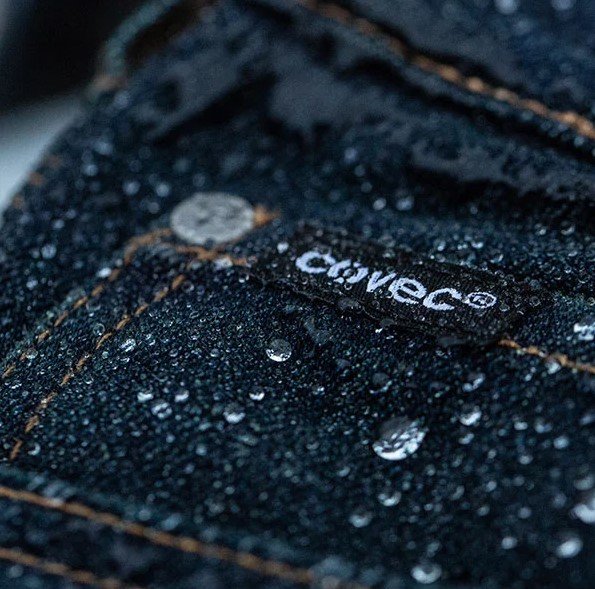
The other consideration with lined riding jeans is the density of the Aramid or Vectran lining. Figures seem to vary for the Aramid cloth’s weight between 160 grams per square meter (g/m2) to 320 g/m2. The bigger the number, the thicker the lining and the greater the protection. The thicker the cloth, the warmer they will be.
Covec, who weave Vectran into their SkinSide material, refers to the thickness of the material as SR4, SR6 or SR8.
The number represents the number of seconds the material protected against abrasion when undergoing the EN 13595-1 Clause 5.4 motorcycle garment abrasion test. It is a useful figure to bear in mind if you are selecting Covec lined motorcycle jeans.
Standards – The Short Version
If you have trouble sleeping, you may wish to try reading the standards for the evaluation of motorcycle safety equipment. Not exactly a gripping read. Before skipping ahead to Mesh and Part Linings, here is the super-condensed version of the standards.
- EN 13595 – Old standard, expires March 2023.
- EN 17092 – New standard, came in to effect April 2018
- New standard – Class AAA is top dog, but nothing wrong with AA or A – it depends on the intended use.
Standards – The Longer Version
The longer version goes like this:
Since 1994, any garment described as Personal Protective Equipment has had to meet a CE standard. For most motorcycle clothing this was EN 13595. However, it wasn’t sold as “protective”, and so only the armour had to meet this standard.
From 21 April 2018, the new PPE regulation 2016/425 redefined all motorcycle clothing as Personal Protection Equipment and must be tested and certified by an independent body. The key phrase here is “motorcycle clothing”. A T-Shirt and jeans – like the £40 eBay ones – are not motorcycle clothing, they are just clothing.
To be sold as motorcycle jeans they must conform to Personal Protecting Equipment Regulation 2016/425. It doesn’t matter where they are made, it doesn’t matter if it is online or from a retail shop; if it is sold in the EU as motorcycle clothing, it must comply with the new standard.
The Regulation defines six new European Standards (EN 17092-1:2020). The first of these standards describes test methods for use with protective garments for motorcycle riders – as consumers, we can largely ignore this.
After that come the three standards, the average road rider will be looking for: Class AAA, Class AA and Class A.
- Class AAA (EN 17092-2:2020) is for heavy-duty garments that will provide the greatest protection level.
- Class AA (EN 17092-3:2020) is will be more comfortable to wear, but will also provide less protection.
- Class A (EN 17092-4:2020) is the lightest and most comfortable but provides the lightest protection.

If you think the eBay specials are worth it, check to see if they have been tested to a recognised standard.
The outgoing standard – EN 13595 – covered jackets and trousers and one- and two-piece suits designed for professional motorcycle riders. In the same style as the new standard, EN 13595 also includes various tests that assess the garment’s protection and integrity and comes in two main sections.
Section 1 (Part 1 of EN 13595) includes the requirements and examination procedures of the clothing, while Section 2 (Parts 2 to 4 of EN 13595) describe laboratory testing procedures for the three of the specialised tests – ‘impact abrasion’, ‘seam burst strength’ and ‘impact cut’.
Following the publication of EN 17092 (the new standard), all of EN 13595 will be withdrawn by March 2023. After the EN 13595 standard has been withdrawn or the manufacturer’s certification against the old standard expires, products can no longer be certified against it.
Confused? I was. Thankfully all I need to look for now is Class AAA, AA or A and I know what I’m getting.
Mesh and Part Linings
Mesh linings, as the name suggests, allow air to flow through the lining. How much this reduces the protection is hard to judge. Sliding on smooth tarmac would have to wear through the lining before the road surface reached your skin.
Looking at the typical Britsh road, smooth tarmac isn’t something we often see. There are always stones and gravel to consider, both of which can find a gap in the mesh.
Part lining – as the name describes – uses the Aramid/Vectran lining only in the parts of the jeans that are likely to contact the road when sliding. Typically hips, thighs, backside and for some manufacturers, the calf area.
Heat
Here is the big message – AVOID NYLON – sometimes referred to as polyamide. Polyamide is a general term, used to refer to a variety of different fabrics, all made from strings of polyamide monomers.
Nylon melts between 190°C and 350°C
The most famous polyamide fabric is nylon, but there are numerous polyamide textiles, including Aramid. Whereas Aramid is an excellent choice in your motorcycle jeans, nylon is perhaps the worst.
Pure nylon is not well-suited for textile applications. It doesn’t breathe well and damages easily. Mix nylon with other fabrics, though, and they can become as tough as the proverbial old boots.
But, and it is a big but, Nylon melts between 190°C and 350°C. Aramid, by comparison, has a melting point in excess of 500°C. The heat generated by friction when sliding along the road is enough to cause Nylon to melt.
If you are sliding along the road, then you already have enough to worry about. You do not need nylon melted onto your skin, to make your day even worse.
As a rough guide, if you see the word polyamide, rather than Aramid, Vectran, Kevlar or Covec, there is a good chance they are talking about Nylon, and it is time to choose a different brand of motorcycle jeans.
Choices, Choices
Mix all of these styles and options together, and I have a fair understanding of what is going on, except when it comes to the price.
As a baseline, a pair of good quality denim jeans will cost you around £50. Upgrade those jeans to include an Aramid/Vectran as a liner or have it woven into the fabric, and the price must increase.
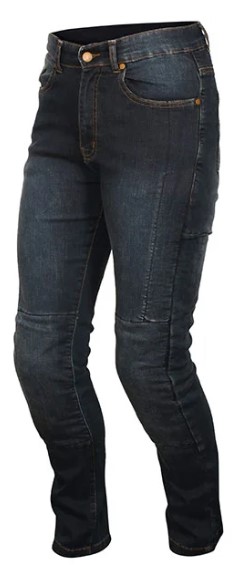 How one manufacturer managed to get that price to over £200 for a pair of motorcycle jeans is beyond me, but they did. Another manufacturer made it over the £300 price mark. Seriously. That is truly amazing work.
Back here on planet reality – The image is of a pair of Weise Tundra Demin Jeans with a 250g/m2 Aramid fibre lining. Typically you will pay less than £100 for them.
You can go cheaper if you wish. I found an advert on eBay for jeans – not motorcycle jeans – reportedly part lined with 320 g/m2 Kevlar for £40.
As much as £300 seems unreasonable, so does £40. Ignoring the obvious possibility of cotton dyed yellow and called Kevlar, what does part lined mean? Only across the backside perhaps.
Personally, I’d go with one of the companies who test their motorcycle jeans to a recognised standard. I hope I never test the abrasion resistance of my motorcycle jeans, but you never know.
Armour and Fit
Up to now, we have talked about abrasion resistance, which is what motorcycle jeans mainly provide. They stop you (hopefully) from getting road rash, should something unmentionable happen.
Impact protection in motorcycle jeans comes almost exclusively from slip-in armour, which will have its own CE rating. Typically there are two areas where the armour is installed – Hips and Knees.
To be effective, the amour has to be in the right place when it is time for the armour to do its thing. Buying a pair of motorcycle jeans with the armour in the right place when you are walking around may result in the armour being in the wrong place when you are hanging off the seat getting your knee down.
Ensure the armour is in the right place when you are sitting on the bike.

Next comes wrap-around. Low sliding tends to impact on the side of your legs, not the front. Pencil thin impact pads might have all the right certifications, but if they are not between you and the tarmac, what is the point of them?
I’m an average shape and size, and the pads on the Weise Tundra Demin Jeans are in the right place for me. Regardless of which motorcycle jeans manufacturer you choose, if the armour doesn’t sit in the right place, it is as good as useless.
Acknowledgements
The featured image at the top of this article is based on an image by Jack Atkinson.





One Response
This was a useful read. I haven’t paid much attention to those standards, but I should now. When I got my current jeans, the process was simple. Went to the local Dainese dealer – they are never cheap but their products’ quality has never let me down either – and got the one with the best fit. Could have shopped around I see.