


Compact & Weightless
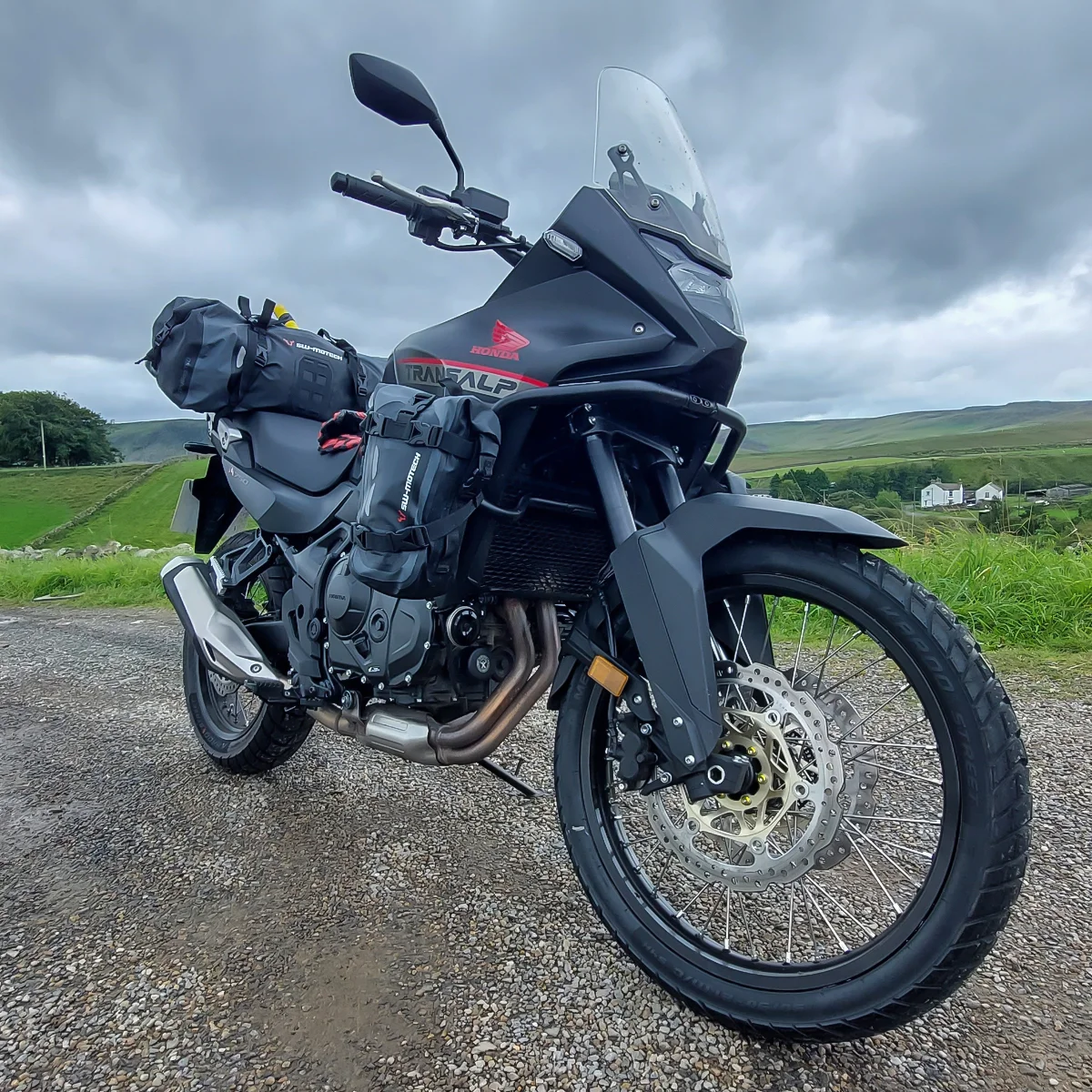
If you have ridden any of the litre-plus adventure bikes, the Transalp feels much smaller than the dimensions prove it is.
Get out the tape measure, and the Transalp has the same wheelbase as its larger sibling and is only 4 centimetres shorter. But in width, the Transalp has a much shapelier figure, having dropped 12 centimetres across the beam (838mm vs. 960mm), making the Transalp feel like a much more compact motorcycle.
Reducing the width has helped the Transalp drop 30 kilograms compared to the Africa Twin, with the XL750 tipping the scales at 208 Kg with a full tank of fuel.
Not being the tallest person in the office (5 feet 7 inches), the Transalp’s narrow waist lets me flat foot on both sides. Yet, somehow, the engineers at Honda have also made the Transalp a comfortable place for those 6 feet tall with size 12 feet (true that ~ Ed.), all of whom have been trying to wrestle the keys away from me.
Brakes & Chassis
The slimmer, lightweight Transalp has an agile chassis that, because I’m slowing 30 Kg less going into a corner and commanding 30 Kg less to change direction, lets the Transalp nip at the heels of higher-performance motorcycles through the twisties.
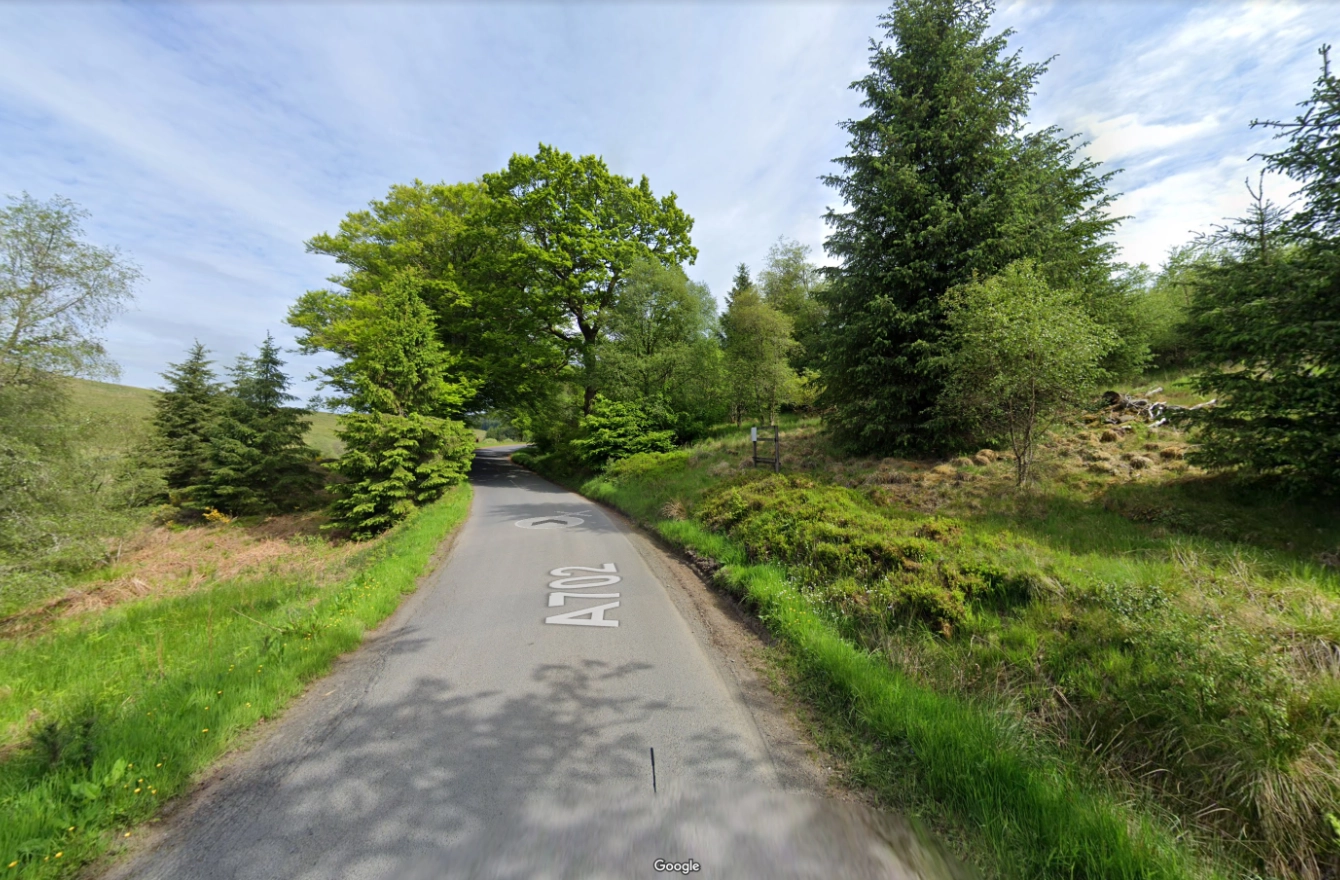
On the tight A702 run from Bogue through Castlefairn to Moniaive in Scotland, the XL750 Transalp was the bike to be on. Gentle pressure on the bars, trailing a little back brake into some corners, and working the throttle – thanks to the selectable engine braking – was all that was needed to keep everyone else in the Transalp’s wake.
The standard twin pot axial mounted Nissin callipers hauling on 310mm twin disks are more than enough to bring the Transalp to an abrupt halt if required and give decent feedback.
The rear brake took a while to find. The initial push on the pedal felt as if it should be enough, leading to comments about it being ineffective, whereas an extra push on the pedal was required if I wanted to coax the rear into positive action.
This could be due to the rear brake needing bleeding, but it didn’t feel spongy, just that longer-than-usual travel was required to push enough fluid through the system. Either way, the rear brake was effective – once I’d worked out how to get the best from it.
And if you are into slow-speed manoeuvring and completing tight U-turns in the road while everyone else is paddling their bike through a 3-point turn, you will love the Transalp.
The poise and balance of the bike at slow speeds encourage you to turn tighter and tighter until you discover that you have reached full lock and are happily going around in circles. Others may see the desire to ride around in circles as strange, but it is highly satisfying, mainly because you can do it, and they can’t.
Suspension
If I have a criticism of the XL750 Transalp, it would be the suspension. On smooth tarmac, there is nothing to complain about. The suspension supports the bike under braking, and there is no wallowing when cornering. But if you scuff up the road surface, the story changes.
On patched road surfaces, the suspension is quickly overwhelmed. It feels like a lack of progressive damping is the cause of the rough ride. If the suspension has to deal with a rapid succession of bumps, it fights the desire to return to its neutral position while also trying to compress as it absorbs the next bump.
The result is a tendency to wander and an increase in steering inputs to make the Transalp go where I want it to.
A well-known section of road on one of our Sunday rides across the Lincolnshire backroads has a flowing section of dips. Think of a series of waves coming to shore. Get the speed right – or wrong, depending on how you look at it – and the Transalps suspension will chase the up-and-down nature of the road.
The standard non-adjustable Showa front forks and the Honda OEM C spanner preload-adjustable rear mono-shock will get the job done for everyday riding, but if you plan longer or more adventurous journeys on the Transalp, consider budgeting for a suspension upgrade.
The Engine
The power delivery of the Transalp has divided opinion in the office. I’m firmly in the “Buy those engineers a drink” club, while the Editor – philistine that he is – finds the unobtrusive way the 755cc parallel twin propels you to naughty speeds, vanilla and lacking in what he calls character.
The same engine is used in the Honda Hornet, but the different-sized rear wheel on the Transalp alters the gearing and how you feel the power is delivered.
In the Transalp, the parallel-twin motor is low-revving compared to its rivals. It is never lacking in power, and if you are over 5,000 rpm in sixth gear, you best be checking the speed limit signs. Open the throttle to the red line and 3rd gear, and the maths indicate that you would be just shy of three figures.
Whether you like how the power is delivered or not is subjective. Does the XL750 Transalp have enough power to get you into trouble? Oh yes, and quickly, too.
Fuel Consumption
Seventy miles to the imperial gallon. Yes, 70mpg, and we were riding without considering how much fuel we would use.
Eight hundred miles (808 to be exact) on a mixture of Motorways, fast-flowing A roads, tight backroads and bumpy but flowing Scottish roads were ridden. In our calculations, we used the amount of fuel we put in the tank rather than the fuel computer on the Transalp, and 69.6 miles per imperial gallon was the final figure.
That puts the Transalp around 20% more fuel efficient than its rivals. Put another way, the Transalp rider will only fill their 17-litre tank four times for their rival’s five.
Electronics & Rider Aids
Usually, when motorcycle reviews talk about electronics, the conversation quickly turns to radar-controlled cruise control and IMUs. The Transalp has none of these, but it has all the controls needed to customise the ride to your liking.
There are three settings for Engine Braking, four for Power and five for Traction Control. As you might imagine, the first thing we did was to set all of these to maximum and go for a ride.
Pretty much, this worked out perfectly. The fuelling is smooth, and the power delivery is linear, so little can be gained from reducing the power output. The engine braking is a personal choice and set flat out, it blended sweetly with the throttle as I rolled on and off the power through the twisties.
The traction control needed to come down one notch from full as it would try to get involved when getting fully on the herbs on a dry road. Reducing it one notch didn’t produce any untoward riding characteristics; it simply stopped the traction control from getting involved when I opened the throttle hard.

The TFT display is pin-sharp, and the primary information is easy to find when you only have a few moments to divert your gaze away from the road ahead.
Like Yamaha, though, Honda appears to have forgotten the simple range calculation from all the data that can be displayed. Considering the planning and effort that must go into gathering and displaying all of the available information in several different forms (MPG – L/100 – Miles – Kms, etc.) I never understand how this simple requirement is missed.
I can tell you the average fuel consumption for Trip A, Trip B and overall. I can tell you how many hours I’ve been riding the Transalp, but I don’t know how many miles I can go on the fuel I have left – unless I do the sums in my head.
What’s Missing?
In truth, nothing. The Transalp is a well-rounded motorcycle you could collect from the dealer, strap a bag across the pillion seat and disappear on. Yet, inevitably, there are a few extras you might wish to consider.
As the Transalp uses Tubed Tyres, a main stand must be at the top of the list of extras to add. Getting the wheels out at the side of the road to change an inner tube will be much easier with a main stand, and yet this is the only accessory I couldn’t find available from Honda. As I write this, only SW-Motech appears to manufacture one.
Other than that, handguards – knuckle guards, as Honda refers to them – would be a welcome touch, as would heated grips. And in this day of modern electronics, a USB port as standard would be a welcome addition.
What Next?
I’ve been doing various calculations trying to determine what would happen if I traded my Africa Twin against a new XL750 Transalp.
Even with the added accessories – although perhaps not Honda-branded – I’ll spend less than £10,000 for a brand-new motorcycle that will burn 20% less fuel than my Africa Twin and stay with the pack on motorways, A roads and the twisties.
It is a tempting proposition. It is only money – what could possibly go wrong?







One Response
A nice read. Honda do supply a centre stand. I’ve got one on my bike as part of the urban pack but should be available separately. There is a usb-c socket under the seat in front of the rear light. Not the best place for it.