



With our invitation to both the launch of the Yamaha Tracer 9 GT and the Italian tour to launch the Bridgestone T32, obviously being lost in the post – what other reason could there be for not getting invited? – the only thing left to do was acquire our own and head for a week in Wales.
Truth be known, the Editor has had his eye on one since it was announced, and with the KTM1090 parked in the naughty corner while we argue with KTM over the warranty, getting our hands on a Yamaha Tracer 9 GT seemed the sensible way to keep riding – even if we did have to buy it.
As to which of the bikes is a keeper, we’ll have to wait to discover.
What follows is a diary of the first 1,107-miles on the Yamaha Tracer 9 GT and the Bridgestone T32 tyres.
When we started, the Yamaha Tracer 9 was brand new and had just three miles on the clock when I collected it from the dealer and headed cross-country to Wales.
The routes we used for the Road Test across Wales are on the Routes page. You can download them using the menu bar above or click here to go there directly.
If Wales hasn’t yet been part of your motorcycling history, it is well worth a visit. It has a reputation for an overt, no sympathy approach to speeding. Choose the right roads, and they will deliver an invigorating ride without risking an unwanted conversation with the occupants of the unmarked BMWs that were cruising around.
Day One – 223 Miles
Despite ordering a comfort seat, and a few other accessories, none had arrived in time, so Wales on the standard – park bench – seat was the only option.
For the first 100 miles, the seat was acceptable. For the next 50 miles, it was bearable, but the last 50 were getting painful. Other than that, first impressions of the Yamaha Tracer 9 and the Bridgestone T32s are that they make an excellent package.
Contrary to most people’s opinion, I’m finding the screen better than other stock screens I’ve ridden behind.
At 6 feet tall, it might be considered odd to have the seat in the low position, but I find this helps me fit into the compact design of the Yamaha Tracer 9. With the seat set low, I can slide further back, essentially making the bike longer.
As a bonus, my head is also lower behind the screen, killing off most of the wind turbulence.
Perhaps an MRA screen with the additional flip should be on the shopping list. Maybe the official Yamaha Touring screen is a better option. As I’m not finding the screen to be the nightmare some describe, decisions like that can wait a while.
The road conditions for the first 200 miles have been mixed. A few patches of sunshine, the occasional shower accompanied by wet slippery roads.
Being new to the bike and new to the Bridgestone T32 tyres there were no heroics. That said, the tyres were planted and didn’t moan, complain, twitch or slide, regardless of how slippery the road surface appeared.
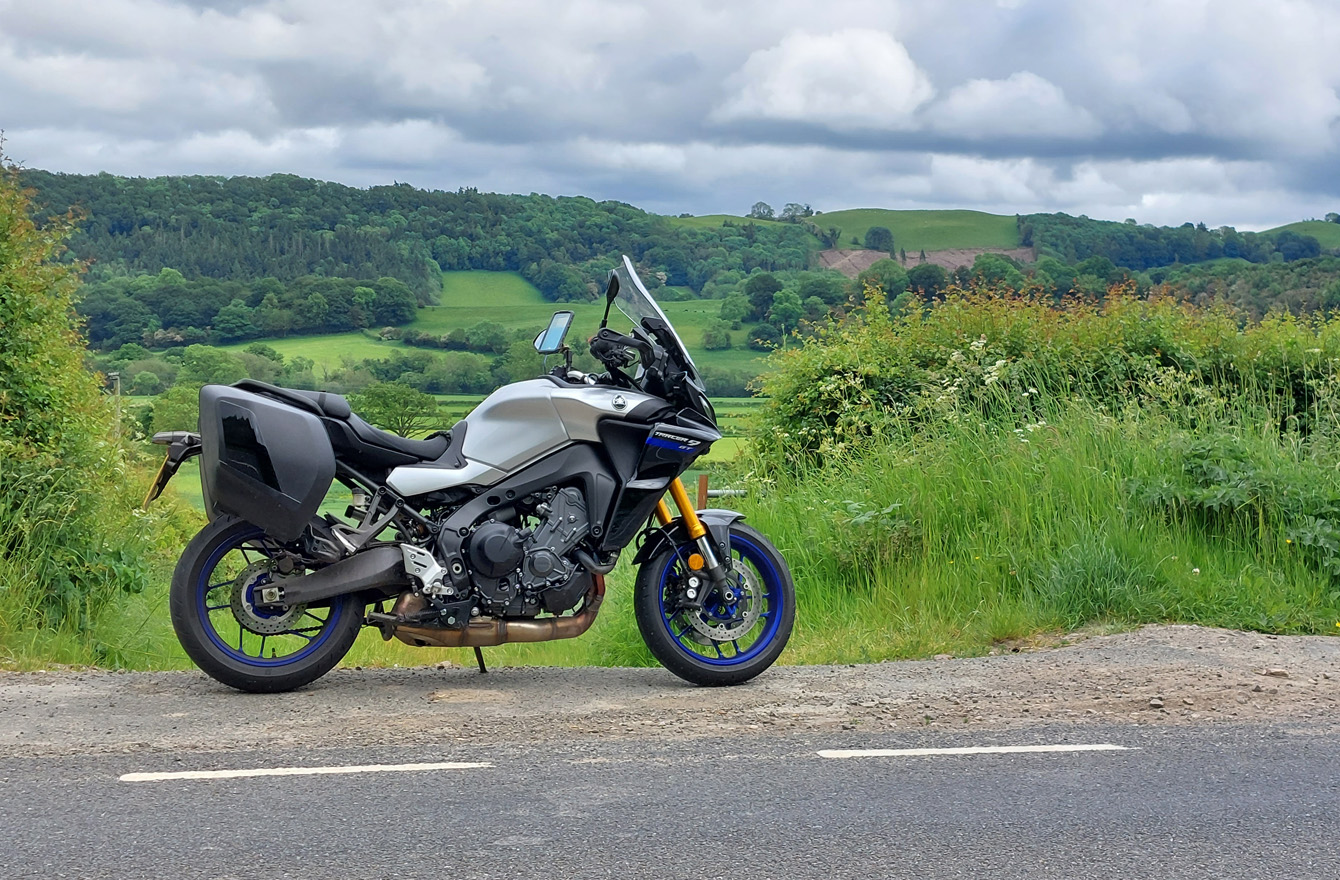
Day Two – 296 Miles (519 Total)
The roads in Wales are excellent. Some of the backroads get narrow in places, especially when crossing old bridges, but on the whole, the tarmac is good and the traffic light. There are numerous sections with solid white lines and areas where overtaking is for the brave or talented, depending on your perspective.
The engine on the Yamaha Tracer 9 is still tight, and yet even when staying under the 5,000 RPM limit, there are no issues overtaking slower road users. I’m just changing gear more frequently than anyone else.
Following the Wales Day 1 route from the touring section, the run through the Brecon Beacons was as impressive as always. We even remembered to stop and enjoy the scenery this time.
There is a blanket 40mph speed limit across the Brecon Beacon Road, which, having ridden it is understandable, due to both the nature of the road and the sheep.
Having spotted one of the fluffy four-legged pedestrians at the side of the road that was showing every intention of crossing in front of me, I’d already rolled off the throttle.
When the cloud-with-legs decided to bolt across the road, I was ready for it. The young sheep was fast, and there was never an issue until having reached the far curb, the dumb animal decided to make a 180-degree turn and return to the original side of the road.
There have been a few comments about the brakes on the Yamaha Tracer 9, and yes, they are not the sharpest, but they are very effective when you apply them hard, and the ABS is excellent.
Braking hard from around 30-MPH while travelling downhill and on a slight curve, the Yamaha brakes brought me to a stop surprisingly quickly.
The sheep, meanwhile, oblivious to my brake test, had scampered off across the hillside.
The standard seat on the Tracer 9 is an appalling travesty. I have no idea what Yamaha was thinking about when they designed it. At six feet tall and of average build, the seat has been getting more painful as the day wore on.
We have around 225 miles planned for tomorrow. It is going to hurt.
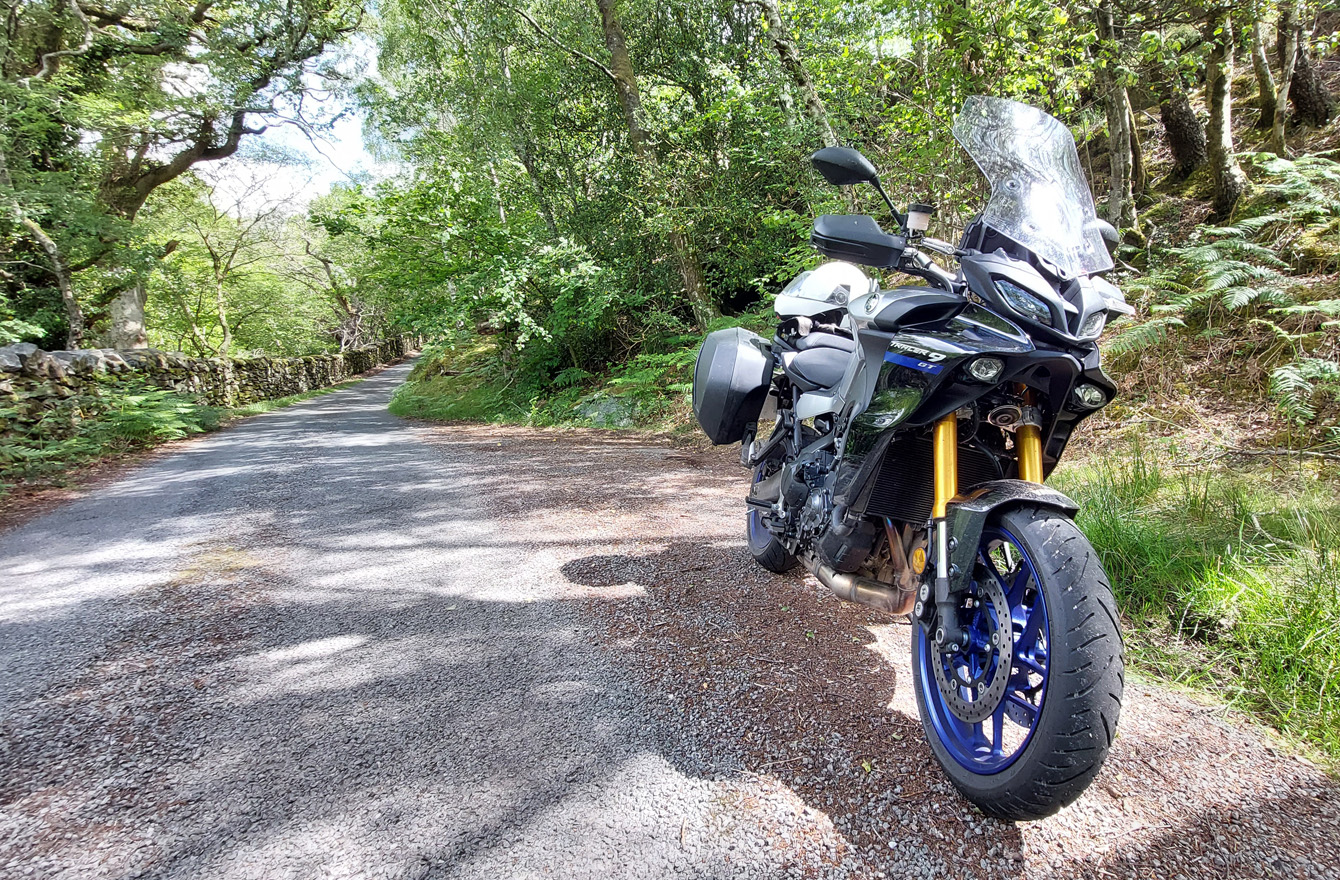
Day Three – 224 Miles (743 Total)
Today began with paracetamol for breakfast – a reminder of the church pew of a seat the Tracer 9 GT is fitted with.
Yamaha calls the motorcycle the Tracer 9 GT. GT as in Grand Tourer. With that seat, unless your idea of a Grand Tour is once a week to the local tea stop, the seat is going to need fixing.
The sarcasm from my colleagues is already in full flow. Yamaha claiming the title for the most uncomfortable seat from KTM, seems to be the most popular barb.
Today’s route across the Snowdonia National Park and then on to the Anglesey Circuit now includes a diversion to the nearest pharmacy for me to stock up on paracetamol. I don’t see me getting through the rest of this trip without chewing a few more of them.
Why Yamaha, why? What on earth were you thinking? How did you miss this obvious flaw in a Sport Touring GT model?
The remainder of the Yamaha Tracer 9 is a joy to ride. The engine is loosening up perfectly, and the chassis is agile, responsive and well balanced.
The fueling is impressive. Pulling away from a roundabout in 4th gear from just 20 mph can be done without complaint, even if the initial acceleration was not exactly remarkable. I’ve no idea why you would want to do this, but I tried it to see if I could be that stupid and rely on the Yamaha to get me out of trouble, and it did.
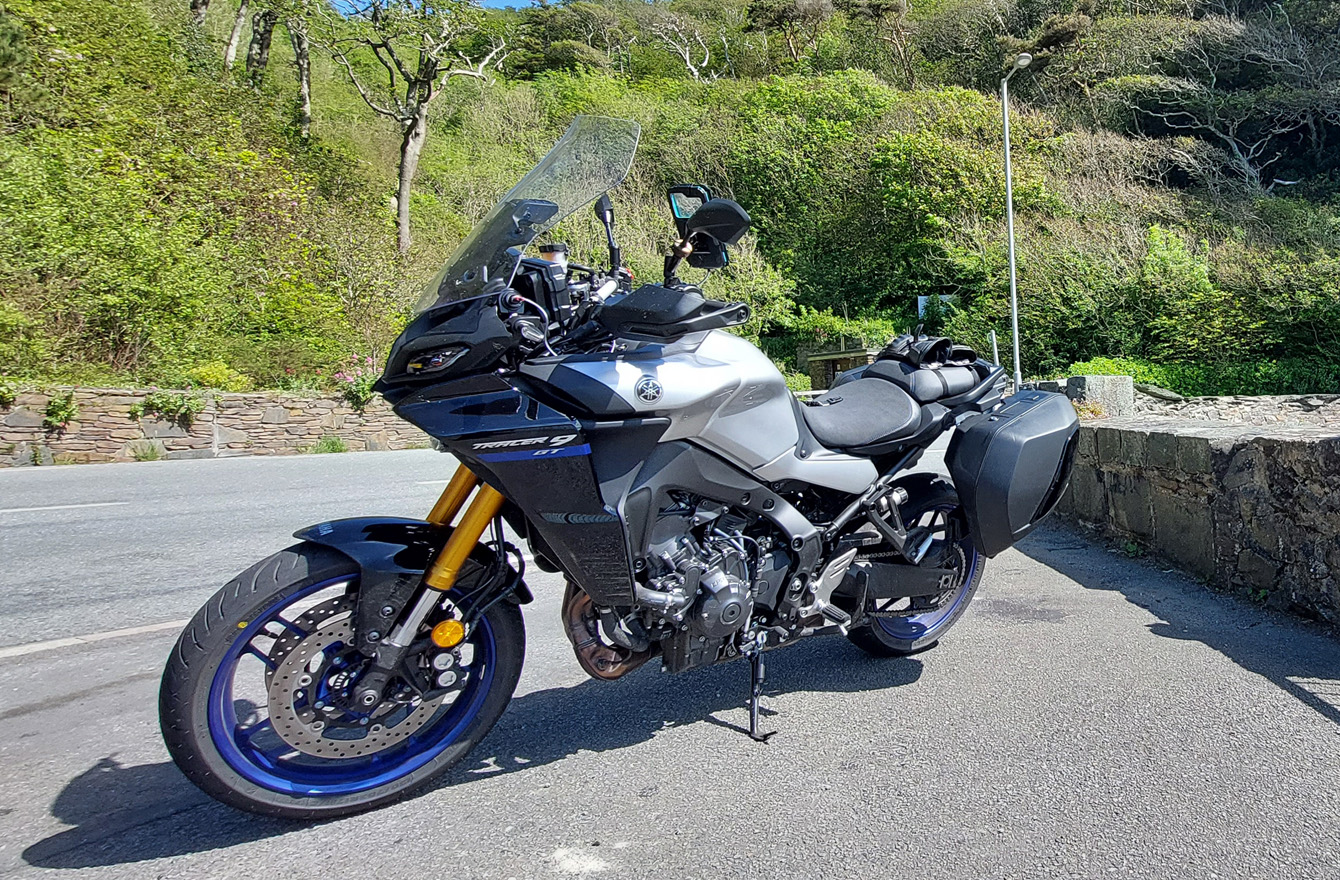
Day Four – 181 Miles (924 Total)
The paracetamol count is now up to eight.
As we are in Wales, we were not going to get away without some rain. Thankfully it wasn’t too heavy, but the showers are prolonged enough for those stylish enough to be wearing Kevlar jeans, rather than textiles, to dig out their rain suits.
The rain also brings the perfect opportunity to see if the Bridgestone T32 tyres step when crossing white lines in the wet.
The white line markings on the Welsh backroads don’t appear to have the years of paint layered on them, as the lines in Lincolnshire do. Nonetheless, the Bridgestone T32s are oblivious to the painted white lines as I cut back and forth across them in the rain.
The rear Bridgestone T32 has a new profile that gives a 13% increase in the contact patch, accompanied by a 6% increase in rain clearing grooves, which also come with “Pulse Groove” technology.
Pulse Grooves are a system of raised grooves within the tread that Bridgestone claim is a more effective way of pumping water from under the contact patch. I’ve not been sufficiently motivated with the throttle to have an opinion yet. Still, the front and the rear tyres have stayed perfectly inline regardless of the changing weather conditions and some semi-spirited riding.
The standard screen on the Tracer 9 is perfect – for me anyway – in the rain. At six feet tall, and with the seat in the low position, there is just the right amount of airflow onto my visor to blow the rain away.
The average MPG has been climbing every day and currently stands at 60.5MPG. Exactly what some of the other road testers have been doing to their Yamaha Tracer 9 engines to achieve a fuel consumption in the low 40s is puzzling.
The planned route home has more motorway miles included than I’d normally choose, but a road test has to include a balance of everything. After four days weaving through the Welsh backroads, perhaps motorway riding will kill the impressive fuel economy.
Despite my economic use of fuel, I have “enjoyed” or perhaps that should be endured, my first experience of the Yamaha fuel light.
Given the 19-litre tank and 60MPG, a sensible fuel range of 200+ miles between petrol stops is achievable. Even so, a fuel Range-To-Empty display for the dash would be a welcome addition.
For some reason known only to Yamaha, of all the fuel calculations they could do, Yamaha opted to ignore calculating Range-To-Empty.
When you run low on fuel, the fuel light comes on, and a counter showing how far you have travelled since the light came on begins to count up.
If anything was going to feed your fuel anxiety, it is watching the miles tick by as you head toward civilization in the hope of finding a petrol station.
I could see the logic in this if the fuel gauge was more accurate. Burning half a tank of fuel does nothing to move the fuel gauge.
Once half the tank has been used, you have three bars to indicate the remaining fuel level. On the assumption that the bars are linear, each bar represents three litres. When two of the three bars are gone, the fuel light comes on, and the paranoia starts.
Whereas this design feature isn’t as bad as the seat, I did once again find myself thinking, Why Yamaha? Why? Every other bike I know has a range-to-empty display. There is trying to be different and being stubborn. This feels like the latter. Would there be any chance of a software update Yamaha to include a Range-To-Empty display?
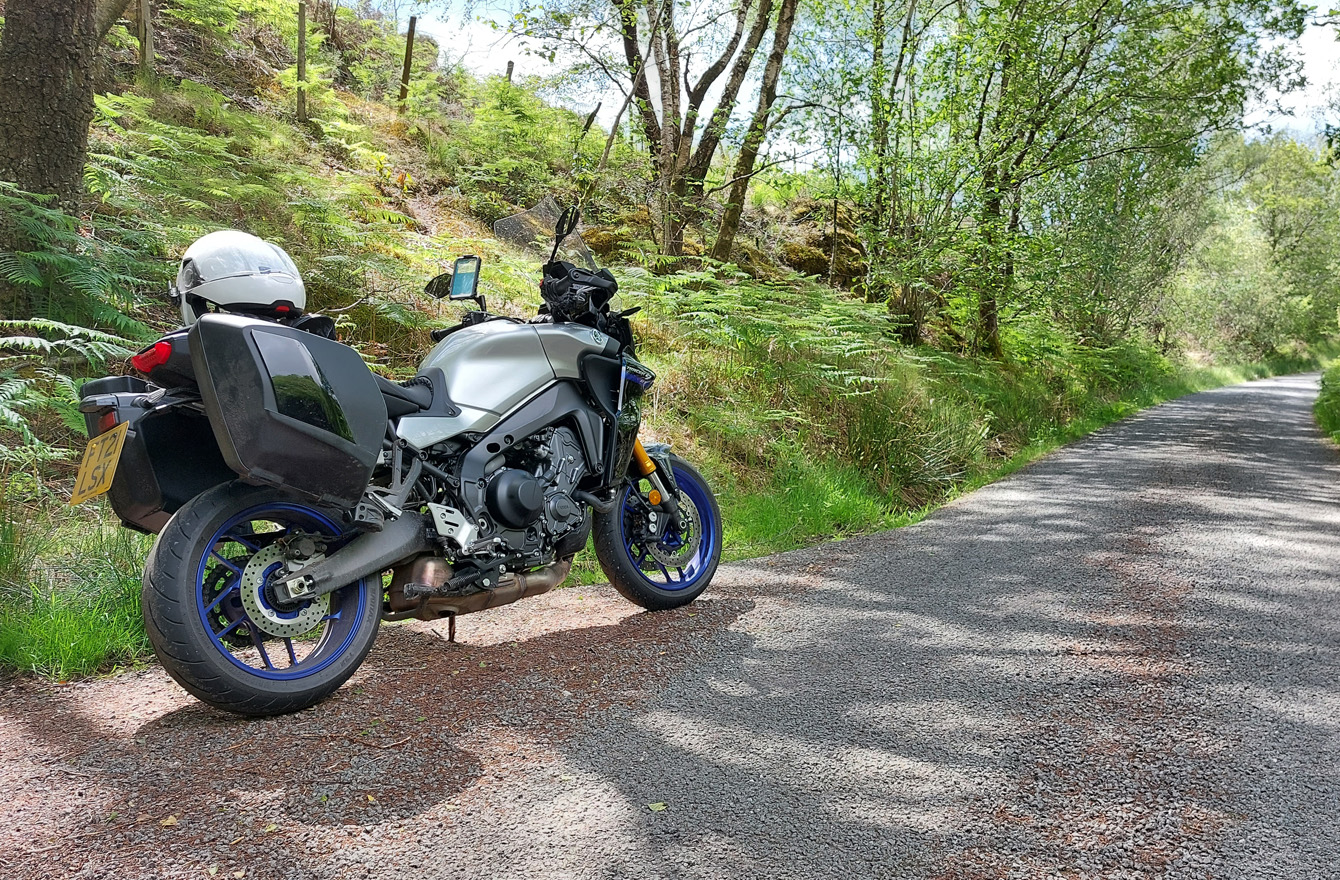
Day Five – 183 Miles (1107 Total)
Day Five started with a visit to David Jones, the Yamaha Dealer in Newtown in Wales, for a belated first service. Talking after the service as motorcyclists do, I mention the seat, and the technician suggests that moving the bars forward may ease the pressure on my backside.
We get to fiddling, and after five minutes of tweaking the bars and adjusting the levers to achieve a straight wrist position, and I’m off back to England.
The adjustments make the ride home more comfortable, yet I can’t complete the 160-mile journey without two stops. Perhaps the altered bar position and the comfort seat will be the answer I’m looking for.
With the first service completed and 1,000 miles on the odometer, I gradually start to increase the RPM as I travel across England. I was enjoying the engine, even when I was running it in. With the increased RPM that is now available, I can tell that the Yamaha triple and I will be very good friends.
As the miles tick by, it occurs to me that I haven’t mentioned the suspension. Having set SUS-MODE 2, the comfort setting, when I collected the Tracer 9, I had already decided it was too soft for me and switched to SUS-MODE 1 (Sport).
Since then, I’ve not touched it other than to take two or maybe three turns of preload out of the rear.
The Yamaha changes direction beautifully with the standard suspension settings, and I can change line mid-corner and filter through traffic with equal confidence. It is a well-balanced, sweet steering agile motorcycle.









2 responses
I’ve just had a ComfortAir delivered for an upcoming trip to south-west Scotland 🙂
This was a joy to read and I really appreciate that the article highlighted the actual merits and shortcomings of the bike instead of your usual “technical specs – praise – flaw but not really – the end” motorcycle journalism.
What I also learned that paracetamol is good for saddle sores. The saddle of my GSX-S1000 is more forgiving, but the 700+ kilomteres – 430 miles – of first day ride I did last year on the first day of my trip greatly redesigned the rest of the tour. I invested into an Airhawk infaltable cushion to cure this ill. Felt good on a 200km trip, but we’ll see on the longer rides I plan later this month.