The Triumph Street Twin is washed, polished, full of fuel and sitting on the driveway, awaiting collection by Triumph.
I’ll be sad to see it go as we have had a memorable week together. Yet like short but powerful romances, the break-up was always going to happen. And in true holiday romance style, it’s not you Street Twin; it’s me.
At six feet tall and with the Street Twin having a seat height of 765 mm, I’m about three inches too tall for the Street Twin. This hasn’t stopped me from proving what a versatile, smile-inducing, sweeping “A” road loving motorcycle it is. Yet, the truth remains that I have found it a little cramped on longer days. Perhaps the 1200cc Speed Twin, with its 807mm seat height, would be a better fit.
According to the highly informative cycle-ergo.com, my knee bend angle on the Street Twin is 74 degrees, 11 degrees tighter than on a Royal Enfield Continental GT, albeit at the cost of more weight on my wrists.
But none of that is the Street Twin’s problem; in this case, unlike the corny line, it truly is me and not the bike that has the problem.
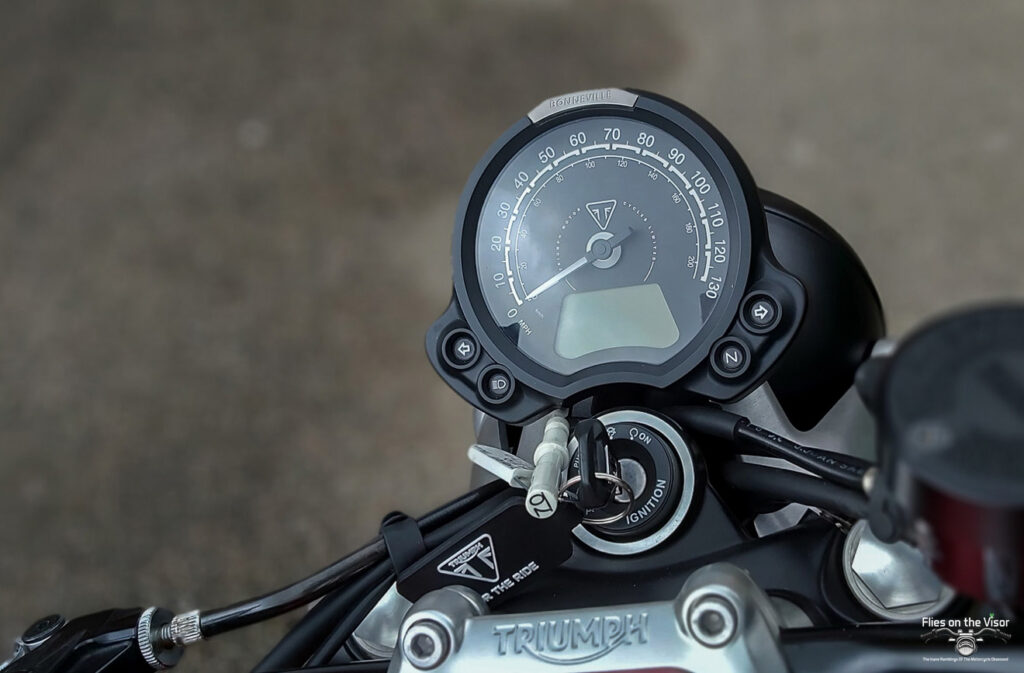
In every respect – purchase price, running costs, flexibility, power, brakes, build quality, fuel economy, handling – the Triumph Street Twin is an absolute delight. I am going to miss it.
To judge the flexibility of the Triumph Street Twin, my colleagues set me three challenges. Commute into a city, go for an invigorating Sunday ride and ride 200 plus miles in a day, including time, sat munching miles on a motorway. [See Sweet Spot Street Twin]
I’ve done all of these things and more on the Street Twin, and whereas it isn’t perfect at them all, I’ve proven that the Triumph is a more flexible and adaptable motorcycle than it is often given credit for.
I’ll get into the detail in a moment, but as a naked, 900cc, 65HP motorcycle, it isn’t the best option for long-distance touring. Riding the Street Twin around Spain would be a blast, but getting to the Ferry would be a chore. The Street Twin wasn’t designed for that. It can do it, but for that one job, there are better options.
And now I’ve given away the ending, here are the details.
The Commute
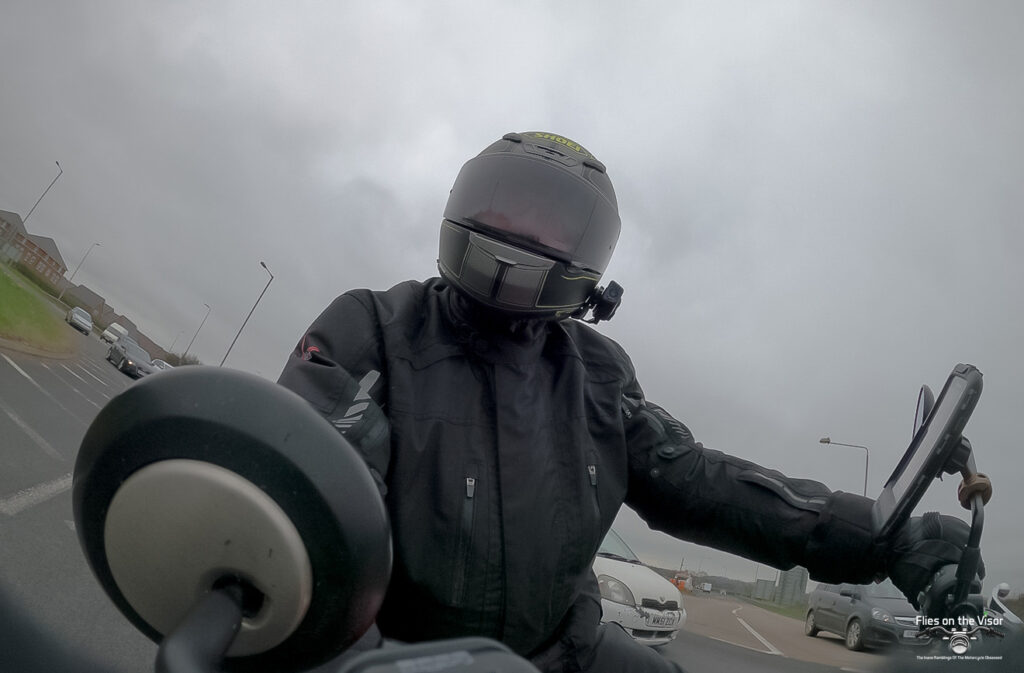
The Street Twin’s smaller size made the commute into the middle of Nottingham, during rush hour, an absolute breeze. With nothing sticking out further than the end of the handlebars and with a short wheelbase (1450mm), I could weave between the cars without worrying about the backend. Getting towards the front of the queue was never a problem, even if I got a few dirty looks from the drivers stuck in the traffic.
Once at the front of the queue, the Street Twin’s perfect gearing combined with the highly tractable engine (65BHP and 80Nm torque) makes leaving the cars behind effortless.
It is entirely childish, yet the tall first gear combined with the smooth torque makes departing from the lights effortless, thoroughly satisfying, and unlikely to attract unwanted attention. You simply feed out the feather-light slipper-assist clutch, introduce half the throttle and you are gone.
By the time the cars are looking for their second gear, you are 50 meters away doing 40mph.
The Sunday Scratch
Had the KTM 1290 that accompanied me across the Lincolnshire Wolds decided to get gone, there was no way I was going to catch it on the Street Twin. The question was, could the Street Twin put a smile on my face while keeping in touch with the other riders on an average Sunday ride.
That, the Street Twin can most certainly do.
Having 65BHP rather than the 130+ of the KTM, I had to put in more effort, making the returns all the sweeter. The Street Twin is an easy bike to ride, and as long as the tarmac is somewhere near smooth, the handling is assured and predictable.
For the £8,000-ish price tag, you get non-adjustable 41mm front forks and twin rear shocks that only have preload adjustment. Most days, this is more than adequate, but some of Lincolnshire roads are very much the worse for wear. Some have so many patches that there is no original road surface left.
On one of these roads, near the village of Digby, there is a succession of waves in the tarmac, along with several places where the road surface has heaved, leaving 4-inch high scars in the road surface.
If you want to know how good your suspension is, this is the road to test it on.
This part of our Sunday ride made the Street Twin very uncomfortable. Pogoing up and down while the front was tram lining the grooves in the tarmac made me more of a passenger than the rider. It is an extreme test, but it does indicate that the Street Twin has limits.
Switch to the smooth (ish) tarmac from the town of Alford back to Lincoln, via the road past Cadwell Park, and the Street Twin was constantly urging me to be a very naughty boy. The long sweeping bends and the tighter corners were just a delight to ride.
And was that just a few yards I noticed I’d pulled on the KTM coming out of some of the slower corners? It can’t have been. And if I did, it didn’t last long. 65, verses 130. I lose.
The Touring Day
It is a naked motorcycle. There isn’t much more to say. As you can see from the video, the Street Twin’s 900cc motor produces more than enough power for 70-80MPH motorway riding.
Exactly how much fun that ride would have been if it was throwing it down with rain is a different story. It is a naked motorcycle. I knew that when I started, and as with my height, that isn’t the Street Twin’s problem. As they say in Germany, “Es ist wie est ist” – it is what it is – a naked motorcycle.
70mph for me was the sweet spot. With a few changes to my normal riding position to balance against the wind, the miles on the motorway (the A1, to be exact) drifted along while listening to the music playing through the Sena 10C Evo. Yes, even with my head stuck out in a 70 MPH breeze, listening to music is still possible.
As the week has gone by, I’ve noticed that I’m feeling the size of the Street Twin less and less. 212-miles has been the longest distance I’ve covered in a day, which was a mix of motorway miles, tight country lanes and lots of open road sweeping bends.
Could I have doubled the distance? If I changed the roads I used for soulless arterial roads, then yes. Would I want to do it three or four days on the bounce? 350-400 miles each day? No, that would be too much. How about repeated days of around 250-miles on decent backroads? Oh yes, that would be perfect, thank you.
Highs and Lows
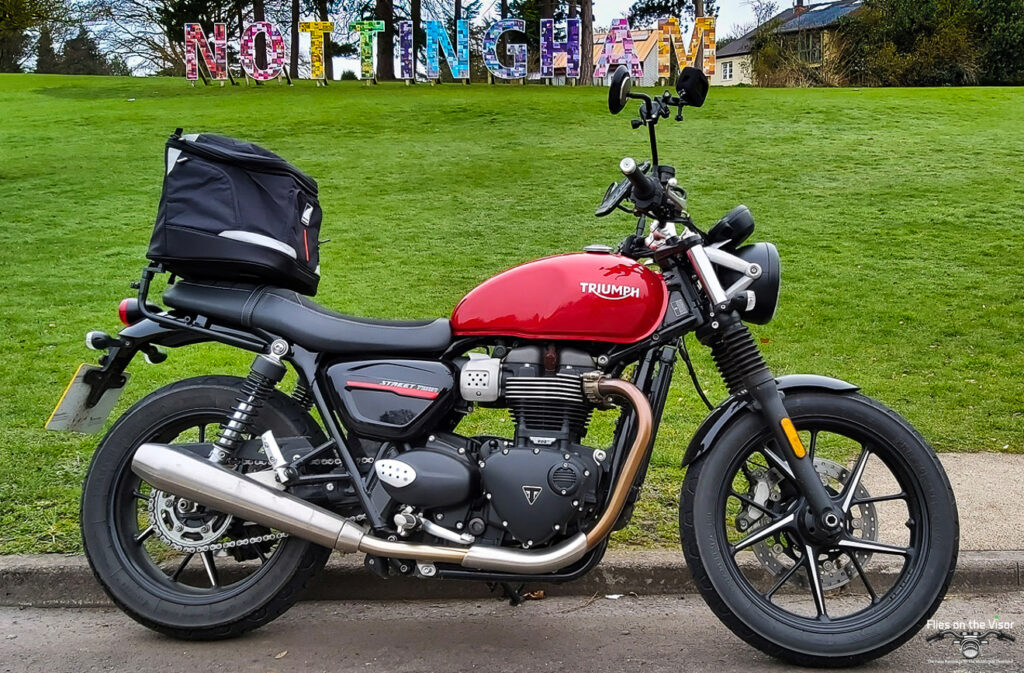
High: Brakes. The single 310mm disc on the front, with a four-piston – twin pot – Brembo caliper is progressive and has more than enough bite to stop me and the 200Kgs Street Twin very quickly. Backing up the Brembo is a 255mm disc with a Nissin single pot, twin-piston caliper on the rear. Both with ABS to help keep me out of trouble.
Low: The 12-litre tank. It is in perfect proportion to the rest of the motorcycle and matches the retro-styled theme with its offset circular filler cap. Yet, when wagging across country, the 100-mile range before the fuel light comes on can be annoying.
High: The exhaust note. The 270-degree firing order gives the Triumph a distinct, crisp exhaust note with just a hint of burble on overrun.
Low: The absence of a centre stand as standard. Unless it is a sports bike, every motorcycle should have one.
High: Heated Grips. They don’t come as standard, but the factory heated grips on the Street Twin are epic.
Low: Standard Mirrors: After a lot of finessing, the view behind is just about adequate. You can see the amount of elbow retraction and head movement needed to get a decent look behind me in the video. Anyway, bar-end mirrors would be thoroughly in keeping with the retro-themed looks.
High: Fuelling. The fly-by-wire throttle keeps the demands for fuel pin-point accurate, and when blended with the high torque engine the Street Twin is silky smooth. Should you experience any lumps in the petrol, it will be due to a lazy over-reliance on the tractable 900cc motor. Not that I’ve experienced this, you understand. I was always in the right gear. Honest.
Low: Side stand access. With my size 11 feet and RST boots, I have to lift the footpeg out of the way with my heel to get to the side stand.
High: Build Quality. Its a Triumph. Do I need to say more? Everything just works and has a robust quality feel.
Low: There are a few signs of surface corrosion where the exhaust diverts into the catalytic converter. This spot is directly in line with the front wheel, and knowing some of the journalists that have had the Street Twin before me and their aversion to cleaning motorcycles, perhaps some TLC is all that is required.
Bottom Line
The question that always comes up is would I part with my own cash money for this bike? And yes, I think I would, with a couple of caveats.
The Triumph Street Twin is a versatile all-rounder, but its sweet spot is country lanes and town riding rather than long-distance touring. Considering the amount of time I spend touring on a motorcycle, for me, the Street Twin would be a delightful indulgence.
That motorcycle I’d keep for days when the sun is shining, and the backroads or the A93 Cairngorms road need to be ridden.
The oversized adventure bikes, hyper-nakeds and sports bikes would all arrive before me. Nonetheless, the Triumph Street Twin proves that you don’t need 200BHP, a six-axis IMU and W rated super sticky tyres to have the biggest grin.