A wise man once told me there were two types of motorcycle jackets. Those that keep out the rain and those that don’t. The same gentlemen did then put a bin liner on to keep the rain out of his – I assume – leaky jacket, so perhaps he was half right.
A lot of years have passed since that damp and soggy Bank Holiday Monday in Southend-on-Sea. Since then, motorcycle jackets and most every other aspect of motorcycle clothing have changed significantly.
We now have single and multi-layer laminates, drop liners, airbags and even jackets that are 50% holes and still easily meet the CE AA standard. Despite all of the advancements, the basic requirements for motorcycle clothing remain the same.

The difference is in how modern motorcycle clothing delivers on these requirements. Gone are the days of waxed cotton jackets and bin liners as your only options.
But, if you are going to invest in motorcycle clothing, you will need to know your drop liner from your laminate and your denier from your Dry2Dry, to name but a few of the terms thrown about by the marketing departments.
Let’s get into it.
Denier Ratings
The denier number, perhaps most commonly associated with ladies’ stockings, refers to the weight in grams for 9000 meters or 5.59 miles of that material.
 Whereas stockings may be 10 or 20 denier, the number is typically in the hundreds for motorcycle clothing and not uncommonly in the low thousands for luggage.
If the numbers sound odd for something so long, fabrics are woven from strands of the material. The term “denier” is a measure of weight for 9000 meters of a single strand of the material.
Denier isn’t a measure of strength. However, there is a loose association between the higher denier numbers for a strand of the same material and their greater protective ability, generally, because they are thicker.
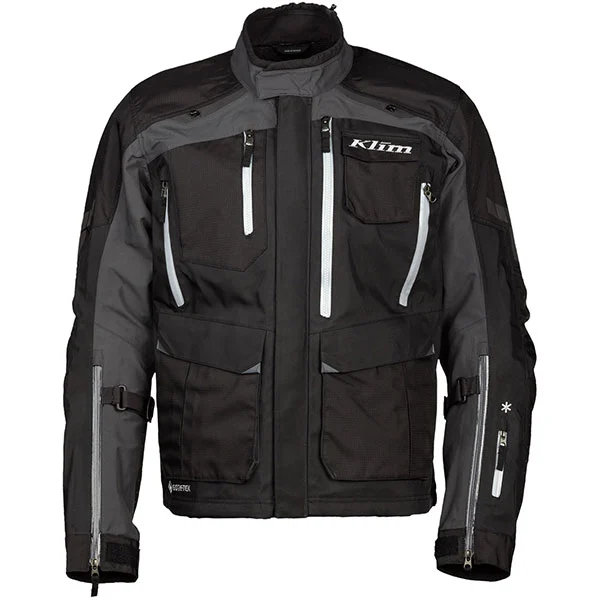
Klim, for example, uses 630 denier Cordura twisted yarn (the fabric) overlays on the shoulders and elbows of their Carlsbad Gore-Tex Jacket.
As a rough guide, a motorcycle jacket made from a material with a 600-denier rating can be considered as being tough and durable. It isn’t an absolute, but a good measure to have in mind.
Waterproof
Nothing to do with denier numbers will make motorcycle clothing waterproof. For that, there must be a waterproof barrier – membrane – between you and the rain.
 Several different waterproof membranes are available, with Gore-Tex being the most well-known. Naturally, the membranes all have different advantages, but the core principle remains the same.
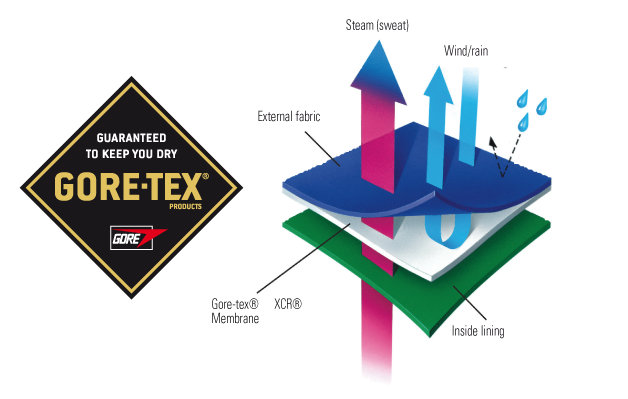
The waterproof membrane is full of holes. Thankfully these holes are so small that water doesn’t pass through them, but not so small that air can’t pass through. This way, the water is kept out while air can still circulate – referred to as being breathable – so we don’t all end up smelling “ripe” or drenched in our own sweat.
Gore-Tex and Other Membranes
Gore-Tex® is arguably the best-known and the best-performing waterproof membrane. Gore – the parent company – is fastidious about how their product is used. If the garment says Gore-Tex, it is going to work.
Technically Gore-Tex is a microporous membrane of polytetrafluoroethylene (PTFE). It is 0.025mm thick with around 1.4 million pores per square centimetre. Gore-Tex® is waterproof, windproof, and breathable.
 Sinaqua® is RST’s waterproof membrane and can withstand a hydrostatic head pressure of 10,000mm/cm², which means the membrane would not allow water through even if a 1cm² column of water, 10 meters high, were placed on it. The ISO standard (811) for waterproofing is a column only 1.5 meters tall. Sinaqua® is waterproof, windproof and breathable.
D-Dry® Reportedly, Dainese developed their D-Dry membrane while working with Nasa on space suits. However, as there is no atmosphere in space, there are only claims of D-Dry being waterproof and breathable.
Drystar® is Alpinestars’ own waterproof and breathable membrane.
Dry2Dry® is Oxford Clothing’s membrane and is used in the popular Mondail range of laminated Oxford Clothing. Waterproof, windproof and breathable. The hydrostatic head rating is stated as 5,000mm/cm².
Drop Liner
The difference between laminated jackets and drop liners is that the drop liner is only attached to the jacket in a few places. Essentially, it hangs down between the outer shell and the jacket’s inner lining.

This has the distinct advantage of adding another layer between you and the outside air in winter. The downside is that the vents on the outside of the jacket can’t let air through to your body in summer as the drop liner is in the way.
But the big disadvantage of a drop liner is that the jacket’s outer shell must be soaked before it can do its job. A soaked jacket is heavier and colder thanks to evaporation and will take longer to dry out once you reach your destination.
After a day in the rain in Spain, my RST jacket took two full days to dry out. This was the point where I decided to invest £25 in an Oxford Rain Seal All Weather Over Jacket.
It would have been the perfect answer to that day in the rain. But, sometimes, I am so dense that I need to learn the lesson the hard way before doing the sensible thing.
Drop liner jackets are great for light rain, but if it is going to be a prolonged soaking, use the Oxford Rain Seal over your drop liner jacket. You’ll not only be dry and warmer, but you also get to be the one who is not complaining about the rain. Priceless.
Laminate
The term refers to how the waterproof layer is attached to the outer shell of the jacket or trousers. The waterproof membrane is laminated (stuck) to the outer shell stopping water from penetrating.
Along with stopping the outer shell of the jacket from getting soaked, this has a significant advantage when wearing the jacket on warm days. As the waterproof membrane is bonded to the jacket, the ventilation zips open both the jacket and the membrane, allowing fresh air directly to your body.
Top-of-the-line laminated jackets will have three bonded waterproof membranes laminated to the jacket’s outer shell. Two membrane jackets are more common. In everyday use, the only difference between two and three-layer jackets is the stiffness.
 If you are a high mileage, all-day, everyday rider, then three is the way to go. For most of us, two layers will keep us dry. That said, if you have the brass (money), go three layers.
The more layers there are, the higher the cost. It once was that even the most basic of laminated jackets would cost significantly more than a drop liner jacket. Today that doesn’t hold true.
Dry2Dry® range of Jackets costs less than £300, and an FLM laminated Touren Jacket costs £150, which is quite staggering.
There will be differences between Oxford, FLM and a Klim or Rukka jacket costing significantly more. The value for money decision I’ll leave to you.
The Paradox
Well, there are two paradoxes to deal with. The first is that washing your jacket helps to keep it waterproof. This is because the dirt and dust clog the material and the membrane creating a path for water to follow. Strangely, soaking your jacket in clean water helps restore the waterproofing.
The second paradox is that in winter – when it rains more – you want the added warmth that comes with a drop liner. In summer – when it rains less – you want the better ventilation that comes with laminated jackets.
All of which is the wrong way around for rain protection. Bugger.