Even if it does involve the wonderfully named “Nikwax Tech Wash” talking about washing a motorcycle jacket isn’t the coolest of topics.
As motorcyclists, we wish to rebel, even if it is only a little. If this wasn’t true we would play golf and go to cheese and wine parties in Seven Oaks.
This rebellious streak is how I found myself covered in road crap at the end of a recent ride and why washing my Helite Airbag Touring Jacket jacket and Oxford trousers was undeniably required.
I wasn’t exactly rebelling as I trudged towards the washing machine, and I’m not going to start a conversation about this at the next tea stop, so let’s keep the rest of this between us, shall we?
UPDATE: Originally, his article mentioned SDoc100 Wash, which is no longer manufactured. As everything else in the article still holds true, we looked for a replacement and found Nikwax Tech Wash to be an excellent alternative. The added bonus is that the current price of Nikwax at SportBikeShop is lower than S100 Technical Wash was.
Why?
A few days ago, work took me across Lincolnshire, and because of where I was going and the inevitable traffic jam, I opted to go on the KTM. It is never a tough decision to go by motorcycle, even if it is raining. What made me think twice was the state of the roads.
 As we leave winter behind for warmer temperatures, there is that layer of ground-up rock salt left behind from the gritting. Every time it rains, the rock salt dissolves and spreads across the road.
When the rain dries, the rock salt powder is left behind as that layer of light brown dust, just waiting for it to rain and the cycle to begin again.
Add to that the mud dragged out of the fields, which seems to be more prevalent this year, perhaps due to the reduced traffic volumes. Add in some rain to make this extra disgusting on my 100-mile round trip, and I was going to get filthy.
Was it worth it?
Of course, it was. When is riding your motorcycle never not worth it? However, the level of filth exceeded my worst expectations.
The traffic on the A17 in Lincolnshire on a weekday is mainly lorries. The size of your average lorry means that they churn up and spray about a lot more dissolved rock salt, mud and water solution than your average car or motorcycle.
It isn’t their fault; it is physics. Moving something that large through the air that has bigger tyres and more of them results in spray and turbulence. Mind you, the oversize 4x4s on the A17 were also doing their fair share of muck spreading.

By the time my 100-mile trip was complete, the KTM and I were both covered in a mixture of liquid mud and rock salt.
For the KTM, the answer is easy. First, wash with Fuchs Silkolene and then two foam baths. Rinse well. Dry and then cover in Scottoiler FS365. Finish off with some WD40 on the wiring under the seat. I must have done it 100 times by now.
For my textiles – which needed a wash anyway, to be honest – the road slime made avoiding the trip to the washing machine impossible.
Like washing the bike, washing my motorcycle jacket is a known activity. Remove the linings, armour and airbag. Check the pockets are empty, and then throw the jacket and trousers into the washing machine at the recommended temperature. Just remember NOT to use ordinary washing powder.
In the same way, as some motorcycle cleaners can damage your motorcycle, the same is true for washing detergent.
Restoring Water Proofing
Whereas having super clean textiles might not match the “adventure look” I’m going for, road grime can start to destroy the laminates, waterproof membranes and coatings that keep the rain out. Road grime isn’t just dirt; it is a solution of chemicals, including a weak solution of hydrochloric acid, oil, fertilizers and a bunch of other things.
The dirt can also block the material’s pores and provide a path for the water to follow. If you are yet to have that sensation where that first trickle of cold rainwater finds its way in through your jacket, trust me, it isn’t pleasant. Washing the dirt and road grime out removes the path the rainwater follows while also helping to protect your textiles from long-term damage.
Washing a Motorcycle Jacket
If all washing detergents were the same, companies would not continue to invest so heavily in research to improve their products.
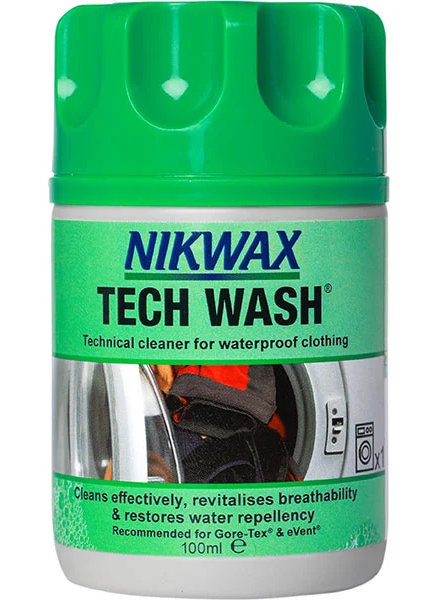
Nikwax innovates and develops all its products at its facility in the South East of England.
The team of dedicated chemists and product developers ensure that Nikwax’s products offer high performance whilst having a low environmental impact.
Nikwax also operates a Chemical Management System which ensures that all chemicals they use in their lab comply with The Zero Discharge of Hazardous Chemicals Foundation (ZDHC) guidelines.
I get that talking about washing a motorcycle jacket isn’t the most enthralling topic, but our motorcycle gear isn’t cheap, and we ask a lot of it.
We expect it to keep the rain out and to keep us warm, so it isn’t unreasonable to show it a little love every once in a while. Especially when the hardest thing I have to do is unzip the linings and take out the body armour.
Fabric Conditioner
Whereas fabric conditioner might be a good idea for your T-Shirts – bought from our Epic T-Shirt Shop naturally – fabric conditioner works by attaching itself to the material’s fibres, which is what the dirt was doing.
Besides, if you are concerned that having clean textiles might damage your street-cred, arriving at your favourite tea stop smelling “lavender fresh” certainly will.
Skipping the fabric conditioner is the way to go.
After a day of drying out, my wonderfully clean textiles are once again hanging in the garage, where I’m hoping some of the garage smell will soak into the material and partly restore whatever street-cred I may have had.
Clarity
The header image is based on a photo by Oli Woodman and is used under license.