



The early morning temperatures are finally low enough for me to check that all of my Keis Heated Clothing is working. I’ve never seen the point of being cold on a motorcycle, and this year isn’t going to be any different.
Happily, all my Keis heated clothing – body warmer, gloves and insoles – are still working for what must be the third or is it the fourth year I’ve used them. A 30-mile road test, cooking on gas mark six, was all it took to prove everything was ready for another year riding through winter.
The downside to the longevity of my Keis Heated Clothing is that there are updated versions for some of the items that I have, but none of the Keis clothing will break and give me the excuse to replace it.
Motohaus the distributor of Keis Heated Clothing, took pity on my plight and sent me a pair of Keis Heated Socks to try as an alternative to the Keis Heated Insoles that have kept my feet toasty for at least the past three winters.
The Science Bit
No matter how many layers you put on, you can only slow the rate at which you get cold on a motorcycle. To maintain your temperature, you need to add heat, which is what Keis Heated Clothing does.
I’d tried several different methods to keep my feet warm. One year I even bought a cheap pair of boots that were a size too big so I could wear an additional pair of extra-thick socks. But, unfortunately, my feet still got cold.
Buying a pair of Keis Heated Insoles was my first introduction to heated clothing and proved the science behind needing to add heat if you want to keep warm.
Keis Heated Socks
The heated insoles are about the same thickness as a normal pair of boot insoles – the ones you might add to stop your feet from getting too ‘funky’ through summer.
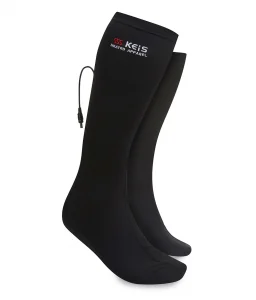 Heated socks that are the same thickness as the insoles would never work, but thankfully the micro carbon fibre and micro-alloy heating technologies that Keis have been using for the past couple of years makes all sorts of new solutions possible.
My new Keis Heated Socks are thinner than a pair of thick wool socks, and whereas I can feel the micro-alloy heated elements in the material, I never noticed the heating elements at any time through the day.
The power leads are towards the top of the heated socks and easily clears the top of my RST boots. I think a trip to SportsBikeShop to see if any of the taller adventure boots cover where the power leads exit the socks might be needed. I’m sure Keis did their homework on this, so really this is just an excuse to go for a ride.
After all, the leads from the heated insoles run inside by boots, and I’ve never had a problem with them. It only takes a couple of extra seconds to ensure the power leads aren’t anywhere I can feel them, so I can’t see the Keis Heated Socks, where the power leads exit above the top of my boots being a problem. Of course, coming home with a new pair of boots might be a problem, but that is a different story.
Do I have Warm Feet?
Yes. It feels like I should have something more to say, but that is the answer.
Rather than enduring cold feet, oversized boots and bulky socks, I wear normal everyday socks and then my Keis Heated Socks over the top. Everything fits easily inside my regular boots and, and I have delightfully warm feet.
We don’t question heated grips. Some of us use heated gloves. So why ignore your feet?
Clarity
The author is a member of the #KeisInspiringRiders Team and an absolute convert to heated clothing. He cannot comprehend why you would ever choose to be cold on a motorcycle.
The title image is based on an original work by Paul Henry Degrande and is used under license.










One Response
I too am a convert to heated kit, it’s warmer than layering up, and without the bulk. I have heated inner gloves, and I used to have a keis premium vest, but it has been commandeered by my partner along with the battery pack and I don’t fancy my chances of getting it back!