Whereas going flat chat, fully on the herbs with your knee skimming the tarmac, is an entirely understandable life goal, if it is your first track day – or the first track day for more years than it is polite to mention – the reality may be a little different.
This was the situation I found myself in when I spotted an evening track day advertised by MSV. My colleagues have been bugging me for years to join them on a track day, and perhaps it was the mental image of a warm summer’s evening mixed with the opportunity to see if I could chew the chicken strips off my Dunlop RoadSmart IVs that finally made me book.
My Honda NT1100 is a far cry from the weapon of choice the track day adverts suggest I should be riding, but that was the other question I wanted to answer: Is there any benefit in a track day for a road rider?
As I’m writing this article after an evening of excess and feeding my need to see how high I could get the figures on the speedo before jumping on the brakes at the end of Cadwell’s Park Straight, everything went well, and there is nothing to report … well … sort of.

First Track Day
Technically, this isn’t my first motorcycle track day, but the original one was an eternity ago. Since then, I’ve raced karts and had the odd blast in a single-seater race car. This might have given me a slight advantage over someone genuinely on their first track day, but not by much.
Despite having consumed too many slices of cake in my life, thankfully, I managed to squeeze into my zip-together leathers and having fitted a brake guard to the NT1100, which wasn’t as easy as it should have been, I arrived at Cadwell Park and went looking for the noise tester.
Nearly all tracks have a decibel limit, which your exhaust note must not exceed. It is a simple static test that takes less than a minute. The tester will ask what CC your bike is and how many cylinders it has and then tell you the number of revs required for the test (mine was 5,000). You rev and hold the bike to the required RPM, and the dB meter registers how loud you are.
While that was happening, they quickly looked at the NT1100 to ensure nothing was hanging off and no fluids were escaping. With the noise test done, I was handed a sticker and was good to go.
Signing On
This was as simple as presenting my driving license, receiving a wristband and getting details about the on-the-day briefing I needed to attend.
Most track days have an online briefing that must be completed before arriving at the track, along with agreeing to all the expected disclaimers.
The briefing at Cadwell was quick, simple, efficient, and well worth attending. In addition to outlining on-track etiquette, there were a few gems about the more invigorating corners and how to approach them. It was nice to be told how to avoid falling into the traps that first-timers typically make.
Hurry Up and Wait
With another sticker for my NT1100 proving I’d attended the novice group briefing, I wandered back to my bike and sat while the advanced group completed their first evening session.
This is when you discover that you are not the only person here for the first time. Parked next to me was Grace and her SV650, who, by her own admission, would have turned around and gone home if she wasn’t sharing a trailer with a more experienced track day rider.
After some slightly nervous chitchat in the paddock and the compulsory trip to the loo, the expected “Attention Paddock ….” announcement rang out, and it was time to have some fun without having to worry about speed cameras, oncoming traffic or people pulling out of the side turnings. Excellent.
Sighting Laps
As the novice group, our first time on track was spent following one of the instructors. We completed two laps line astern and were then led back into the holding area.
The sighting laps allowed us to spot the helpfully placed turn-in and apex cones and familiarise ourselves with joining and leaving the circuit.
You might think that is a waste of time, yet one gent hadn’t listened and took off back to the paddock at the end of the two laps. I did wonder what had happened to him, as he never reappeared.
Back in the holding area, I’m parked behind a Kawasaki ZX10 running on slicks. It’s not exactly what I expected to see in the novice group, but each to their own. Looking around, I could see some familiar faces, so I figured I must still be in the right group and carried on.
Let Loose
When we were released from the holding area, I opted to hang about at the back of the group as I didn’t want to get entangled with a group of friends on sports bikes, all of whom wanted to prove they were the fastest.
There is a well-enforced track etiquette about when to overtake and when not to. Everyone played by the rules, and the sports bikes flashed past me on the straights, even if they were only marginally faster in the corners.
Most people passed on the side with the most space, leaving room for us both to manoeuvre. Yes, the occasional torpedo head wanted to jump at the first opportunity, but the sooner they were gone, the less time I spent wondering if they would do something unexpected.
Finding a quiet piece of track to do your own thing is much easier than you might think. Cadwell Park, for example, is 2.175 miles long. The lap record – held by Bradley Ray – is 1 minute 25 seconds. Timing isn’t allowed on track days, but if I’m lapping in 2 minutes 30 seconds, it is going to take Bradley Ray three laps to catch me. And trust me, nobody on track was anywhere near Bradley Ray’s performance level.
Getting Faster
The 15-minute track sessions are long enough for around five laps of Cadwell Park. I decided to focus on the section of Cadwell from the turn-in at Coppice to the second apex exiting Charlies onto the Park Straight, as this was where I thought I could make the most significant improvement.
Trying to improve every corner on every lap would have overloaded my brain. Picking one part of the circuit to work on also reminded me to enjoy myself for the rest of the lap. Keeping it simple is often the best way to maximise the enjoyment.
Sticking to somewhere near the racing line and not making unexpected changes are all that is required, you don’t have to be “fast”.
How fast I was is a relative question, but who cares? I was having excessive amounts of fun, scraping my boots on most corners, chewing at the chicken strips and pulling small wheelies over the Mountain—unlike Grace, who was “fully committed” her first time over the mountain, but you’ll have to wait for that story.
Was It Worth It?
Spoiler alert—Yes. The NT1100 is a surprisingly capable motorcycle. OK, I am cheating a little, having fitted a Maxton rear shock, but the NT1100 isn’t lacking, other than in raw horsepower compared to others in the group.
I discovered that the NT1100 has better brakes than most of the sports bikes on track (or perhaps you’re better on the brakes, ~ Ed.). They would pass me on the straights, and I’d then make half the gap back on them by out braking them into the next corner.
I need to work on my habit of stabilising the bike by using the rear brake. After the last session of the evening, I noticed that the rear brake was cooked and needed to cool down before I rode home. I need to get myself out of that habit.
Engine size isn’t a factor. Grace flew past me into Coppice on her SV650 and was gone. She was so much faster into that left-hander than I was. She was chasing Roger at the time. Heck knows what she had been worried about at the start of the evening.
The Ride Home
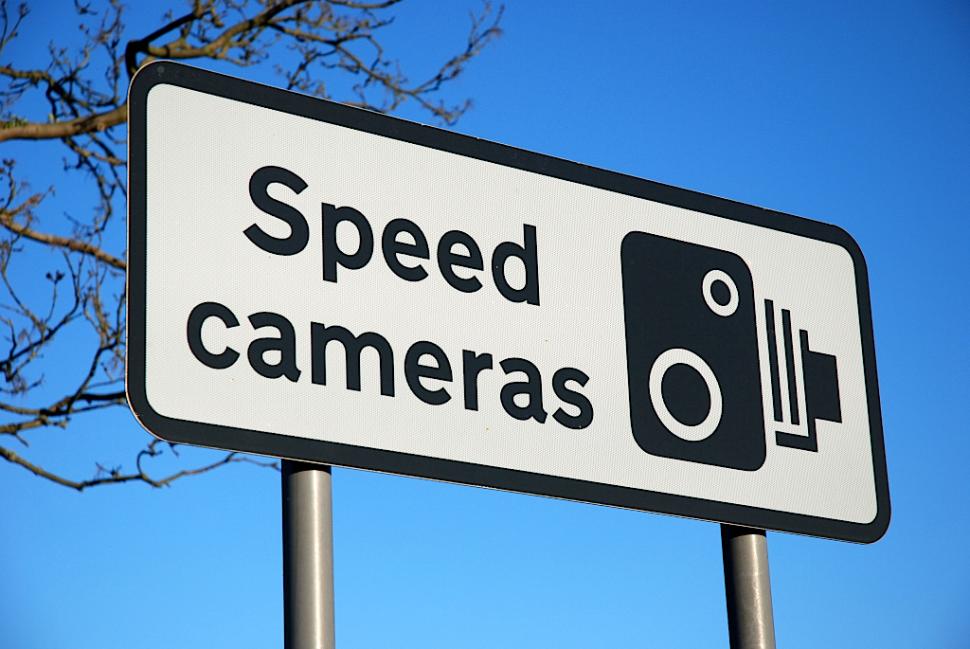 I was surprised not to see a speed camera van on the twisty roads leading away from Cadwell as we rode home. Roger had the speed limits nailed, as it would be all too easy to forget what 60mph feels like when you have spent the evening doing 100+
Motivating my brain and making it work at speed in an unfamiliar environment was a brilliant way to improve my road riding. On track, my brain had to work much faster than usual, even though there was no oncoming traffic to worry about.
Those advantages carried through to the ride home and the days beyond. An evening track day once or twice a year? … yep, it’s absolutely worth it, and you need nothing more than the desire to try it to join in the fun.
The Saga of the Honda Lever Guard
Following a very unfortunate set of circumstances at Daytona some years ago, where one rider clipped his brake lever on another bike and inadvertently started a multi-bike incident, brake lever guards have been compulsory in all forms of motorcycle racing and track days.
Handguards are acceptable for track days, but as the NT1100 doesn’t come with handguards and there are few decent aftermarket options, I set about finding a suitable lever guard.
You might think this would be easy; a Google search will reveal a wide selection to choose from, yet Honda has taken an interesting approach to fitting bar end weights, which makes things slightly awkward.
Inside the bars on many Honda motorcycles, you’ll find a weight into which the external bar end weight screws. The internal weight is held in by clips you get to by removing the hand grips.
However, the popular approach is to attach a homemade slide hammer and persuade the internal bar end weights to come out, breaking the clips – which are easily replaced – in the process.
All of this is necessary to create space inside the bar for the expanding collar, which is how most of the after-market lever guards are attached.
I’m told that the internal weight is also key to making Honda’s heated grips effective. Along with damping out vibration and keeping the external bar end weights attached, this design came in to fix the barely lukewarm grips that adorned the Africa Twin a few years ago.
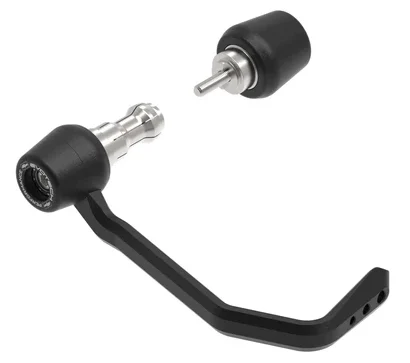 As this is my everyday motorcycle, and I ride it all year round, I didn’t fancy the idea of ripping the internal bar weights out. I needed a lever guard that would attach by screwing into the existing internal weight, leaving me with the easily fixable problem of spacing the guard away from the throttle.
Sadly, that meant I needed to return the exquisite EvoTech Performance lever guards I’d bought. They may be expensive, but damn, the quality of them is unparalleled. They are so well made; I just liked holding them (weird, I know).
Eventually, I found the R&G lever guard, which, although having the expanding collar fitment, can also be attached using the original bar end screw and one of the included spacers to keep it free of the throttle.
For good measure, I added some star washers to encourage it to stay where I’d positioned it, but it eventually worked itself loose, and I was black-flagged towards the end of the second session as it had drooped. All it took to fix the issue was to check before each session that the screw was as tight as I dared.
On reflection, I should have hung onto the lousy AliExpress handguards I bought. The thin inner guard, onto which the larger hand guard clips, would have been perfect as a lever guard. If only I hadn’t consigned them to the bin a few weeks back. Such is life.