European touring for many of us is an escape from regulation. We aim for mountains, not metropolises; passes, not people, and look to get away from it all “on the twisties”.
And yet, there are over 400 low emission zones in Europe: the Italians have ZTL areas, the Dutch have Milieuzones, and then there are the Belgians, French, Germans, and Austrians to consider.
Now put all of this into a landscape where crossing from one country to another is often marked by only a road sign, and the chances of brushing up against one of these impediments are increasing.
At first glance, it looks like a pain in the arse, but with a few wrinkles, it is easy to navigate, except perhaps for Italy, if you know how the game is played.
My first run-in with these zones came when leaving the Baden-Württemberg area of Germany (the B500) and tracking along the border with France. The GPS was moaning, but in its typically cryptic fashion, and after much button pressing and cursing, I worked out that I was heading for a collection of low emission zones.
Since then, the Germans have done away with several zones, but it is still a good example, especially in Europe, where you can get caught out and not know it.
On the French side (Grand Est/Alsace)
- Strasbourg (Eurométropole): This is a permanent, wide-ranging Low Emission Zone (ZFE-m) covering all 33 municipalities in the metropolitan area, operational 24/7.
- The Rules for 2026 state that vehicles with Crit’Air 4, 5, or “unclassified” are prohibited. From 1.1.2025, Crit’Air 3 is also restricted. However, the French have exemptions on main transit routes like the A4, A35, N83, N353, and D1083 – and of course don’t make that obvious to visitors.
- Mulhouse: An area for a future ZFE implementation, with current emergency zones activated “automagically” and in French.
German Side (Baden-Württemberg)
- Freiburg: Abolished as of 1 May 2025, along with Karlsruhe, which was abolished as of 1 March 2023.
- Pforzheim: Still has a low emission zone requiring a green sticker.
- Stuttgart: Maintains a strict, large low emission zone (Umweltzone) requiring a green sticker (Euro 4 diesel or better).
- And just when I thought I understood it, I discovered that motorcycles in Germany are largely exempt from these rules.
Dream On
The good news is that LEZs rarely touch the roads we dream about. The issue is that they sit squarely on the gateways to those roads. France, Germany and Italy all approach the problem differently, and understanding those differences is now part of trip planning, because you know someone from the local Politzi is ready to lighten your wallet if you try to colour outside the lines.
France (Zones à Faibles Émissions)
France is the one country where low emission policy actively intersects with motorcycle touring. Not because it blocks great roads, but because it controls access to almost every major launch point for them.
Cities like Lyon, Grenoble, Nice, Marseille and Toulouse – all official low emission zones – sit directly on the edges of the Alps and Pyrenees.
Ride the Route des Grandes Alpes, and you’re almost guaranteed to clip one. Finish a Mediterranean run, and you’ll likely roll straight into one.
The Crit’Air vignette applies to motorcycles as much as cars, and it’s linked directly to emissions standards. So, depending on the Euro Classification and the age of the motorcycle, you can be in any of the classes 1 through 4.
The official Crit’Air website – link below – does make this easy, but it isn’t one-size-fits-all, and a different bike means another sticker.
The class of sticker you have defines which areas you are allowed in, which is a pain if you’re riding in a group.
French LEZ Basics
| Requirement | Details |
|---|---|
| System | Crit’Air sticker (mandatory for all vehicles, including bikes) |
| Cost | ~€3.85, valid for life – Official website for the Crit’Air sticker |
| Basis | Euro emissions standard/registration date |
| Enforcement | Camera + spot checks, fines up to ~€180 – How very French of them. |
The takeaway: if you’re on anything Euro 4 or newer, France is frictionless once you have coughed up for the sticker.
On older machinery, the edges of your tour — hotels, fuel stops, wrong turns — can become restrictive.
Germany (Umweltzonen)
Germany is almost the inverse of France. It has dozens of Umweltzonen, spread across major cities, many of which sit close to iconic riding areas like the Black Forest or Alpine foothills. Munich, Stuttgart and Freiburg are all typical routing points.
But here’s the important bit: motorcycles are effectively exempt.
While cars must display a green emissions sticker to access these zones, motorbikes do not require one and are not subject to the same access rules.
German LEZ Basics
| Requirement | Details |
|---|---|
| System | Umweltplakette (emissions sticker) |
| Motorcycles | Exempt from the requirement |
| Cities affected | ~50+ nationwide |
| Enforcement | Irrelevant for bikes – Das ist wunderbar! |
The takeaway: Germany looks restrictive on a map, but for motorcyclists, it’s largely a non‑issue. You can treat it much like you always have — as an open territory with great roads. [Is this why you are always going on about it? ~ Ed]
Italy (Zona a Traffico Limitato)
Italy’s approach is less about emissions classification and more about controlling access to historic centres. Which sounds harmless — until you realise just how many touring routes funnel you through places like Milan, Florence, Bologna or Verona.
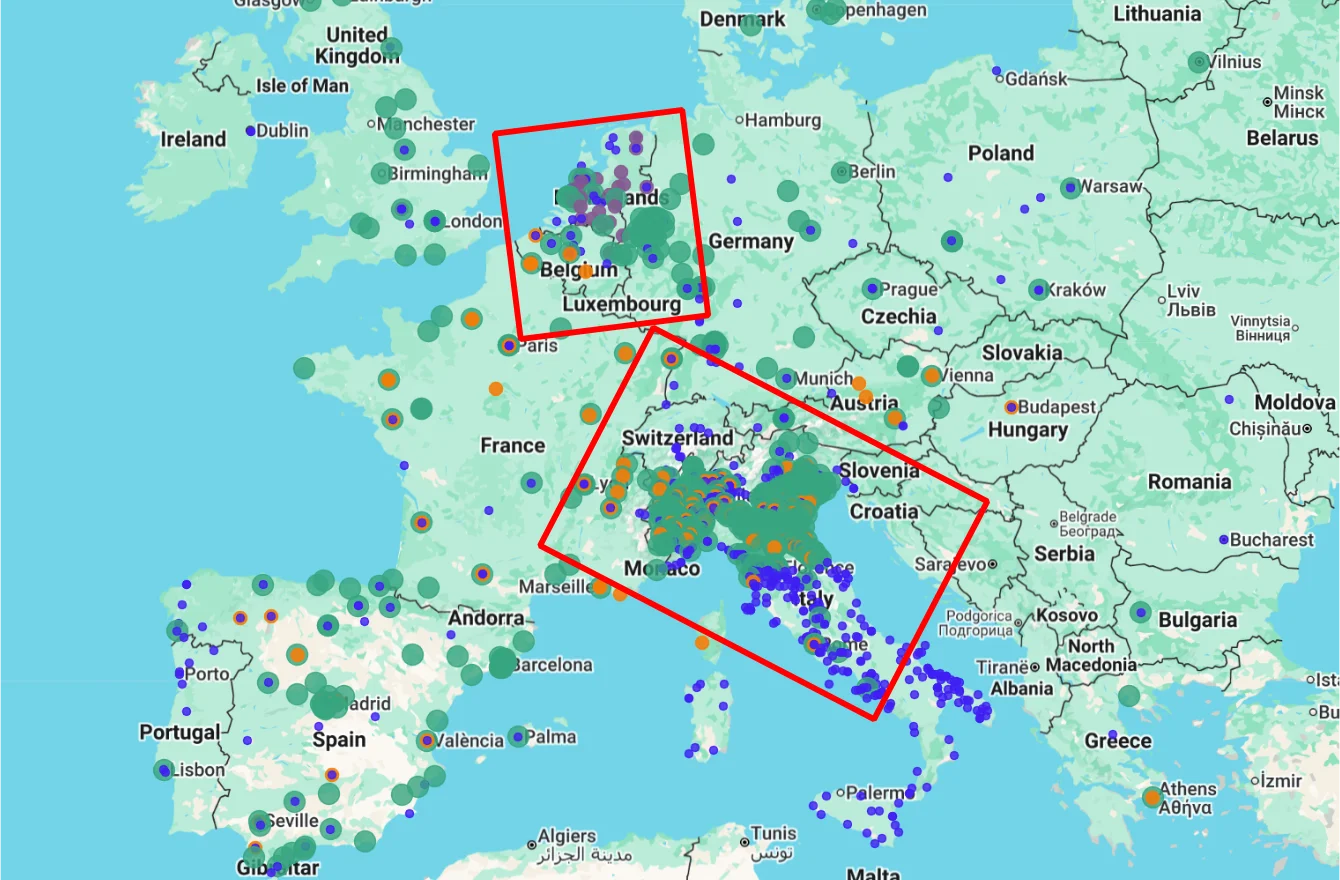
Instead of LEZs in the French sense, Italy relies on ZTL (Zona a Traffico Limitato) zones. These are everywhere — around 300 towns and cities use them — and cameras aggressively enforce them.
The Dolomites, Stelvio and Tuscany all orbit cities where ZTLs are unavoidable if you’re stopping overnight or refuelling.
Italian ZTL Basics
| Requirement | Details |
|---|---|
| System | Restricted access zones (ZTL) |
| Purpose | Reduce congestion, protect historic centres. |
| Access | Permit‑based (residents, hotels, authorised vehicles) |
| Enforcement | Automatic cameras |
| Fines | Typically, €80–€350+ So much for the Dolce Vita |
Motorcycles aren’t universally banned — in some cities, they’re allowed, sometimes time‑dependent — but the key is that access is conditional, not guaranteed.
Italy is perhaps the most difficult to navigate. I found two sources for information on the ZTLs ZTL Maps (interactive city layouts) and MappaZTL (OpenStreetMap-based coverage). The maps didn’t work for me on the first one.
Having found out you are going to enter one, the convoluted process seems to be …
Confirm the details on the official city site. You are looking for activation times, who is blocked and whether motorcycles are impacted.
If so, check with your accommodation whether registration is required. They can likely make that happen for you or at least tell you how to do it.
On the approaches, check the signage carefully. This is Italy after all.
And, to make life even more interesting, the Italian ZTLs sites are now starting to talk about low emission zones.
There are two types, B and C (no idea what happened to A). Type B is a LEZ, and unlike the French, who offer classes, the Italians offer only Yes or No as your options.
| Vehicle Type | Status (current & upcoming rules) |
|---|---|
| Very old bikes (Euro 0–1) | Already banned in many cases |
| Older bikes (Euro 2–3) | Phased bans rolling out (2025–2026+) |
| Modern bikes (Euro 4–5) | Generally allowed (for now) |
| Electric motorcycles | Fully allowed / exempt |
| Two Strokes | They are generally banned because none of them has a Euro rating. |
Area C is a mix of a ZTL and a LEZ. You need to be on a compliant motorcycle (Euro 4 or higher), register your motorcycle, and pay around 5 euros per day.
Cameras enforce everything. The rules vary from city to city. Get it wrong, and the Italians will invite you to cough up somewhere between 80 and 335 euros.
The takeaway: Italy Euro 4 or higher, and really, they are on the page of whether you should be there at all.
Netherlands LEZ (Milieuzones)
The Netherlands is one of the easiest countries in Europe for motorcyclists when it comes to LEZ rules, as the Dutch primarily target diesel vehicles — not motorcycles.
In practical terms, if you’re riding a 4-stroke petrol bike (Euro 3 / 4 / 5), you can treat Dutch LEZs as a non-issue.
Some cities do regulate two‑wheelers. Amsterdam has a ban on older petrol pre-2011 scooters, and The Hague has a ban on older mopeds – no idea why, but those are the rules.
On January 1, 2025, the Netherlands introduced a new system for Zero Emission Zones, but as I write this, motorcycles are not included. Yet, you can see where the regulations might be heading.
The Dutch are living up to their reputation for being chilled out about most things, including motorcycles.
The takeaway: You have to love the Dutch.
Where LEZs actually affect real tours
Despite the government oversight and bureaucracy, most of the riding itself remains untouched. The Stelvio, Furka, Grossglockner, Route Napoléon, and Pyrenean passes are all still open, unchanged, and free of stickers or permits.
It will be the hotels, fuel and food stops or a simple wrong turn that will lighten your wallet, without due care and attention.
Bottom Line
Low emission policy hasn’t killed European touring — it hasn’t even touched the best parts of it. What it has done is shift the challenge.
Where once the risks were mechanical or meteorological, they’re now administrative. Stickers, permits, signage — small details that matter disproportionately.
And that’s the quiet truth of riding Europe in 2026: The best roads are still wild, empty and free. It’s everything around them that’s starting to need detailed planning.
Or take the Ferry to the Netherlands, and ride to Germany. No permits, stickers and the lowest speeding fines in Europe … not that I know anything about them. Honest.
Here, some route ideas … They are free.