Up here in the northern hemisphere, the arrival of May has brought a sudden burst of sunshine and the mouth-watering prospect of touring.
There is already chatter around the office of camping in the Durham Dales, a return trip to Wales and the Cain Valley Hotel is already booked, and the desire to scribble “Gone Touring” on the calendar and disappear grows stronger with each sunny day.
Now comes the question … Where are we going?
Northern Europe
France, the Netherlands and the Black Forest region of Germany are all excellent answers to the question “Where are we going?”.
Riding through the Netherlands to the Black Forest, I’ve done a few times. One day to get there and another to get home doesn’t eat much into the “me time”, and the roads are superb.
France is easy to get to, but the 50-mph speed limit away from the Autoroutes “Le Peage” can make travelling any distance frustrating. And yes, I appreciate that reality may differ, but explaining myself to the local French Police isn’t high on my list of things to do this summer.
Speed camera warning devices, including those built into navigation devices, are prohibited in France. Getting caught with one is a hefty fine and confiscation of the device, which is going to be an expensive inconvenience, especially if you are using your phone.
And if speed cameras are part of how you answer the “Where are we going?” question this might help you decide.

Where Can I Find …
- Brittany Ferries Holidays – Spain Packages
- Le Peage – Frech Toll Roads Guide
- Lane Splitting Rules – Traffic Rules in Europe
- Getting to Norway – A Guide
- Picos de Europa – Free Touring Routes
- Travel Insurance – The Ins and Outs
- Speed Camera Density – Who has the most
- Black Forest – Free Touring Routes
- Ferry Options Northern Europe – They Cost How Much?
Norway
This is towards the top of my bucket list, but having checked a map, I noticed Norway hasn’t got any closer. It is still going to take a few days to get there, and a few more to get back.
It is all time spent riding and therefore counts, but with so much to offer, spending 5 days out of 10 actually in Norway doesn’t feel like I’m maximising the touring time.
Spain
It is the default answer for many of us, although it does present a similar problem to Norway – 36 hours on a ferry from Portsmouth to Santander and the same coming back.
The straight-up cost of the ferry looks to have increased and is around £700 plus whatever cabin arrangements you choose. Last year £700 would have included a cabin.
I’m told but haven’t verified that booking via Brittany Ferries Holiday and staying a few nights near Potes (Picos) in one of the package hotels drops the overall cost of the ferry crossing significantly.
Most of us touring Spain will be heading to the Picos, even if only for a few days, so it must be worth investigating. You can’t do this online, though; you must call Brittany Ferries – the number is on their website (link above).
Spanish Road Numbers
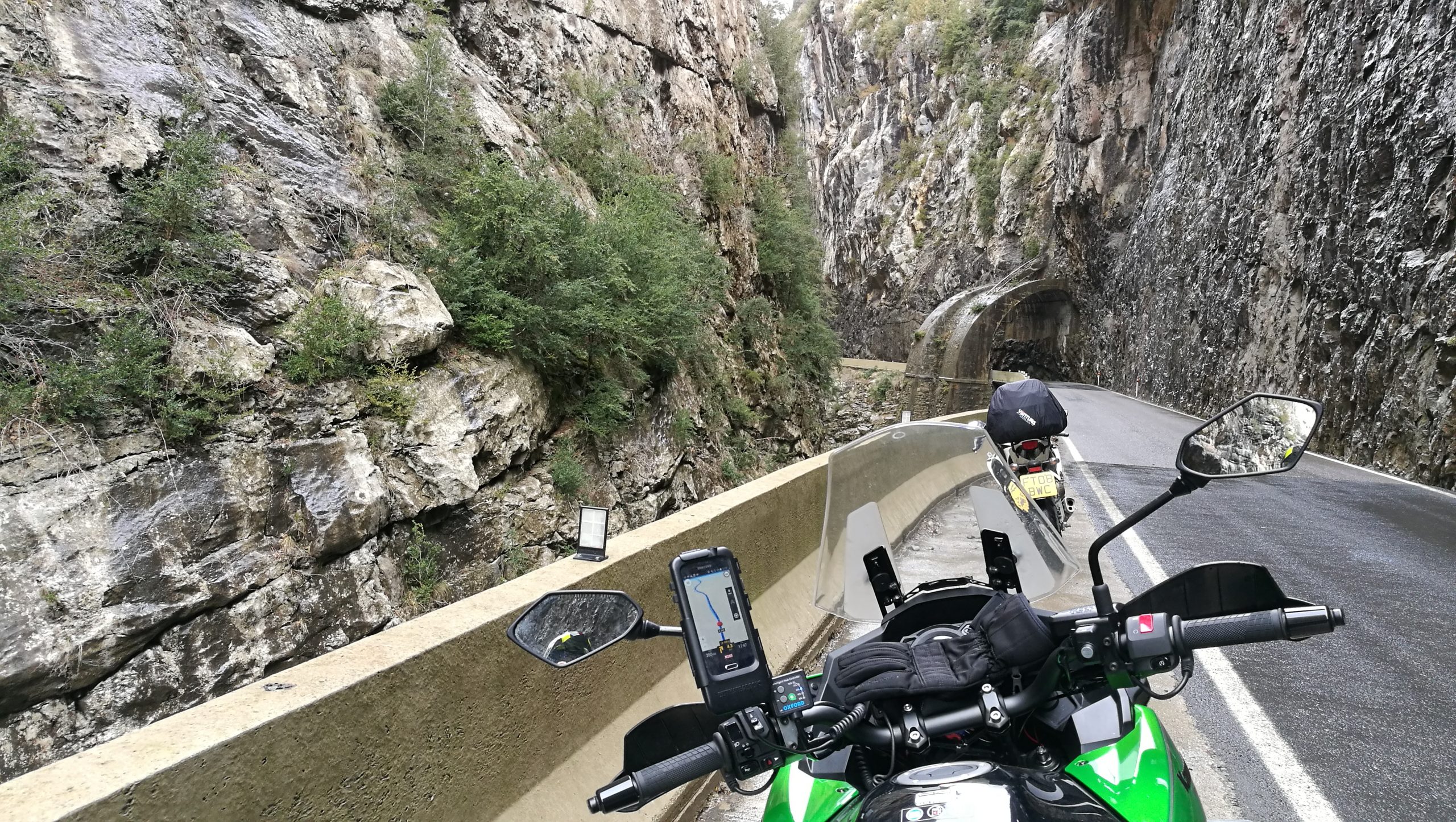
Despite several trips to Spain, I’ve never fully understood the road numbering system. Some of the fantastic roads that are everywhere in Spain might start with an N, others AS, and then there are those beginning with CL, CA, and numerous other prefixes.
While it appears to be almost impossible to plan a disappointing route through Spain if you avoid the motorways, here is a (very) rough guide to the road numbering.
Autopistas (AP): Likely to cost you money, so unless you need to cover a lot of miles, in a time-efficient yet soul-destroying way, these are to be avoided. Also, the cost may vary depending on the season.
Autovias (A): Are (mainly) free motorways. Still to be avoided. There is a saying in Spain that there are two types of motorways – busy and very busy.
Then there are the pseudo-motorways built by the regional governments. In Catalonia, the C25, which links Girona and Lleida, is a motorway, but not always shown as such on maps.
There is a whole science about how Catalonia numbers its roads. It is based on the road’s direction, which then defines the first number for that road. However, life is too short to wrap my head around it.
National (N): Similar to the UK arterial (A) roads, but without traffic. The N-260, arguably one of the best roads in Spain for a motorcycle, is only wide enough for two cars to pass in some places, but it needs to be on your bucket list.
CA/L or B: Typically mean tighter twisty roads, probably through mountains or forests. They turn the grin factor to 11.
Then there are the roads where the letters indicate the region you are in, and around Madrid, it just gets ridiculous. There are “A” motorways, “M” motorways (for Madrid) and “R” motorways (for Radial). All totally bonkers unless you live there, and then I’m sure it all makes sense.
All of that said, the AP and A roads are for those who want to cover distances in a hurry; otherwise, avoid significant towns and cities, and Spain will deliver you some of the most motorcycle-oriented roads in Europe. It is hard not to have a great time.
Where Are We Going?
Damn good question. As mentioned earlier, Wales is the first stop, and the gentle flow of Amazon packages containing camping accessories means a night or two under canvas is being planned by someone.
The Editor is drawn by the romance of camping in the Pyrenees, but the reality will most likely be an upmarket B&B with a personal shower and a balcony. He’ll call it work.
Scotland must be in the mix, along with Ireland. There is always somewhere we haven’t been, no matter how many times we visit.
And then there is Denmark. Why do you never hear much about Denmark? The area around the Holsteinische Schwelz Nature Park (northeast of Hamburg) has lakes, forests and curving roads. Or there is the 228km North Sea Coast Road that goes through Viking Harbours and some of the WWII fortifications. More investigation required.
And on that note, I’m off to stare at the map some more and see if I can work out where we are going – or perhaps just me – and if I’m crazy enough to take a tent.