



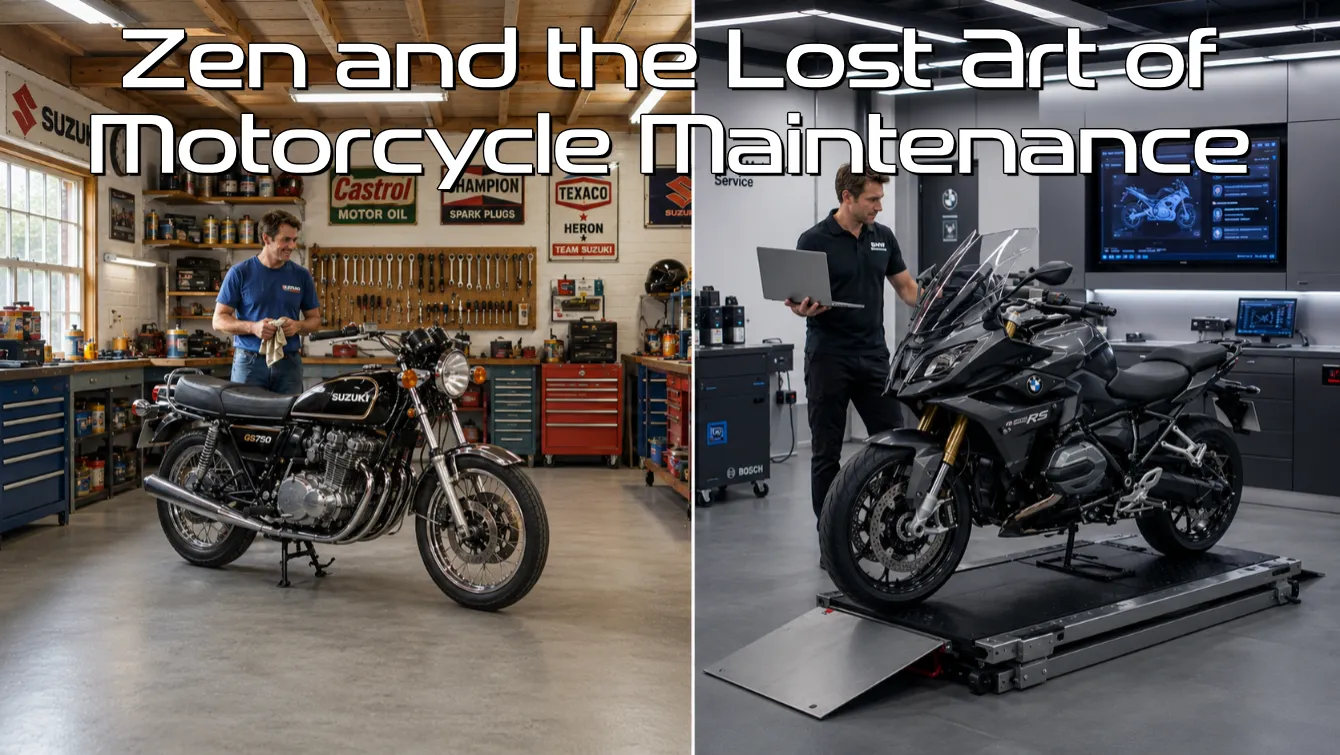
When you’re buying a motorcycle, are you drawn to technical complexity, or are you looking for something you can maintain with spanners rather than a laptop?
Looking at the manufacturers’ lineups, there seems to be a distinct divide between motorcycles with every technological advancement possible and those that use traditional engineering to deliver a great ride.
Suzuki
It is perhaps Suzuki that has the most complete range of road motorcycles designed this way. At the top of their range is the new Suzuki GSX-S1000GX, complete with six-axis IMU, Semi-Active Showa EERA® Suspension, Brembo callipers and a bi-directional quick shifter to help you release the 150BHP and 106Nm of torque. It is a lot of motorcycle for the £14,500 price tag.
Alternatively, if you prefer traditional solutions to complex problems, Suzuki has the GSX-S1000GT. Priced at £1,800 less than the GX (£12,699), the GT loses some of the complexity, replacing the semi-active suspension with fully adjustable 43mm KYB front forks and a rear shock adjustable for rebound and preload.
The engine in the GT delivers the same power and torque numbers as the GX, perhaps none of which should be a surprise, given the frame, engine, and swinging arm are shared between the two models. They are two different versions of the same motorcycle, aimed at either side of the motorcycle complexity divide.

Suzuki GSX-S1000GX
- 999cc Straight Four – 150HP – 106Nm
- 232 Kg – 845mm Seat Height
- 45.5 MPG (Imperial) Fuel Economy
- Semi-Active Showa EERA® Suspension
- Extensive Electrics Package with IMU
- Bi-directional Quick Shifter
- Brembo Radially Mounted Caplipers
- Tubeless 120/70R17 & 190/50R17 tyres
Honda
Honda has taken this concept in a different direction and given us a choice between the off-road styled CRF1100L Africa Twin (£13,199) and the touring-focused NT1100 (£12,650).
The only difference – that I know of – between the two engines is that the inlet tracts on the NT1100 are different, delivering a wider spread of torque across the mid-range. The Africa Twin produces more peak torque, but it is packed low in the rev range.
The NT1100 frame has a few more lugs on it than the Africa Twin version, but it is otherwise identical. Even the suspension on the AT and the NT is essentially the same, although the AT does have the option to come with electronic suspension if you so desire.
But They All Do That
Well, sort of. There is a difference between taking core components and reusing them in a different model – platform engineering – and offering the same motorcycle with different options.
I once spotted a “cheap” BMW R1250GS for sale second-hand in Chris Walker’s eBay shop. Living close by and thinking I might snag myself a bargain (dream on), I hurried to the showroom in Grantham to take a closer look.
The lower-than-average price was because the previous owner had bought an R1250GS with manual suspension rather than the TE version, which is by far the most popular.
In a brief conversation with Chris, he mentioned their problems when trying to give the seller a fair trade-in value. There was nothing to compare the bike to on the second-hand market, and the BMW Dealers were only interested if they could get what they thought to be an unpopular model at a bargain basement price.
Suzuki and Honda have opted to make distinctly different models from a common platform. The Suzuki GSX-S1000GX is, in Suzuki’s own words – the ultimate Sports Crossover. The GSX-S1000GT looks completely different, and having ridden one 3,000 miles to Portimão and back, it truly is a genuine Grand Tourer.
There is no confusion or “wrong options” to buy at the dealership. Nice.
What Do You Desire
I recently spent a few months refreshing my Ducati Multistrada. Despite being eight years old, it is loaded with technology. True, some of the technology may not be as sophisticated as the recent versions – not all Inertial Measurement Units (IMU) are the same – but it still has one.
Some of the refresh work I could do myself, while for other parts, the semi-active suspension, for example, I opted to take to Parkitt Motorcycles, who specialise in such things.
Had this been a traditional suspension set-up, it would have been straightforward to refresh and potentially a little lighter on my wallet.
When I bought the Multistrada, I bought into the wonders of the electronics, yet having found the settings that worked best for me, I didn’t change them unless I loaded the bike with luggage.
The same was true of my V-Strom. Once overhauled, the treacle that had once been fork oil had been replaced, and the fork internals cleaned up; I set the suspension and only needed to adjust the rear pre-load when I put luggage on the bike.
Mileage
Having added even more miles to my Multistrada, I decided it was time for my love affair with the Ducati to come to an end. Whoever buys it will get a cracking motorcycle if they can get past the fact that it has covered 37,000 miles.
Some people consider this high mileage, but that is often a false impression caused by the number of motorcycles only ridden in the summer months. If a motorcycle has been cherished and has a solid service history, who says 37K is a lot of miles? Only the dealers and the trade-in values they offer.
Our colleague Roger is keeping his Africa Twin. It wants for nothing – not that it ever needs anything – and is now pushing 40K. Other than a trip to the dealer every 16,000 miles for the valve service, he does the rest himself.
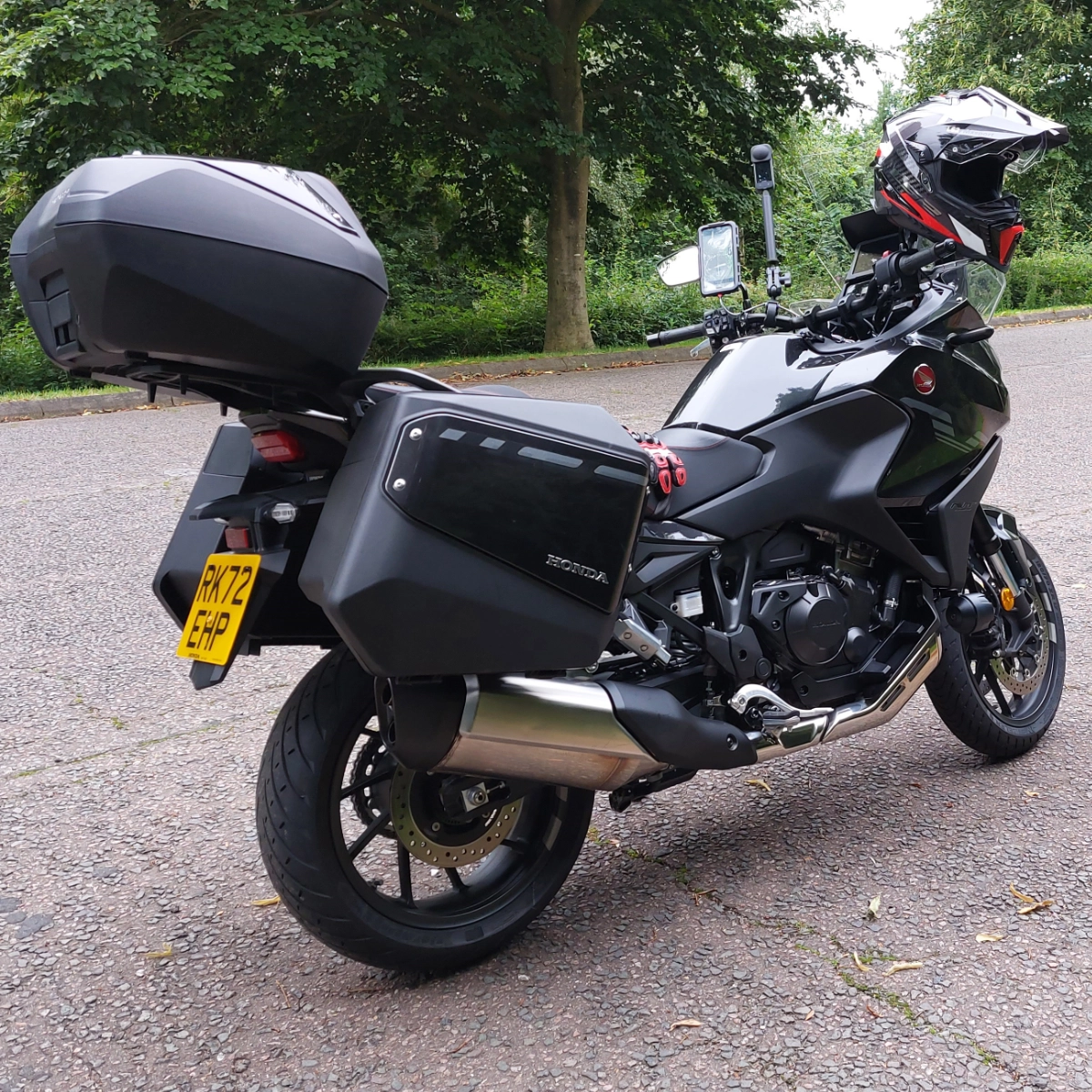
2023 Honda NT1100
- 1084CC Twin – 101 BHP – 104 Nm
- 238 Kg – 820mm Seat Height
- 310mm Twin Disks with 4-Pot Calipers
- 256mm Single Pot Rear Disc
- Preload Adjustable 43mm Showa Forks
- Showa Rear Shock – Remote Preload
- 120/70R17 Front Tyre
- 180/55R17 Rear Tyre
Honda NT1100
My heart wanted another Multistrada, the V4S, to be precise. I even got as far as looking at the price tag in a dealership and then backed away before I did something expensive.
Having spent many an evening trawling the internet looking at motorcycles (nothing new there then ~ Ed.) I finally opted for a Honda NT1100 based on practicality.
Having found one in the right colour and with the extras I wanted that seems to have been used for one summer and then sold, a deal was done, and the Ducati has now departed.
I’ve ridden the DCT and manual versions of the NT1100 for road tests. The NT1100 isn’t a fire-breathing monster, and neither is it a couch potato. I found the Showa suspension they fit at the factory worked fine for me on both bikes, leaving only the decision between DCT or manual to be made.
The DCT gearbox is impressive technology, yet what pushed me towards the Honda in the first place was the simplicity of the maintenance. Swapping one set of complex technology for another seemed counter-intuitive, so I wimped out, went manual, and bought a quick shifter.
The Complexity Question
Engaging riding, European touring and Sunday scratching doesn’t require me to be on the complex side of the motorcycle maintenance equation. If I end up road-testing Suzuki’s GSX1000GX, I’m sure I’ll love every minute of it, but there is a distinct other side to motorcycling that can’t be ignored.
Motorcycles that push the boundaries of technical innovation will always be desirable. The baseline of what we consider “traditional technologies” will continually move forward. The BMW R1300GS will be popular, yet Royal Enfield, who openly state that they “choose to keep things simple”, repeatedly appears around 6th in the MCIA sales figures by manufacturer.
Ask me the complexity question again in 12,000 miles, and I’ll let you know how all ofthis played out.








One Response
I enjoyed that. I will be interested to see how you have got on after 12,000 miles.