



My head hurt almost as soon as I started digging into the science behind trail braking. I’d read all the commentary online about why it was a good idea and then read all the comments about why it isn’t.
Even asking people who hold strong views on the subject, I never quite reached the absolute conclusion I was searching for. Somewhere in their explanation, they would say, “It is complex.”
Being faster than me on the road or a racetrack isn’t a good measure either because I’m not that fast a rider. I can hold my own, but I’m not going to hang it out to prove a theory no one can state with absolute clarity.
My faith in tyres, suspension, road surfaces, and the dynamics of a motorcycle heading rapidly towards a bend I need to brake for only goes so far. That said, I can trail brake sufficiently to feel and understand the benefit.
This has been essentially self-taught (don’t try this at home), and the next step is to go to the British Superbike School to discover what I should have been doing.
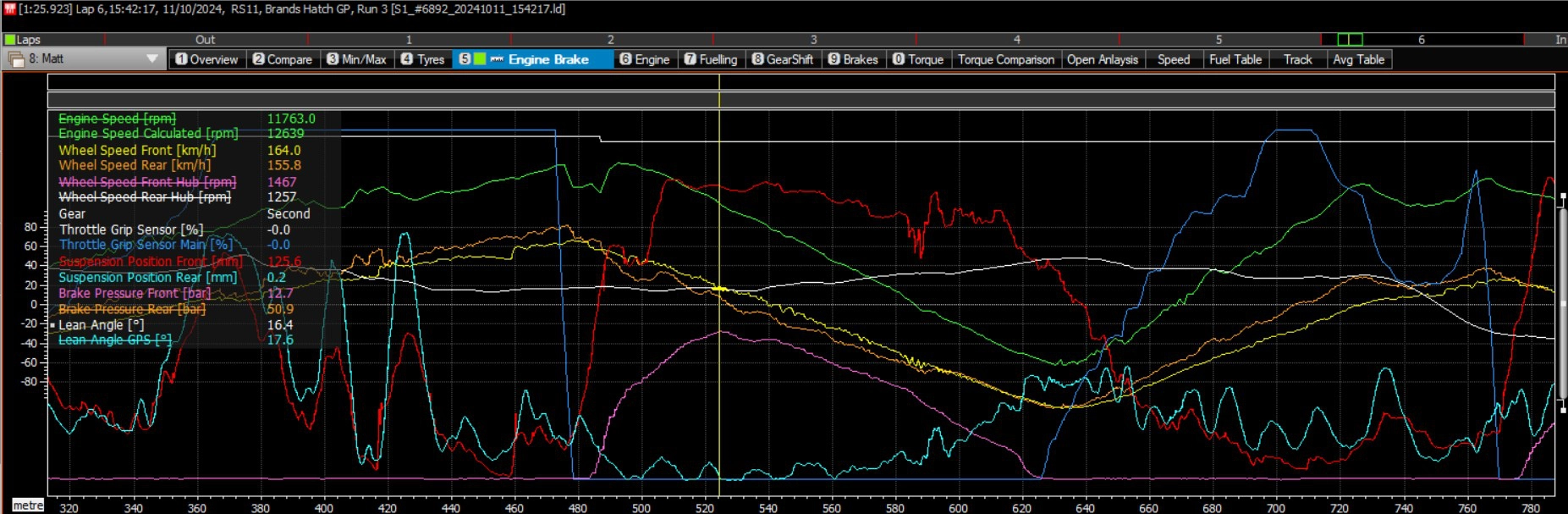
Trail braking, by the way, isn’t just about trail braking into a corner. The trail braking technique applies equally to braking in a straight line. It is about controlling the dynamics of the motorcycle while braking.
This article isn’t about how to trail brake—for that, you need to ask someone qualified to teach the technique—but about what happens with the available grip when we do.
I can’t claim to have a definitive and complete answer. In truth, I think very few people know because of the array of physical laws that come into play, but if you are interested in the science behind trail braking … get yourself a mug of tea and dive in.
Where Can I Find
- British Superbike School – Gainsborough Lincolnshire
- Barton Motorcycle Training – Facebook Page
- Jewell Motorbike Training – Independent Training At All Levels
- A Demon on the Brakes – Wanting To Brake Like Toprak
- Trail Braking and Suspension – YouTube Video
- Dunlop RoadSmart IV – Official Site
WTF is Grip
The primary focus of trail braking is grip, specifically front tyre grip.
The front tyre has a set amount of grip for the conditions at any given moment. If the road surface is wet or damaged, the grip is reduced.
If we cover the same piece of road in diesel or ice, there is next to no grip available. Therefore, we can establish that the amount of available grip is directly related to the friction between the tyre and the road surface.
The sand-coloured stretches of tarmac on the approach to pedestrian crossings and some bends are “Shell Sure Grip,” a high-friction surface that increases the level of available grip by increasing the friction between the road surface and the tyre.
The grip also changes with how we ride the motorcycle. When we brake moderately, the tyre’s contact with the road remains stable, and the grip is maintained.
Braking typically increases the front tyre’s contact pressure with the road, helping improve grip (traction) thanks to Amonton’s First and Second Laws.
Amonton’s First Law states that the force of friction is directly proportional to the force. This is a fancy way of saying that if you press two surfaces together, there are greater levels of friction between them. The more we press, the greater the friction between them. (No shit Sherlock)
The second law states that the amount of friction is independent of the size of the contact area between two surfaces, provided the force and materials remain constant.
This one bent my brain for a while, but it reflects the idea that the level of friction between two surfaces remains constant (as long as everything else does). If you have a larger area, you get the same level of friction; you just get it many times over. The value of friction doesn’t change.
[Some people have too much time on their hands ~ Ed.]
Lean Angle
When the motorcycle is upright, all the weight is straight up and down (vertical). Braking, when vertical, means that the total amount of grip available only has to work in one direction—forward or longitudinally.
In a perfectly balanced world, if we brake hard and exceed the amount of grip (friction) the tyre has with the road surface, the tyre skids forward in a straight line.
When we lean the motorcycle into a bend, we introduce several other factors that influence the amount of grip available.
Angle and Load Transfer
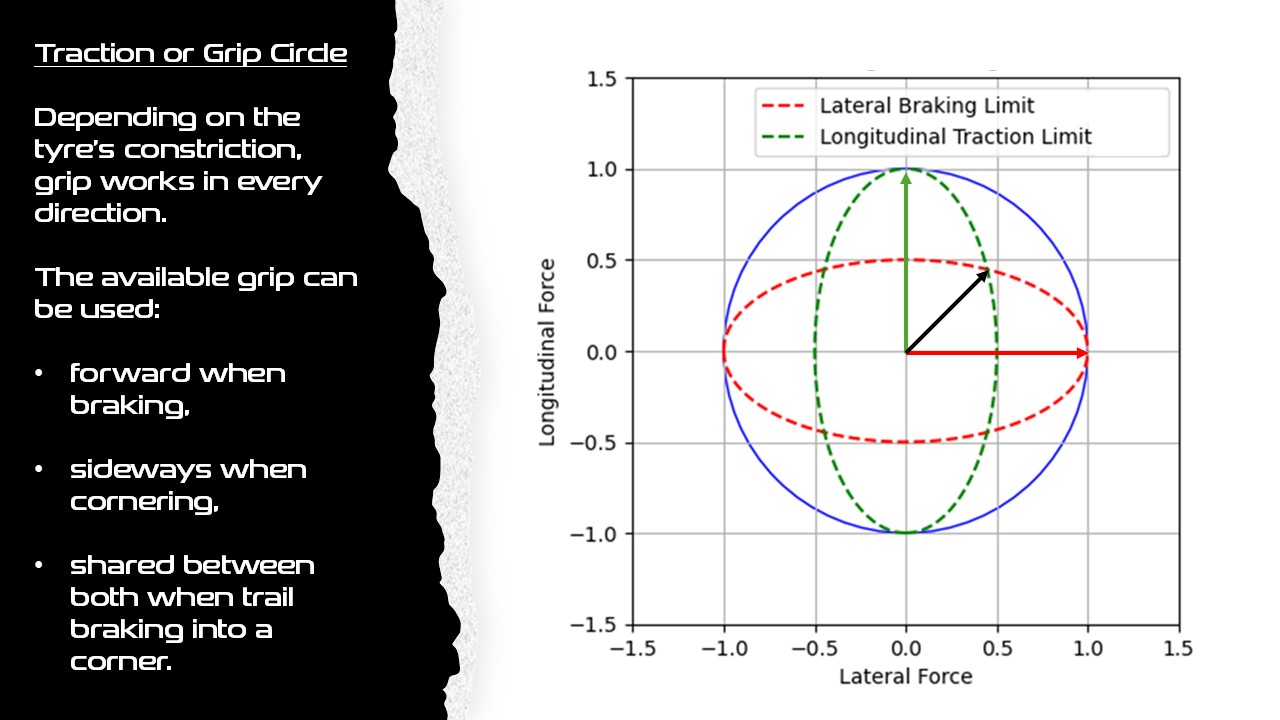
The amount of grip a tyre can provide is proportional to the load on it. As the lean angle increases, the amount of grip required to resist the lateral forces also increases. This is the Grip or Traction Circle concept.
Cornering increases the weight pushing on the front tyre. This comes from centripetal force, which is the force that tried to throw you off the roundabout in the children’s playground when it was spinning.
As centripetal force acts from the inside of the turn outwards, it pushes on the motorcycle, increasing its weight and the friction level between the tyre and the road surface, resulting in more grip.
[The counter-argument to this is that centripetal force acts horizontally; therefore, none of the force is pushing the tyre into the tarmac ~ Mike Abbott]
Now, add some extra friction through trail braking into the corner—more load on the front—and the amount of grip available on the front tyre in a corner is much greater than I initially thought. This also means that the rear has less weight on it and, therefore, less grip.
Then, there is the change in steering dynamics brought about by the compressed forks, but that is a whole different story.
However, when you release the brake to drive out of a corner, you reduce the force/weight on the front tyre, reducing the total amount of grip. Often, when you see someone on track tuck the front close to the apex of a corner, it is because they released the brake, reducing the amount of grip.
[Counter argument – The rider didn’t release the brake soon enough or by enough. Or too much throttle for the grip ~ Mike Abbott]
Contact Patch Changes
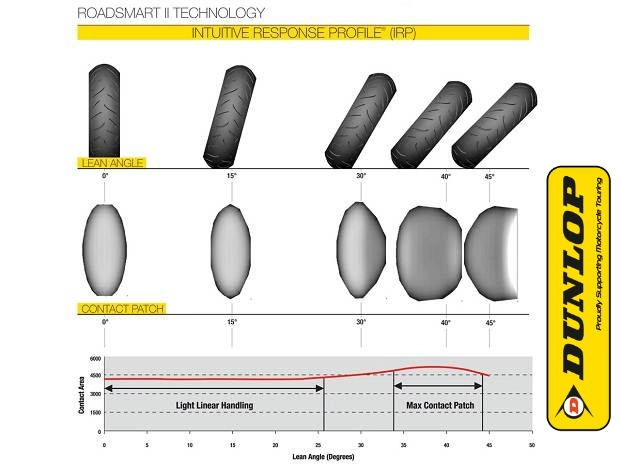 As we lean the motorcycle, the tyre’s contact patch (the area of the tyre in contact with the road) changes position on the tyre and becomes smaller, especially on tyres with a less rounded profile.
Racing tyres have rounded profiles and maintain a more stable contact patch even at steep lean angles.
Conversely, road tyres have a sharper profile, which enhances change in direction but at the cost of a smaller contact patch when lent over.
However, even this isn’t always true. The image shows how Dunlop has been working on increasing the contact patch for road tyres when cornering since the Dunlop RoadSmart II was released.
Quantifying Lean Loss
Whereas I couldn’t find a formula to predict how much grip is “lost” through changes in the contact patch for a specific lean angle, the level of grip from a road tyre typically reduces rapidly around 45 degrees bank angle. The tyre’s shape isn’t designed for more than that. For racing tyres, the optimal angle might extend closer to 60 degrees.
The amount of grip reduction varies based on factors such as tyre compound, profile, pressure, road surface, speed, and weight.
I did say this hurt my head when I started digging into the subject.
Trail Braking
On a race track, we can play with all of these factors to maximise a lap time. The corners always come in the same order, and the level of grip lap-to-lap changes very little. We know what is around each bend, and there are Marshals with flags that warn us when things have changed.
If we are running race tyres, they have a different profile designed to maximise edge grip, and if we do cock it up, there are gravel traps and air fences to help us come to a stop.
On the road, we are not going to get anywhere near the level of commitment that track riders can. The number of additional factors that road riders deal with makes it all but impossible to trail brake to the maximum with certainty at every corner.
To quote Neil Jewell (see Sources), ” … If you are trail braking on the road, you’ve read the corner wrong, but you should absolutely know and understand that you can continue to brake into a corner, knowing you have to release the brakes the more you lean. This, on the road, may give those vital few more meters of deceleration that we need to avoid running wide.”
Where I’ve been testing the theory, I can brake later and turn tighter without any heroics, knee dragging or the Doctor’s Dangle. The bike pivots faster, uses a smaller radius, and lets me get out of the corner sooner.
What could possibly go wrong?
Sources
A lot of reading and the beloved internet sorting the wheat from the chaff.
Mike Abbott MBA, RoADAR (Dip), DVSA RPMT 800699, ACU Coach #62210 at British Superbike School, who Raced for 15 years. Has ridden on three continents. RoSPA Instructor, DVSA Post-Test Trainer, ACU Road Race Coach.
Peter O’Grady from Barton Motorcycle Training. Peter runs a 12-hour course on the science and execution of how to trail brake. He found out late in life that his time around Oran Park in Australia on a production GSX-R750 would have qualified him for that year’s World Superbike Round (1:19.5 – Qualification time was 1:22)
Neil Jewell, from Jewell Motorcycle Training, is one of the UK’s most qualified motorcycle instructors and a damn fast track rider. Neil also has qualifications in Education. If you want to experience road riding instruction at any level, done effectively, give him a call.
Listening to the advice and explanations from these gentlemen has been an absolute joy, but to indicate just how complex a subject Trail Braking is … Not even they agreed on every aspect.








2 responses
Me neither, but your explantion makes sense.
Your description of centripetal force is not how I remember it from A-Level maths (which admittedly was a while ago).
> This comes from centripetal force, which is the force that tried to throw you off the roundabout in the children’s playground when it was spinning.
No, there was no force trying to throw you of the roundabout in the playground: the reason you were being “thrown off” is that, per Newton’s First Law, a body in motion which is not being acted on by a force will continue that motion in a straight line. Assuming you weren’t actually being thrown off, that was because your arms holding onto the bars was providing a centripetal force, which was acting on you to continuously change your direction (so that you go around in a circle until you let go).
So applying this to motorbikes: if you’re cornering then there must be a centripetal force acting on you, which unless you’ve lassoed a lamp post to slingshot it can only be coming from the friction between the tyres and the road. The centripetal force is _provided_ by the friction, it isn’t adding to it
At least that’s how I remember it.
(So _do_ you get extra grip for free by turning the bike or by leaning the bike? Intuitively it feels like the bike is “digging in” so there ought to be, but mathematically … I don’ t know)