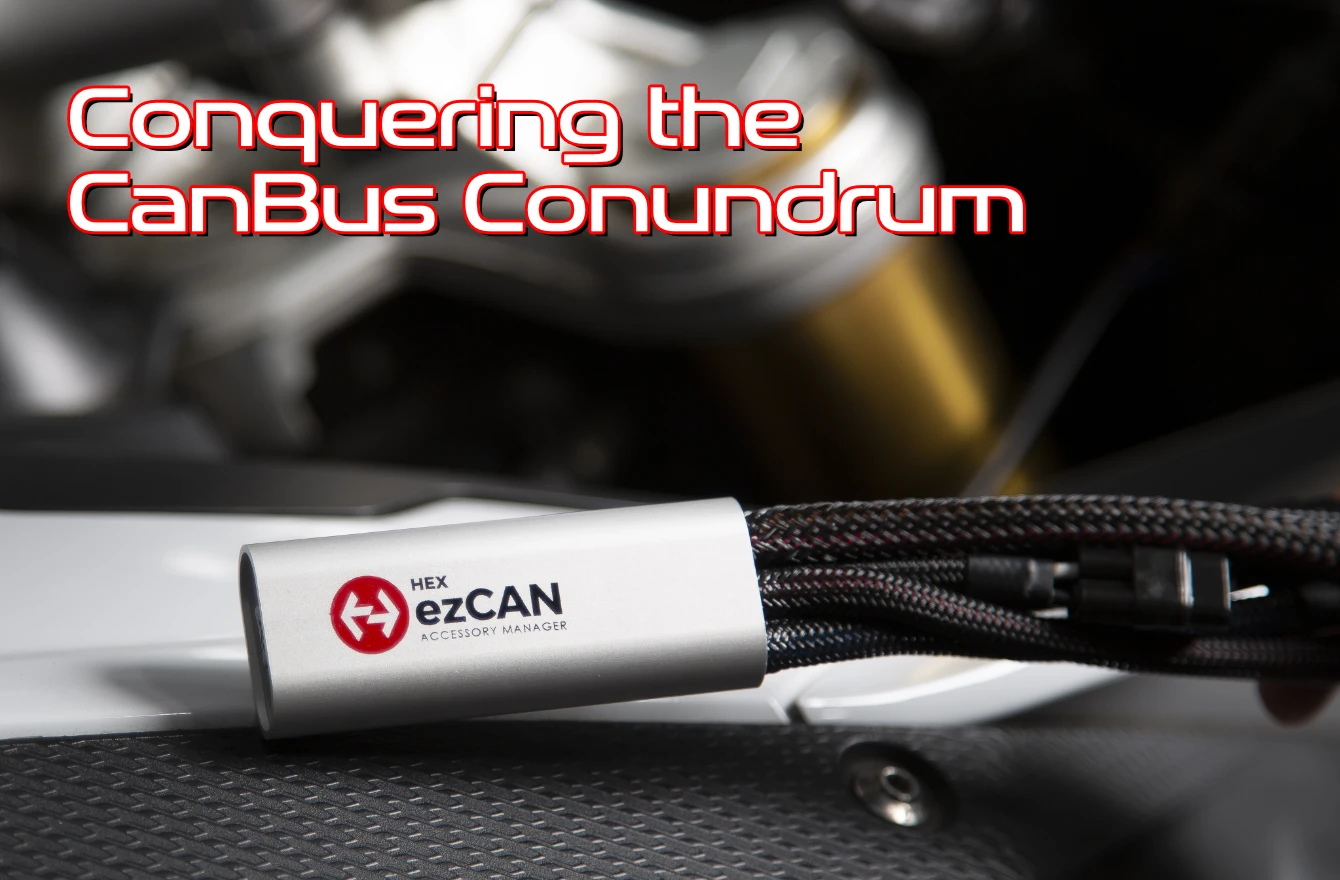

The Hex ezCAN expands your motorcycle’s CanBus system, creates four additional power feeds (sometimes called “switched lives”), and gives you the ability to mix, match, and customise how some of the systems on your motorcycle behave.
It is all very impressive, but why do we need them? You could blame Bosch, but they were only fixing a different problem.
CanBus History
In early 1986, the German industrial giant Bosch presented their design for a Controller Area Network Serial Bus system – what we call CanBus today – to the Society of Automotive Engineers, and in doing so, Bosch cured one problem and unknowingly invented another.
What Bosch fixed with CanBus was the ability to monitor systems on vehicles, allowing increasingly complex electronic systems to be controlled in real-time.
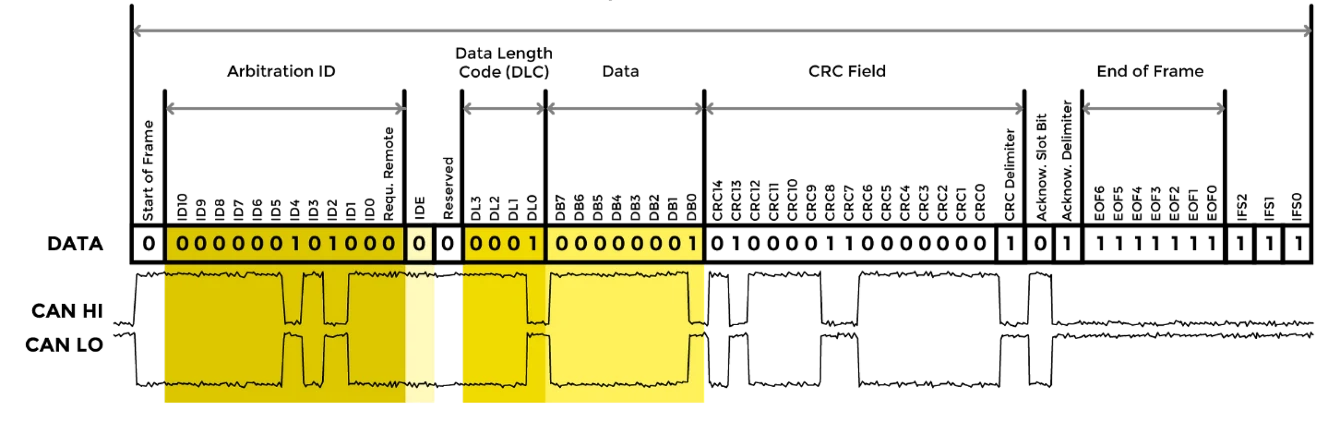
The problem Bosch inadvertently created was that with a CanBus system monitoring and maintaining the vehicle, any departure from “normal” is seen as a fault, even if that is something as simple as adding extra lights.
If something goes wrong, such as the rear brake light switch on my Multistrada failing, CanBus systems are excellent. I didn’t know the switch had failed. The switch on the front brake was still working, so the chances are I wouldn’t have noticed the failure until the next MOT.
However, the CanBus system knew something was up as it stopped the cruise control from engaging – the rear brake is one of the ways cruise control can be disconnected – and put an error on the dash.
A quick trip to the dealer, where they plugged in their magical diagnostic box, and hey-presto, the engineers knew exactly what the problem was.
Sadly, the CanBus system is also what stops me from using the built-in fog light switch on the Multistrada with anything other than Ducati’s official fog lights.
If the auxiliary lights I connect to the Ducati’s wiring differ from the ones that the CanBus system is programmed to expect, it is going to be seen as an error, and the CanBus system will start complaining.
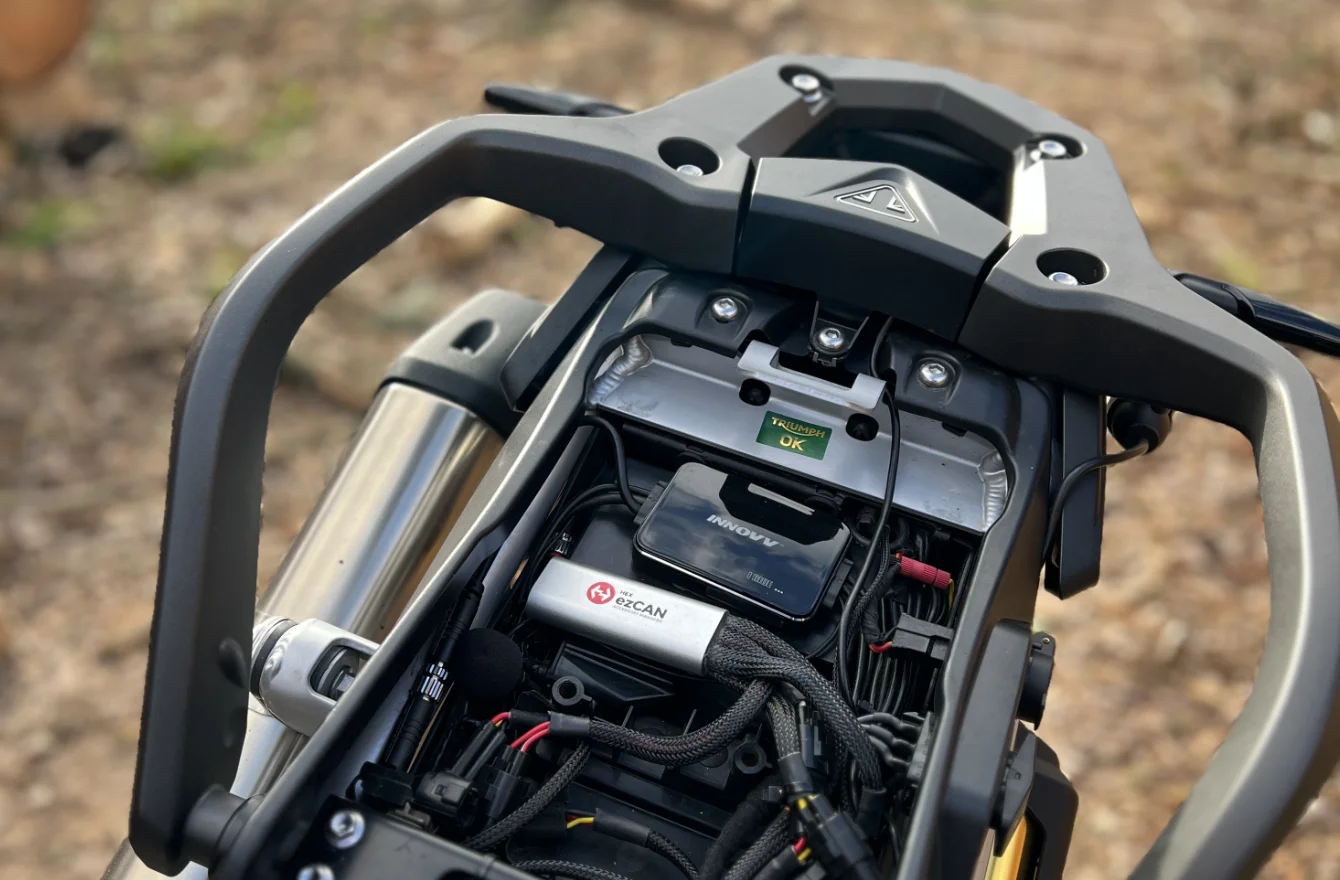
Hex ezCAN
Part of owning a motorcycle is personalising it. The factory-supplied horn on most motorcycles is pathetic. An asthmatic squeak that it is doubtful anyone would hear over the radio or their phone conversation.
The horn isn’t one of the items that the early CanBus system on my 2015 Ducati is monitoring, so I replaced it with a Denali Mini Sound Bomb. And now, when I wish to communicate with other road users, I feel I’m getting my message across much more clearly.
My colleague Carle wanted to over-communicate in these situations and tried fitting the full-sized Denali Sound Bomb to his KTM 1290. The CanBus system on his KTM had other ideas and objected by giving him a “General Error” as soon as he pushed the horn button.
With the CanBus system always watching, adding anything to the electrical system will be challenging.
The Hex ezCAN solves this problem not by bypassing the existing CanBus system, masking, or confusing the manufacturer’s system but by connecting with it and extending the factory CanBus system, giving you the ability to control what happens when specific signals are seen.
The Clever Bit
With the Hex ezCAN plugged into the existing wiring – it is a plug-and-play installation – you now have four additional power feeds for accessories. But the best bit is you can now configure the Hex ezCAN to issue instructions to the CanBus system.
With a full-size Denali Sound Bomb connected to the Hex ezCAN, it is a simple task to tell the ezCan to power the sound bomb when the horn button is pressed.
When the CanBus system detects that the horn button has been pressed, it signals the manufacturer’s electronics to send power to the original horn. The Hex ezCAN sees the same signal and sends power to the Denali Sound Bomb connected to the ezCAN at the same time.
In addition, the ezCAN can also send signals into the CanBus system to tell other components of your motorcycle what to do. A favourite extra is to flash the headlight when the horn button is pressed. Or perhaps, when communicating with other road users, you would like the indicators to flash while you have the horn button pressed.
Auxiliary Lights
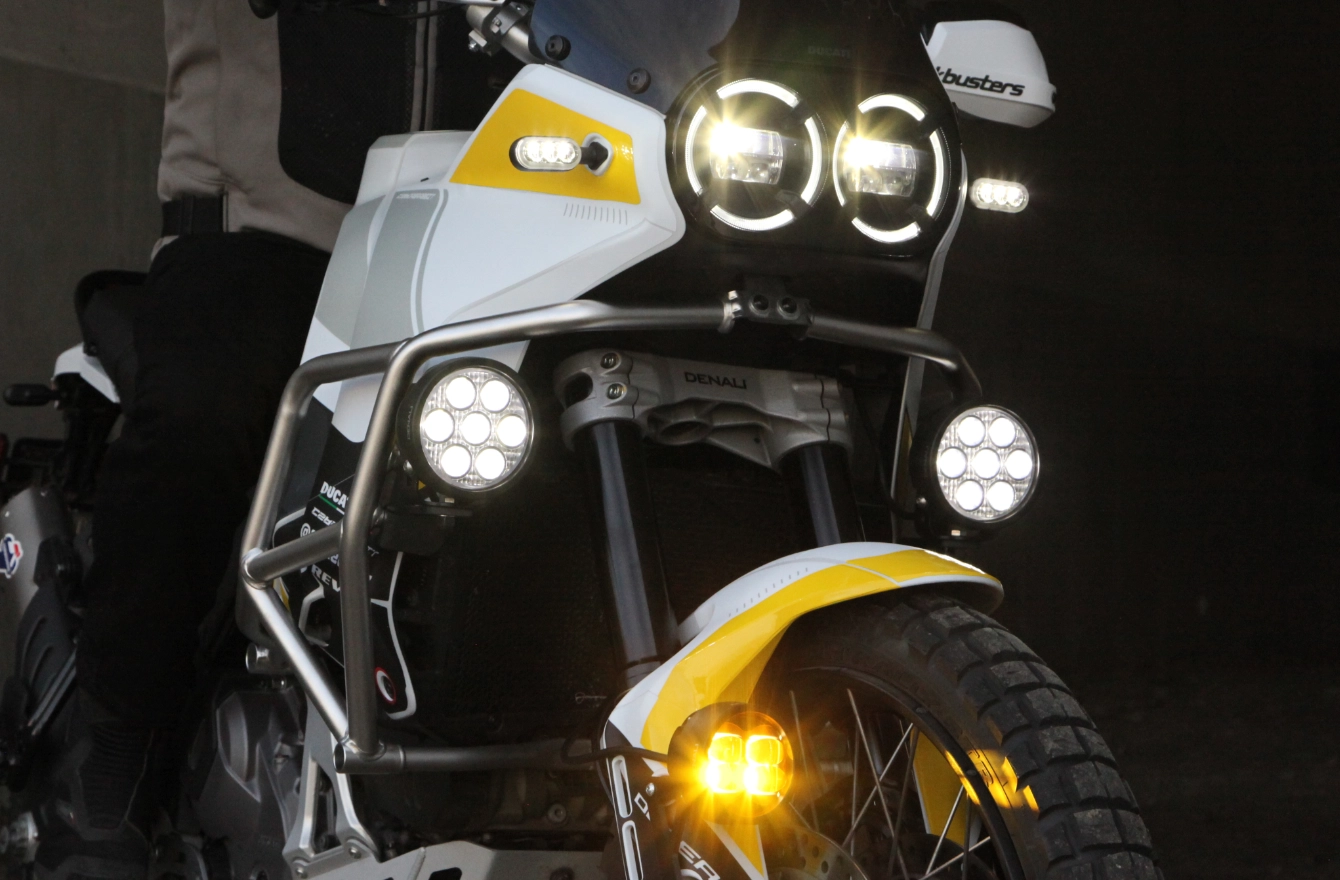
Perhaps the most common use for Hex ezCAN units is adding auxiliary lights.
I went through a long process of getting very bright LED auxiliary lights on my KTM 1090 to function the way I wanted them to. I wanted full power from the lights when the high beam was on, but for town riding, all that was needed was half the massive number of lumens the extra LED lights output.
Thankfully – or perhaps annoyingly – my KTM 1090 didn’t have a CanBus system monitoring everything, but KTM had kindly added numerous switched live power feeds at the front and rear of the bike for me to play with.
Getting the lights working as I wanted took several attempts. What would have been a simpler, neater and easier solution would have been to install a Hex ezCAN and use it to instruct the CanBus system to do what I wanted.
I could have used the information from the light sensor that controls the dash brightness to dim the auxiliary lights at night unless I had full beam on, in which case the instruction would be to give me full power.
I could have also turned the auxiliary light off on the side where the indicator was flashing. Or perhaps have the auxiliary light flash in turn with the indicator.
Or … well, you get the idea. If you really wanted to, I’m sure you could tell the horn to sound every time the indicator flashed.
Programming
If getting all of this to work would require me to spend hours hunched over a laptop, drinking Redbull and eating Jelly Babies – as I’m told computer programmers do – then I think I’d prefer to do things the old-fashioned way. Thankfully, the satanic art of computer programming has been done for us.
Hex Innovate, the manufacturers of the ezCAN, have pre-programmed the most popular options into the ezCAN. Choosing what you want the ezCan to do is as easy as selecting what to put in your favourite burger.
The power setting for auxiliary lights is selected through on-screen sliders that are part of the configuration program. If you want the lights to flash when the horn is pressed, there is an on/off option for that and a host of other features.
And because it is push-button configurable, you can always change the settings and try something else if it isn’t doing what you want.
Bottom Line
It is rather weird that in curing the problem Bosch created, we now have an easy solution that gives us even more options.
But that is some deep-thinking shizzle, and for me, it is the simplicity of the ezCAN solution that I appreciate.
Now, if only I could talk Hex Innovate into developing the ezCAN for those of us with eight-year-old Ducatis, in addition to the range of fancy new bikes they have covered.