Bleeding brakes. That phrase in everyday English means two different things.
The first is the traditional meaning – changing the brake fluid on your motorcycle.
The other, although commonly spelt “bleedin’ brakes”, is an exclamation of the frustration felt when the brake lever you need to squeeze is out of reach for the brake calliper you are trying to bleed.
Changing the brake fluid is one of those jobs that we should do more often than most of us tend to. So, I thought I would see if science or technology had come up with easier ways to bleed motorcycle brakes than the traditional method.
As with anything mechanical, especially with something as vital as brakes, seek professional advice if you are unsure and remember I’m an idiot.
The Bleeding Brakes Problem
Motorcycle brake reservoirs and the master cylinder are on the handlebars, while the bleed nipples are on the callipers. The front brake lever I need to pump to get the fluid to push through the system is top right, and one of the bleed nipples is low and on the left.
Anyone who has bled brakes will tell you this is a job that is much simpler when there are two of you. One works the lever and fills the reservoir while the other directs proceedings while opening and closing the bleed nipples.
It sounds simple, but at some point, the coordination goes awry, brake fluid gets squirted on bits you don’t want brake fluid on, and generally, what should be a simple task gets overly complicated.
It is time to apply some science to the problem.
The Value Solution
You need to open and close the bleed nipple on the calliper when bleeding brakes manually to ensure you don’t suck old brake fluid back into the system when you release the brake lever.
Hence the squeeze the lever – open the bleed nipple – hold the lever – close the bleed nipple – release the lever method, when bleeding brakes.
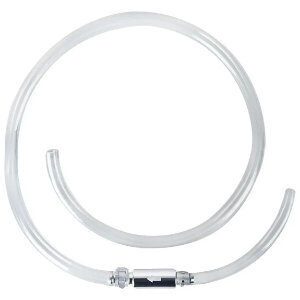 Oxford manufactures a “Solo Brake Bleeding Kit” that helps simplify the problem, by adding a one-way valve to the brake fluid drain tube. Once you have pumped enough fluid into the drain tube to fill the tube and the valve, you can keep pumping without closing the bleed nipple as the valve stops old fluid from being sucked back into the calliper.
Initially, you still have the problem of needing three hands and being in two places at once while you pump enough brake fluid into the valve. The benefit is that once the one-way valve is full, you can concentrate on pumping the lever and filling the reservoir without closing the bleed nipple.
When all the old fluid has been flushed through the system, you will need to squeeze the lever one more time and hold it to the bars while closing the bleed nipple on the calliper. Which sadly brings us back to needing to be in two places at once.
I have an Oxford one-way valve and it is a good improvement over the traditional method, but it still isn’t perfect.
The Venhill Vampire
The Venhill Vampire is, without a doubt, the slickest solution I’ve found. It truly does make bleeding brakes a one-person, no-hassle job.
The clever bit is that the Venhill Vampire uses reduced pressure in their bleeding system to suck the brake fluid out.

Connect the Vampire to the bleed nipple on the calliper and use the hand pump to suck air from the system, creating suction. There is a pressure gauge showing you how much suction there is in the system, but you only need one or two pumps to create the pressure differential needed.
Before opening the bleed nipple on the calliper, remove the cap from the brake fluid reservoir so that a vacuum isn’t created as the Vampire sucks the old fluid out.
Without this, the Vampire and the vacuum in the reservoir would end up fighting each other and the fluid wouldn’t be pulled through the system.
Loosen the bleed nipple on the calliper, and the Vampire will start sucking the old brake fluid from the system and into the collection chamber.
As soon as the fluid is flowing, you no longer need to do anything at the calliper and can concentrate solely on adding new brake fluid to the reservoir as the level drops.
When the new fluid has been sucked all the way through the system, close the nipple on the calliper, which stops the flow of brake fluid. Ensure the reservoir is full, replace the reservoir cap, and the job is done.
No brake levers to pump. No nipples to open and close repeatedly. Fast, simple and effective.
And the extra bonus? When you disconnect the Vampire, the suction pulls the last of the old fluid in the drain tube into the Vampire’s collection chamber rather than it dribbling onto the calliper and the garage floor.
You have to love science when it makes a job easier.
Build Quality
It would have been easy to make this out of cheap plastic. Venhill could have cut a 100 corners and in this disposable age made something that would have worked a couple of times and then given up.
They didn’t.
The handgrip and the pump are metal. The gauge mounting and nozzle are brass. There is a decent manual explaining how to use the Vampire to not only bleed brakes but also test a number of other things such as thermal vacuum switches.
But the best part for me was on the back page of the manual. A list of spare parts should you ever need one.
Proper old school quality. Made to last and should something fail in the future, buy the part you need, not a whole replacement until.

Clarity
All the way through this article, considering it is called a Venhill Vampire, I’ve wanted to use the line “I want to suck your brake fluid”. Having resisted until the very end, I finally gave in.
My thanks to Venhill for the loan of a Vampire to assist in writing this article.