
Not everyone owns an ultrasonic cleaner. They’re brilliant machines, and there’s a reason professional workshops swear by them, but the price can be off-putting if you’re only looking to clean the occasional bolt, bracket, or washer.
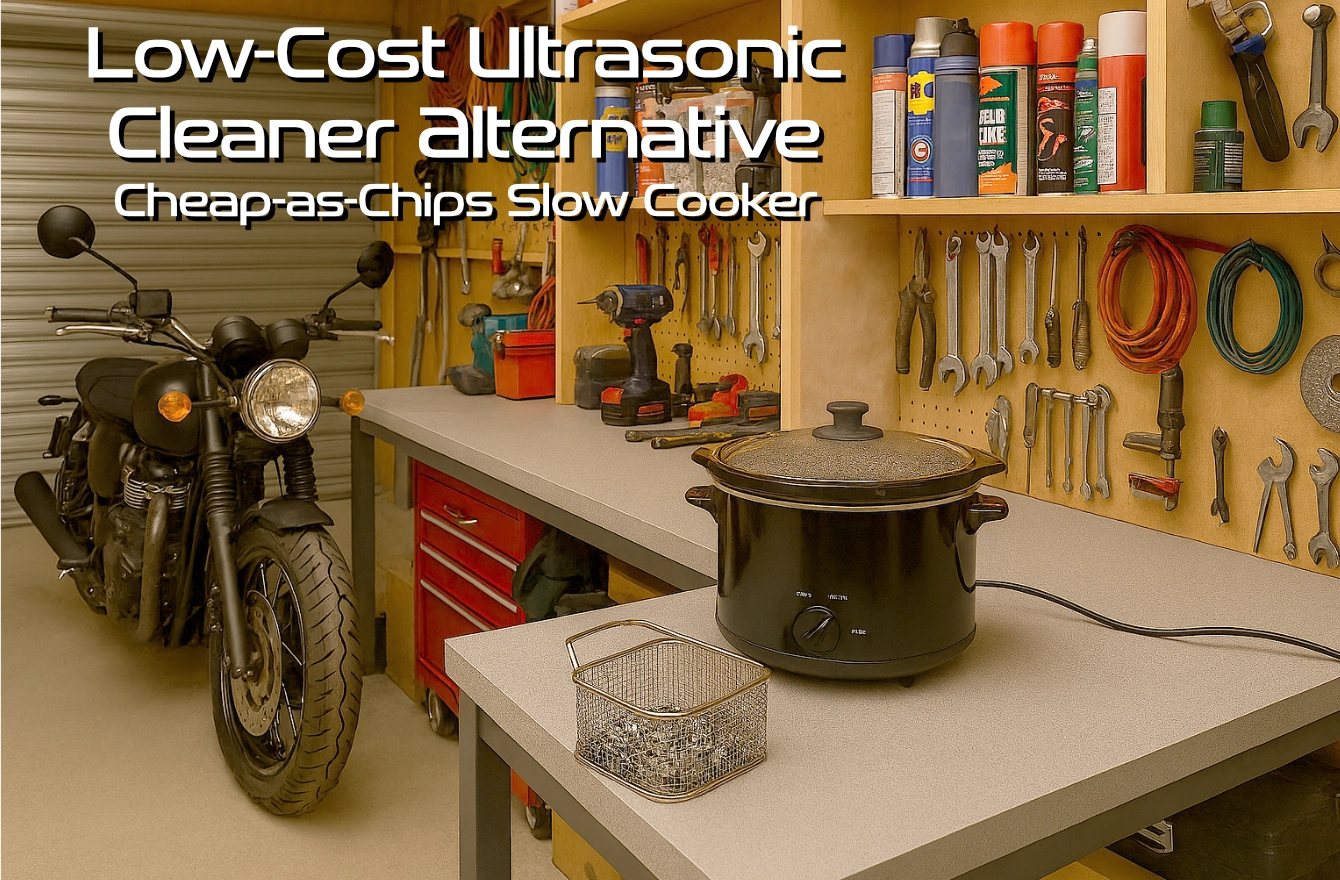
If you’ve ever wondered whether there’s a cheap ultrasonic cleaner alternative, the answer is surprisingly simple: a second-hand slow cooker. It doesn’t replicate ultrasonic cleaning technology, but for the right parts, it offers a genuinely helpful, low-cost DIY method that gets the job done.
We found a slow cooker on Facebook, did some chemistry shizzle to find out what worked and what didn’t and now have a collection of shiny bolts.
Are we tight-arsed… maybe, but saving at least £100 over the cheapest ultrasonic cleaner we could find that was a reasonable size, always feels good.

Ultrasonic Cleaner Alternative
The beauty of this trick is that slow cookers are everywhere. People buy them with good intentions, use them twice, then shove them in a cupboard for five years before finally giving up.
You can usually find a perfectly functional unit for £5–£10 on Facebook Marketplace – where I got mine – Car boot sales, Local charity shops, Freecycle if you’re lucky and even eBay if it is local.
All you need is a simple mechanical slow cooker with a High/Low/Warm switch. No digital displays, timers or fancy features required.
To avoid the hounds of hell and several beatings, don’t use the slow cooker you found in the kitchen. Despite being at the back of a cupboard, never having seen the light of day since it was bought, if you get caught using it to boil bike parts, you’ll trigger a level of domestic outrage usually reserved for using the wrong chopping board.
Why a Slow Cooker Works
Let’s be clear: A slow cooker does not replace a proper ultrasonic cleaner. It doesn’t create cavitation bubbles, shock vibration, or the fine‑detail cleaning that ultrasonic tanks are known for.
Nonetheless, warmth alone massively increases the effectiveness of cleaning solutions. Grease softens, dirt breaks down, and corrosion loosens—all without expensive equipment.
So while it’s not a true ultrasonic cleaning process, it’s still a practical, budget-friendly alternative for small motorcycle parts.
Tuning The Mixture
Different motorcycle parts need different mixes. Having tested them on a variety of bits, the mixtures that worked best for us are:
| Solution | Best For | Mix | Why | Cook Time |
|---|---|---|---|---|
| Degreaser & Hot Water | Oily bolts, chain guard hardware, engine screws, and general grime | 1 part water‑soluble degreaser (XCP is good) to 4 parts hot water | Warm degreaser cuts through engine oil dramatically better than cold. This is the closest slow cooker cleaning gets to the feel of a real ultrasonic clean. | 30–60 minutes on High |
| Bicarbonate of Soda & Water | Light rust, scuffed steel hardware, old washers, brackets | 2 tablespoons of bicarbonate of soda in 1 litre of hot water (optionally add washing‑up liquid) | A bicarb bath softens rust and prepares the surface for brushing. | 45–90 minutes on High |
| White Vinegar & Water | Aluminium corrosion, carburettor bodies (carefully), coolant‑related mineral deposits | 1 part white vinegar to 2–3 parts water | Vinegar is mildly acidic. Heat accelerates the chemical reaction. Diluting the solution with water helps it spread into smaller areas. Aluminium must be rinsed quickly to avoid etching. | 10–20 minutes on Low (rinse immediately) |
What To Do After “Cooking”
Once your parts have had their warm bath, here’s the finishing routine:
- Rinse Thoroughly. Use hot water to flush out cleaning solution residue. Vinegar can etch aluminium if left too long.
- Brush as Needed. Now the grime is softened, a toothbrush, brass brush or stiff nylon brush finishes the job easily.
- Dry Properly. Prevent flash rust on steel parts by drying them thoroughly. Compressed air or your Brühl Bike dryer works well—otherwise, a warm radiator or a fan heater.
- Protect Steel. After cleaning everything, steel parts benefit from a light coating of Bulldog BDX, WD-40, or machine oil.
- Aluminium usually needs a quick polish to ensure all the cleaning mix has been removed.
Chip Baskets (Fries)
One small but worthwhile upgrade to this whole slow‑cooker‑cleaning setup is adding a wire basket.
 You don’t want your bolts, washers, or brackets sitting directly on the slow cooker’s base — that area gets the hottest, can create hot spots, and, in extreme cases, might discolour the metal. It also makes giving the parts a mid-clean shake awkward.
A simple stainless-steel basket keeps everything suspended, allows the cleaning solution to flow freely around each part, and makes the whole process much tidier.
You don’t need anything exotic either. A cheap chip‑shop-style fry basket or stainless serving basket, such as these from Amazon, works perfectly.
Drop your parts in the basket, lower it into the solution, give them a shake halfway through, and when the “cooking” time is up, you get everything out in one go. No fishing for tiny washers with a fork, no rummaging around in hot, murky liquid — just a simple, clean, safe way to handle everything at once.
Bottom Line
A slow cooker won’t beat a real ultrasonic cleaner. It isn’t as fast, precise, or aggressive at removing deeply embedded grime. But as a low-cost alternative to ultrasonic cleaning, especially for bolts and small parts, it’s far more effective than scrubbing them by hand in a plastic tub.
For £5 and a bit of kitchen‑cupboard chemistry, it’s a handy workshop trick that saves time, saves effort, and cleans better than you might expect.