

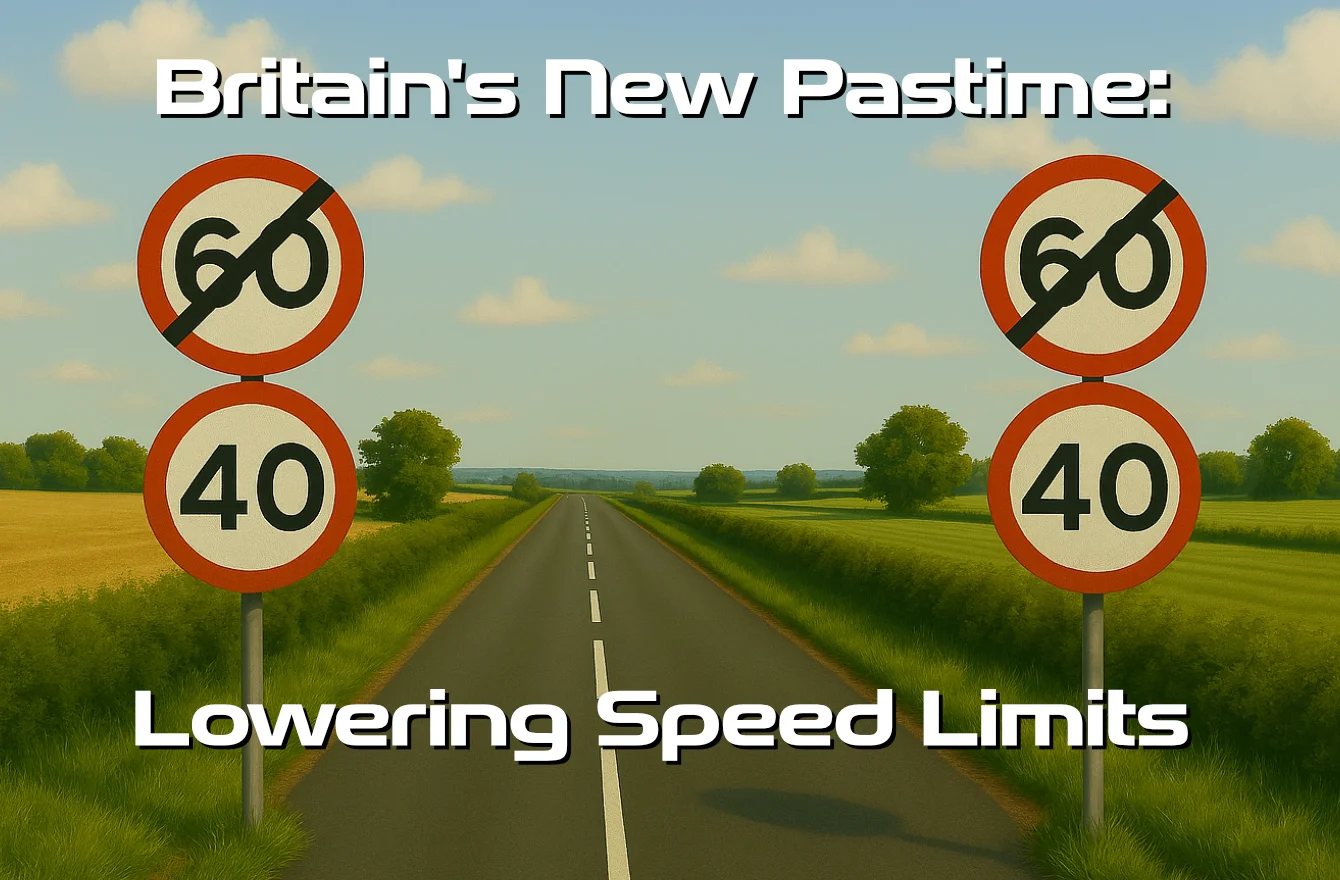

You’d best strap in for this one … I’m on one …
Rant Mode On…
If you ride a motorcycle in the UK, or for that matter, drive one of those car-things, you’ll have noticed a pattern: every road that used to get you where you are going with all reasonable haste is being slowly suffocated under freshly printed “40” or “50” signs.
It’s like someone in a county hall somewhere woke up, spilt their tea, and decided it was time to ruin everyone else’s day.
And before anyone starts pointing fingers at Westminster, let’s be clear: the Government hasn’t ordered any nationwide crackdown on speed limits [That would require thought and a plan ~ Ed]. The Department for Transport’s own guidance says speed limits should be “evidence-led and self-explanatory,” not randomly sprinkled around like confetti at a wedding.
It also states that their guidance isn’t binding—local authorities can follow it… or, apparently, decide “Nah, let’s do whatever,” which increasingly seems to be the preferred option.
Arbitrary Speed Limits
If you ride, you’ll already know that poorly chosen speed limits hurt us more than car drivers.
A motorcycle thrives on balance, smoothness, and momentum. When a flowing B-road gets nuked from 60mph down to 40mph for “reasons,” we lose the smooth flow and extra stability. What was once a sweet rhythm becomes an exercise in holding third gear like a learner on test day.
And yet, despite the fact that the DfT guidelines emphasise using “the right speed limits in the right places” and introducing lower limits only “over time and with local support,” that support for the change rarely manifests outside a consultation buried deeper than squirrels bury their winter stash.
Who’s Pulling the Levers?
It isn’t Parliament, and it isn’t the Police.
Speed limits are set by local traffic authorities, which means county councils, not district councils. County Councils have the legal powers, and the government guidance explicitly says so.

For motorcyclists, that explains a lot. You’re not dealing with national policy; you’re dealing with whichever committee got to the biscuits last that morning and is now in a bad mood.
As for consistency between counties? Forget it. You may as well flip a coin at the county border.
The Fosse Road
The Fosse Road in Nottingham was once the A46 and has now been replaced by a fancy dual carriageway. It was once the main arterial road connecting Leicester with Newark. On my way to the office earlier this week, I noticed the speed limit had been reduced on the sections flanked by fields.
Nottinghamshire County Council publishes its notifications – they are called Traffic Regulation Orders or TRO – on a consultation portal that is a subset of its main website.
If you can find that portal, with a bit of searching, you’ll find:
- A 2016 order reducing Fosse Road (East Stoke) from 40mph to 30mph “to improve road safety.” – Yes, agree with that one as East Stoke is a village and the road runs right through the middle.
- A 2025 proposed TRO offering a confusing mix of 40mph and 50mph patches along Fosse Road, Fosse Way and associated villages, justified by vulnerable road users and the lack of footways. And this is the one that has lowered the speed limit in places where there is nothing but fields.
So yes, technically, the public was “consulted.” Notices were “published.” But let’s be honest—posting it on an obscure council sub‑site is like whispering into a hedge and calling it communication.
As for the local support part of the DfT guidelines, my guess is that some local residents asked for further reductions – they have themselves a community speed camera – and bingo, the hundreds of people who use the road every day are affected.
And let’s not even get into the extra pollution that decelerating and accelerating randomly creates.
You can find TROs for Nottinghamshire Here
The Bigger Picture
Motorcyclists rely on clear, consistent, logical speed limits more than anyone. We’re not protected by crumple zones. Our safety depends on reading a road accurately. That’s why the DfT’s evidence-led approach makes sense: limits should reflect the nature of the road, not the nature of local politics, pressure groups or resident associations with a different agenda.
But instead of consistency, we’re seeing a drip‑feed of reductions with no obvious trigger for their need.

New housing might be years away, populations unchanged, accident stats stable—yet the number on the speed limit sign suddenly becomes smaller.
Meanwhile, the studies showing that simply lowering a limit doesn’t automatically increase safety don’t figure in the debates. Yes, there is solid evidence that shows the lower the speed limit, the less attention people pay.
Behaviour Doesn’t Change
A before-and-after study in Minnesota found that drivers reduced their speed by only 1–2 mph after limits were lowered. Situational awareness is more of a stimulant than signs.
The B500 in Germany is a great example. It has a 70KPH speed limit, but the road is so wide it feels as if you could run faster than you are travelling. A relaxed mind and scenery to look at equals less attention to what is going on. Go down the same B500 at 120KPH, and you know people would be paying attention.
A driving‑simulator study measuring eye movements found that lower speeds correlate directly with reduced fixation activity, meaning drivers scan less and engage less visually with their surroundings.
There are over 175 behavioural studies show that when driving becomes less demanding, drivers exhibit reduced vigilance and their mind-wandering increases.
Studies by IIHS show that when the driving task feels easier, drivers become more complacent and more distracted, demonstrating a strong link between low task load and low attention.
The Safety Argument Catch‑All
For Fosse Road, the justification leans heavily on cyclists, pedestrians and the lack of footways. Fair enough—but these conditions didn’t appear overnight. Many have existed for decades, and with the new A46 dual carriageway, most of the traffic no longer uses the road.
The idea that speed suddenly became the danger feels like a narrative crafted for convenience.

Zero Acknowledgement
In all these TROs and site notices, motorcycles barely get a mention. Vulnerable road users? Yes. Cyclists? Yes. Pedestrians? Yes. Motorcyclists? Apparently, we don’t exist.
You’d think with the push for safer travel, someone would recognise that arbitrarily slowing a motorcycle mid‑flow on an open rural road isn’t just annoying—it can be unsafe.
Why This Matters for Riding Culture
Riding in the UK has always balanced safety with enjoyment. We’re not out there scraping knee sliders past primary schools. A consistent set of speed limits that respects our ability to judge conditions, assists in maintaining a smooth flowing riding style and doesn’t place us at risk is all I’m asking for. And don’t take the French way out and say “OK, everything is a 50”.
The growing sprawl of arbitrary limits is chipping away at what makes riding great. Roads that once let you breathe now feel like someone fitted your bike with a restrictor plate.
Bottom Line
If councils want compliance, trust, and real safety improvements, they need to stop treating motorcyclists as an afterthought.
Follow the DfT guidance in spirit, not just when it fits the narrative needed to pander to one group or another.
Explain the changes clearly. Put notices where people actually look. Listen, really listen to the feedback, and for the love of smooth cornering, stop lowering limits just because someone, somewhere, might complain someday.
Because right now, it feels less like thoughtful speed management and more like death by a thousand speed‑limit signs, and if that doesn’t work, they’ll break out the average speed cameras.
…Rant Mode Off
All the images are AI-generated – Like you didn’t know that already. No Karens were hurt in the writing of this article.











One Response
they do that here too. if there’s a pothole, they lower the limit. if there’s too many pensioners driving slow out to shoalhaven heads, they lower the limit