You have passed your test, put some miles under your belt, realised that surviving wasn’t the same as riding well, and looked for advanced motorcycle training. It sounded sensible. Responsible. Almost grown‑up.
Modern bikes are fast and bristling with electronics. Braking systems are light years ahead of the machines many of us learned on. Traffic density has exploded. Distraction is built into modern life.
And yet, much of what we call advanced motorcycle training still traces its DNA back to a book written when headlamps were optional, and roads were empty.
That doesn’t make it wrong. But it does make it worth questioning.
And before this all kicks off into an argument, I’m NOT criticising but questioning. If we think that what we learned 10 years ago applies 100% today … I’m going to challenge that assumption.
Post‑Licence Advanced Motorcycle Training
Traditionally, this means IAM or RoSPA. Structured. Disciplined. Sensible. No wheelies, no heroics, no nonsense. Just observation, planning, positioning, and progress.
And for many riders, that alone brings real benefit. More awareness. Less rushing. Better judgment. I’m not here to tear down what works, but I am asking whether what worked still fits the road we’re riding today.

Police Riding – Civilian Roads
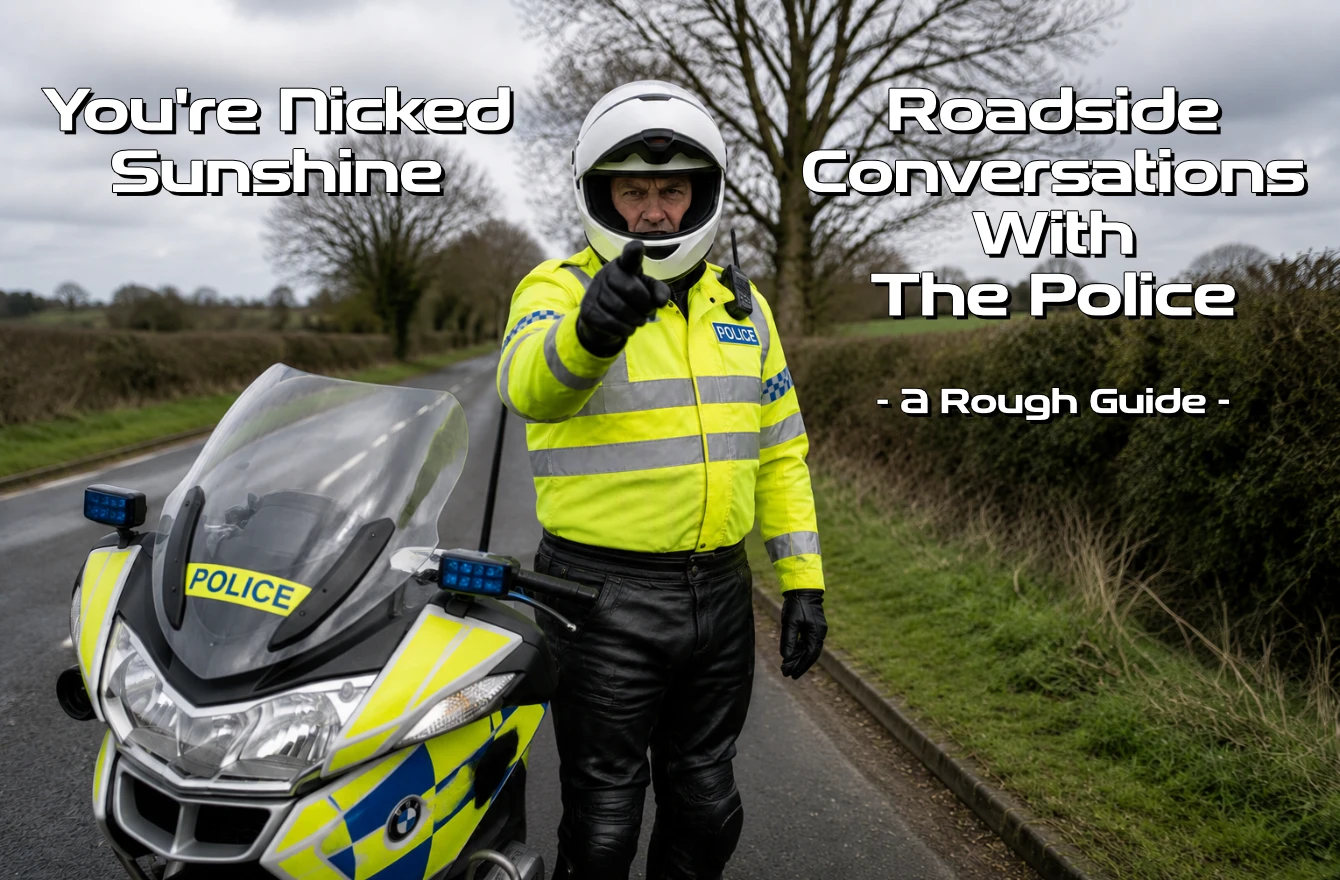
Most advanced civilian schemes are rooted in Police Roadcraft. That’s not a secret, and it’s not inherently a problem. Police riders are exceptionally capable. Smooth. Controlled. Impressive to watch.
But they are also selected, professionally trained, and continuously reassessed. They ride daily, often at higher speeds, with radios, blue lights, “Police” emblazed on their motorcycles, authority, and institutional backing. Their riding exists within a very specific operational context.
For the rest of us, it does not.
We ride for pleasure, transport, or therapy. Often infrequently. Often rusty. Often distracted by life rather than focused on pursuit or response.
Borrowing principles from police riding is one thing. Quietly assuming the context is transferable is another.
Making Progress
Few phrases in advanced motorcycle training are as emotionally loaded as making progress. It makes me cringe every time I hear it.
Used well, it encourages decisiveness and flow. Used badly, it becomes a justification for pace.
I’ve seen it interpreted both ways. Sometimes by trainers. Sometimes by riders. Sometimes by riders who believe they have now transitioned to some ethereal plane because they have an “advanced” qualification.
The uncomfortable truth is that confidence grows faster than competence. Especially when reinforced by a badge, a pass, or a quiet nod that says, “You’re one of us now.”
None of this is deliberate. But it is human.
Motorcycle Safety Hasn’t Improved
Here’s the awkward bit. Despite better bikes, better tyres, ABS, traction control, and now increasingly sophisticated rider assistance systems, UK motorcycle casualty figures slowly increased for years.

That doesn’t automatically indicate that advanced training is failing, but it does raise a reasonable question:
If technology keeps improving and training content remains valid, why aren’t we seeing results?
Doing the same thing more carefully isn’t an improvement. It’s repetition.
Panic Causes Crashes
An alternative view – and resonates strongly with my own riding – is that panic, not poor observation, may sit at the root of many crashes.
Perhaps rather than panic, situational overload is a more acceptable phrase. You lose the rear on diesel coming out of a corner, and as the slide starts, you instinctively close the throttle. The typical result is a high side.
In the same bucket of instinctive, automatic reactions, we could put:
- Braking harder than we’ve ever practised, but never to the maximum
- Rolling off abruptly mid‑corner because we think it will slow everything down
- Fixating on one thing
- Freezing because we have reached mental capacity
- Doing nothing because we don’t trust what the bike will do
None of these is a failure to observe. When something out of context happens, we try to process the situation – fail – and end up doing the wrong thing.

And someone getting on the scantamonius soap box and saying “You should have expected/seen that” doesn’t help. You didn’t, and now you need skills your traditional advanced training didn’t teach.
Machine Control Is Not a “Basic” Skill
Emergency braking at speed is rarely practised properly. It isn’t tested during the licence process (at speed is the key phrase). It’s often assumed that observation will prevent the need.
Anyone who rides in the real world knows that assumption doesn’t survive first contact with a white van.
Cornering confidence is similar. Riders are told where to position, when to turn, what line to take – but not always given enough exposure to what the bike actually does when pushed, unsettled, or loaded unexpectedly.
Machine control is sometimes treated as basic, or worse, assumed. It shouldn’t be.
Modern Bikes, Old Assumptions
Today’s motorcycles are phenomenally capable. They can brake harder, lean further, and recover more gracefully than most riders ever discover.
The gap between what the bike can do and what the rider believes it can do is often huge.
Advanced systems like ABS only help if the rider is willing to use them. And many riders still aren’t, because they’ve never actually felt the system work in practice.
Confidence that comes from understanding beats confidence obtained from a certificate every time.
Is Advanced Motorcycle Training Still Relevant?
Yes, but not automatically.
Post-licence motorcycle training remains valuable when it evolves, questions itself, and recognises that civilian riders are not police riders and don’t need to ride like them.
What matters now is more of a balance:
- Observation and reaction
- Attitude and ability
- Planning and recovery
- Progress without panic
- Control without ego
Bottom Line
Despite all my certificates and “qualifications”, I’ve learned more in the last few years by questioning assumptions than by repeating doctrine.
There’s no glory in qualifications. They don’t make me safer tomorrow than I was yesterday. Only practice does that. Reflection. Correction. Occasionally, humility.
If traditional “advanced” motorcycle training means anything today, perhaps it should be not that you’ve arrived, but that you’re still on your way.