



Is motorcycle touring an art, a science or just something you discover how to do in a way that suits you?
There are no end of “top tips” available from people who ride long distances, and even the question of what constitutes a reasonable distance to travel in a day is a topic that will get you several different opinions.
Touring on your motorcycle and making a note of what you would do differently next time seems to be the best education. So from our last session of getting lost, drinking too much coffee, getting rained on and generally messing about on motorcycles, here is what we discovered this time.
What A Bunch Of Tools
On my first flirtation with motorcycle touring, I packed an extensive tool kit. I had spanners and sockets for every occasion. I think I left the torque wrench behind, but I definitely packed a breaker bar at the bottom of the top box.
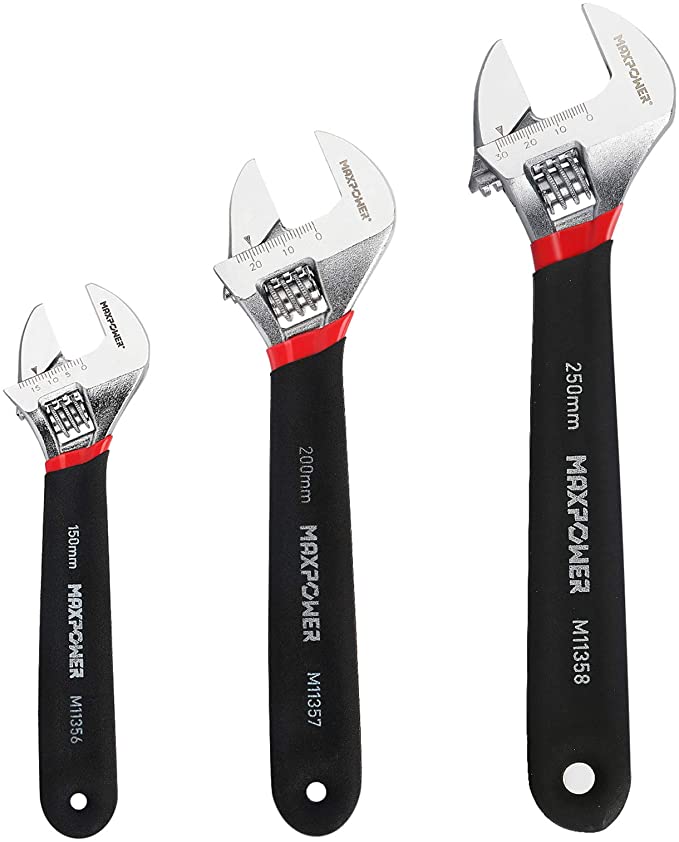
What exactly I thought I was going to fix on the side of the road, I’m not sure. The absence of any spare parts would have defeated anything requiring major mechanical surgery. Other than adjusting the chain or tightening a loose bolt, any roadside repairs would result in a temporary hack to get me to somewhere a better repair was possible.
Over the years, my tool kit has reduced in size. The Devil’s tool, an adjustable spanner, has replaced a comprehensive set of ring and open-ended spanners I once carried. Now the spanners are limited to those needed for specific everyday maintenance tasks. A wide selection of cable ties and a roll of industrial-strength duct tape are the essential “tools” I reach for when packing.
From the scant but effective collection of tools we carried on the last motorcycle tour, duct tape patched a broken pannier lock. It was also used to retain Dave’s adjustments to the Tracer 9GT saddle – more on this in a later article. We also used the bicycle Allen key set, to save a boot slider from being lost.
Some may consider it the easy way out, but good European Breakdown and Recovery Insurance is worth every penny. I’d rather wait for roadside recovery than overestimate my ability to fix a problem at the side of the road. Sod’s law also says it will be dark and raining when things go wrong – not the best of conditions to try and fix something.
Buying Tyres
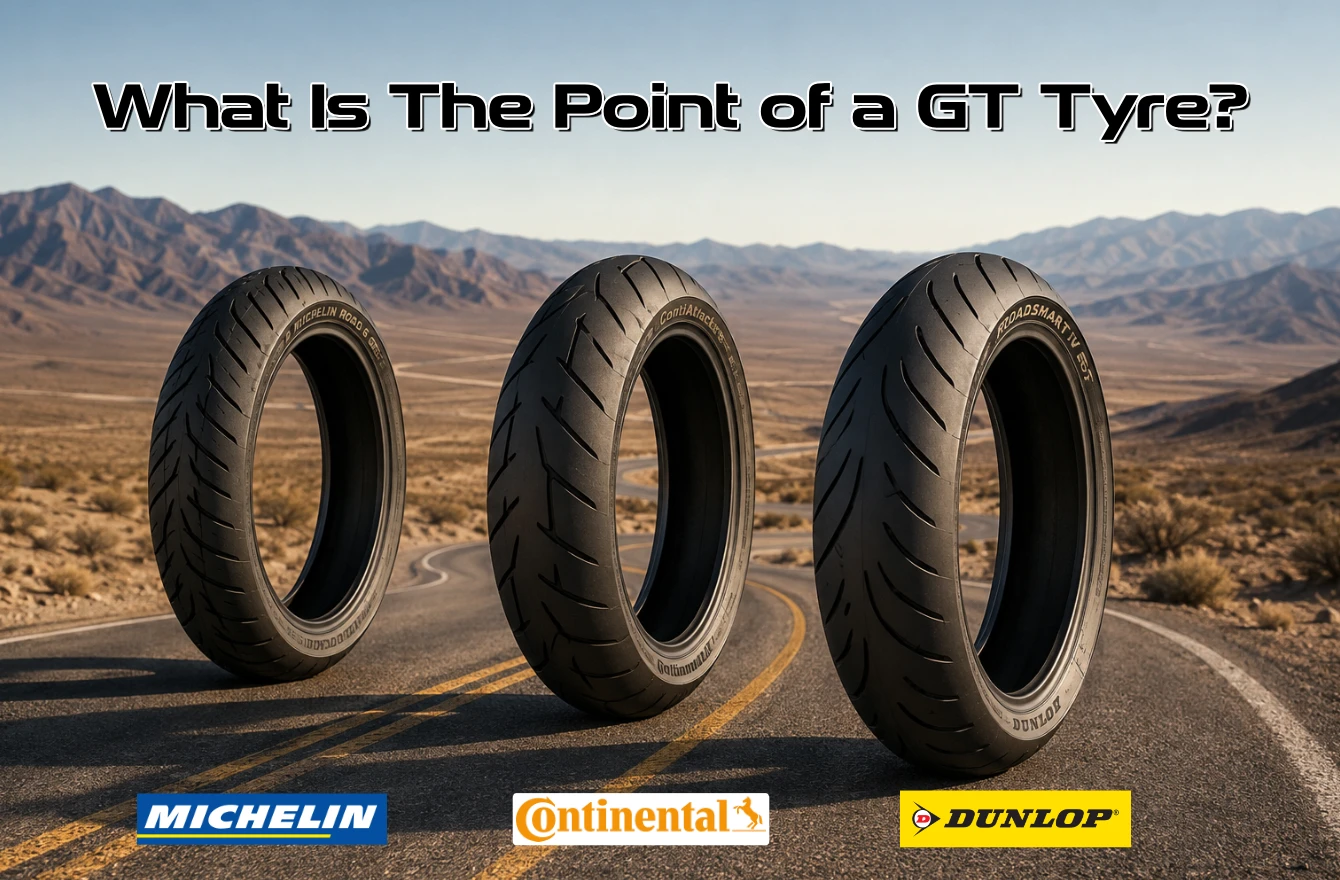
Living in the area covered by Mobile Bike Tyres, getting a new set of Dunlops fitted is as easy as calling Mark and Sarah. Sadly, there is a geographical limit to the area they cover, and there are no guarantees that the same type of service exists wherever you are touring on your motorcycle.
Checking your tyres have enough life for the trip ahead is one thing. Getting a replacement due to a puncture is another.
Sadly, we messed up and thought there was more life in the tyre fitted to the Suzuki GSX-S1000GT we took to Portimão. Or perhaps it was due to our excessive enjoyment of the 150BHP coupled with the comfortable handling. Whether it was poor judgement or excessive exuberance, we needed to find a new rear tyre.
You would think that finding a motorcycle tyre would be a simple task. A quick Google for a motorcycle dealer, and we were away. Our reality, however, was somewhat different.
Finding a motorcycle dealer with the tyre in stock was the first issue. Unfortunately, tyres are not typically items that dealers carry in stock, so a two-day wait was as fast as we could get one, not counting weekends and public holidays.
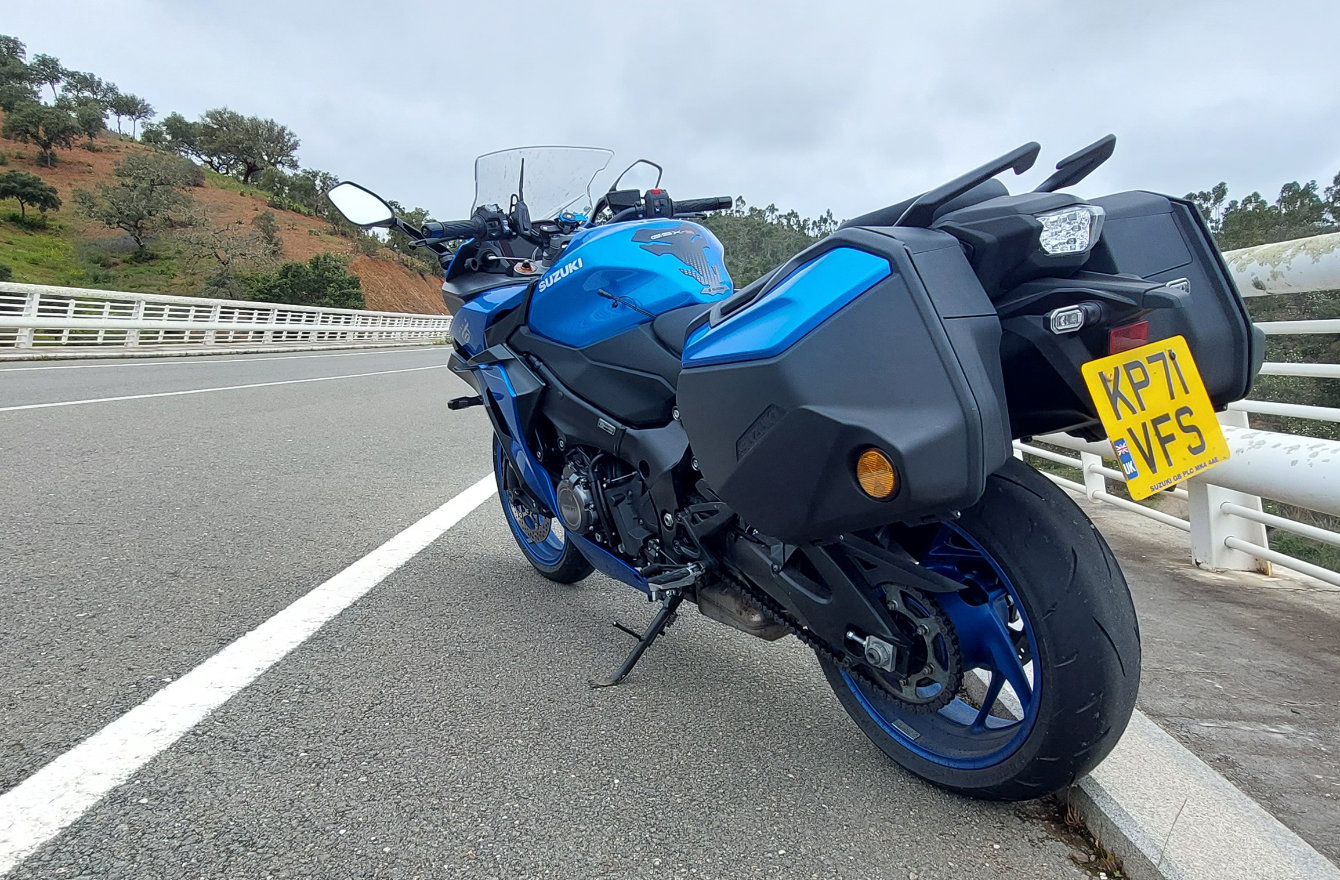 The rear isn’t going to cover another 1,500 miles
Our next brainwave was trying to find someone selling a tyre on eBay, which might have been simpler if we had spoken Portuguese. We did eventually find one on eBay, but a couple of hundred miles in a different direction to the way we were going.
We also tried a Suzuki main dealer in Gijon, but they never reopened after a long lunch break on a Friday afternoon. Not every country has bought into the 8-to-8, seven days a week, retail lifestyle.
Lesson learnt for next time: Know how to ask for a tyre in a few different languages, and if you need one, order ahead, so it is waiting for you when you get to the dealer.
Luxury Items
When packing for a motorcycle tour, the usual mantra is to pack what you need and then lose half of it as it is unnecessary. This is true for things such as socks and t-shirts, as your motorcycle boots will not care if you are wearing yesterday’s socks for a second or even a third time.
There is one item, though, for which there is always space: The portable camping stove.
JetBoil is the well-known brand, but not wanting to pay for the name and coupled with the fact that I’m cheap, I copied Roger and bought the excellent Coleman Firestorm. It is essentially the same thing without the hype.
Our argument for this wonderful device is that it packs up into a small space even if you include the gas canister and provides access to coffee and hot food when you need it most.
Staying in roadside hotels doesn’t always mean that you will have a kettle in your room to make the drink that claims to be coffee. However, a Fyrestorm and a handful of your favourite instant coffee fixes that problem.
Having been caught out before and tried to put together a reasonable meal from the snacks available at a rural petrol station, a couple of pre-packed camping meals often accompany the Fyrestorm. The other thing you need is water and, even if you don’t have a stove, you should always be carrying water.
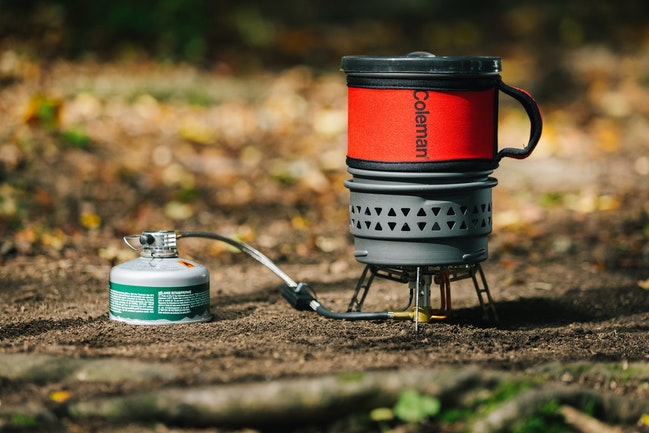 Past Fyrestorm brew ups have included pasta bolognese followed by coffee while waiting for the ferry in Holland. For some reason, there isn’t a café where you queue while waiting for the boarding process to start.
The other brew-up that comes to mind is the ad-hoc cup of coffee on the side of Loch Fyne in Scotland while soaking up the views. Quiet, peaceful and as easy as pulling to the side of the road.
Distance and Curvature
We are entering into dangerous territory here by discussing how far you might consider travelling in one day. Everyone has their own opinion, and naturally, for them, they are right.
One motorcycle tourist I know does day and day about on his travels. Each stop is at least two nights long. One day to arrive, and the next to see the place before moving on after a second night’s rest.
Riding different roads is what I enjoy, and so four or five days on the bike before a double night stop is my preference when touring.
In any of the cases, the intensity of the riding defines the distance you can cover. In the past, I’ve done Calais to Berlin in a day – 576 miles or 927 kilometres. It was a dull day, made possible by spending ten hours hanging on the throttle on Autobahns.
Ten hours riding the Scottish back roads or through the Picos in Spain, and you are not going to cover anything like that distance and will be knackered at the end of it, especially if you are riding a fully-loaded motorcycle.
Part of the dark art of motorcycle touring lies in translating the roads you see on the map into effort and time, rather than reading the total distance and thinking it will only take a few hours.
Good Humour
The expression “It wouldn’t be much of an adventure if it all went according to plan” is perhaps the most important thing to remember when motorcycle touring. Problems will typically resolve themselves unless maybe you are riding through a war zone or in a location where your bike is worth more than your soul.
 Agreed, sitting on the side of the road in the rain with a bike that won’t start is a pain in the arse, but really what is the worst that will happen? Armed with What3Words, decent European breakdown coverage, a mobile phone and Google Translate, I can’t think of much you can’t fix.
However, there is no cure for the sour-faced worry guts that makes everything a problem.
Now, before my colleagues read this and start trying to work out who I’m talking about [they are all paranoid], I’m lucky to spend time with like-minded idiots. They are more likely to take the mickey out of whatever has happened – while helping resolve the problem – than decide the world has ended and contribute nothing but negativity.
Things are going to go wrong. Getting lost, GPS-induced mystery tours, riding naff roads, and getting wet are all part of motorcycle touring. It all contributes to the adventure and makes motorcycle touring an enthralling and engaging activity. So, embrace the mistakes, and remember no one got out of bed this morning planning to have a bad day.
Plus, having your own motorcycle touring tales to tell at the tea stop is more interesting than listening to the guy who thinks a Bike Night 30 miles away is a long way to go for a mug of tea.
Motorcycle Touring – What Next?
No sooner were we on the boat travelling back to the UK than we were planning the next sequence of orchestrated errors, which we call motorcycle tours.
Dave is off to the Harz National Park in Germany – he seems to have a thing for trees – while Carle and Roger are determined to go the full Bear Grylls and are plotting wild camping in Scotland.
What could possibly go wrong? Let’s do it and find out.








2 responses
Forgot to add that my “toolkit” also includes a small can of WD40 (for its intended purpuse, plus removing vignettes without residue), a visor cleaner spray (often refilled with ordinary window cleaner fluid) and a small piece of microfiber cloth.
This is a nice article, capturing the reality of motorcycle touring.
Regarding the toolkit, I wholly agree. A multitool, adjustable spanner, some allen keys (often they are included in the toolkit supplied with the bike), duct tape, cable ties and that’s that.
Bike equipment: a good inflatable seat cushion (Airhawk), and cruise control matters A LOT when mile-munching. Luckily they can be attached rather easily to most bikes.
A recommendation: move the reflective vest as accessible as possible. When I stopped in a downpour at the side of the freeway in Romania to get my rain gear, not a minute has passed before the police stopped and reprimanded me for not wearing reflective vest. It was under the seat that was under my packed saddlebag, so I didn’t bother fishing it out… Luckily they didn’t fine me.
Last but not least, it is worth it not to cheap out on accomodation. In bike forums the measure of ultimate manliness is MC camping off road while killing and cooking your own food. I don’t subscribe to this. I stay in hotels and travel light. No stoves, towels, toiletries, sleeping bags, as few clothes as possible (you can have them washed and dried in a hotel overnight) so 20-40 liters of saddlebag space is enough for a week or two. I tour on a sportsbike and go for enjoyment instead of survival, without surrendering my man-card.