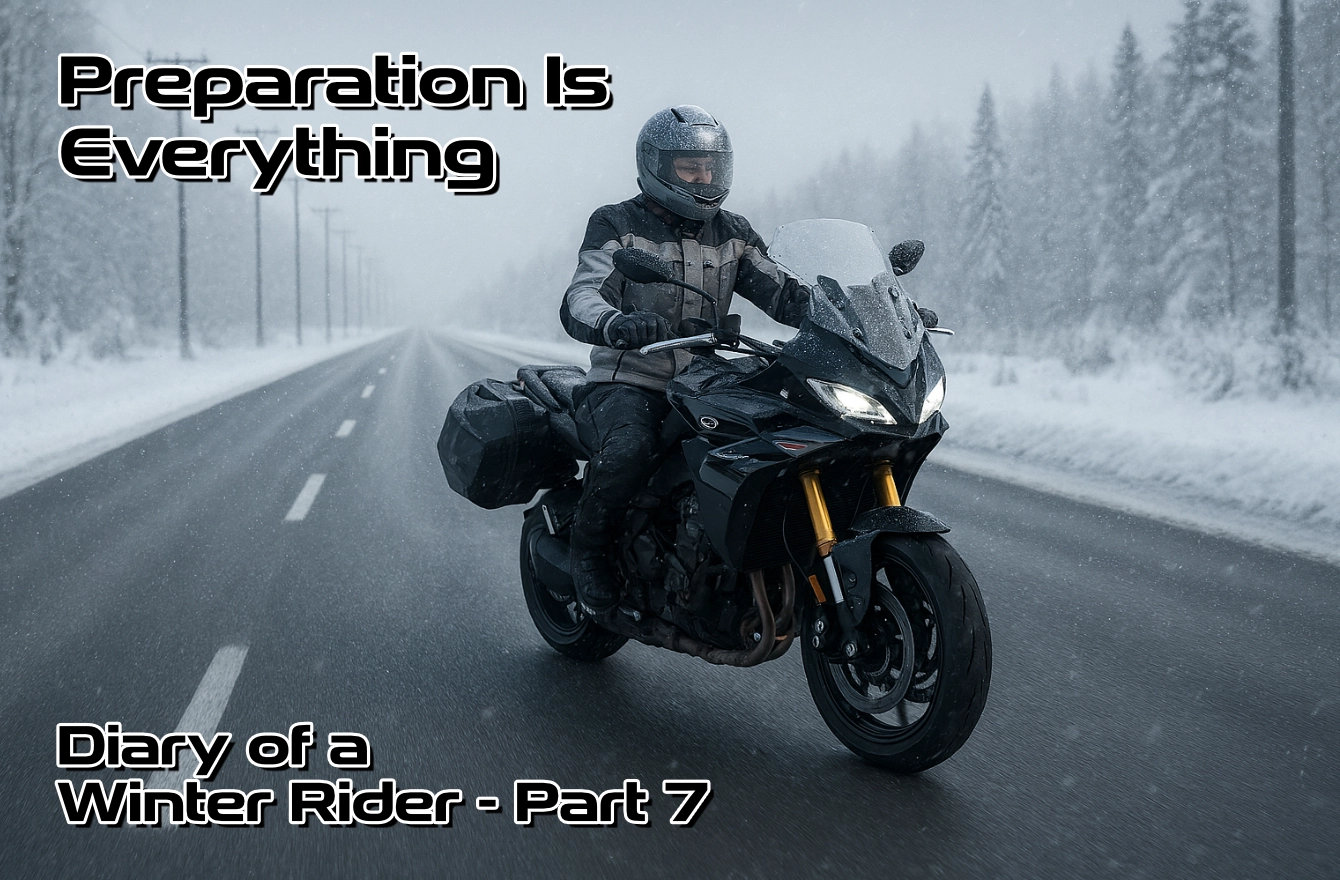

Dear Diary,
Although winter is officially here, the temperature has yet to drop below zero. We have come close a few times, and dressing the Suzuki GSX-S1000GX for winter has been a chilly job.
I know I’m going soft, but I don’t think anyone has yet spotted my KEIS heated vest under my overalls when I’m working in the garage. Although the old-style battery I have is a bit of a lump, I think I’m still getting away with it.
There is a newer, smaller, fast-charging battery available, but as with all my KEIS gear, the stuff won’t break or stop working, so I don’t have an excuse to buy a replacement.
Suzuki GSX-S1000GX
When the idea of once again riding a Suzuki motorcycle through winter came up, the last thing we expected was that the GSX-S1000GX would be the suggested bike.
On a crisp, sunny winter’s day, blowing away the cobwebs with a spirited ride was a welcoming idea, but when thinking about dark, drizzling nights and the roads covered in grime, 150BHP and a quick shifter were not top of my list.
Yet, as I often find in life, I was wrong; the GSX-S1000GX is a delight when the roads are covered in grime, and it is raining. Perhaps a little too good, as the confidence the bike gives – even on OEM tyres – strokes my ego and encourages me.
The throttle mapping and the 4-pot motor are a work of art. There isn’t any step when opening the throttle from all but closed at the apex, just a smooth transition from rolling in to getting back on the power.
Just in case I do get carried away, the traction control is maxed out (setting 7), and the throttle map is on B mode, which is where I preferred it on a 2,000-mile road test a few years back.
Tank Range
The argument in the office is that the tank should be bigger on the GX. At 19 litres (4.2 imperial gallons), the effective range is approximately 160 miles, leaving a margin for finding a petrol station.
 One side of the argument is that this needs to be 200 miles, plus a safety margin. Put another way, it requires an additional 5 litres.
The other side of the argument is that I need coffee and a bio break by the time I’ve covered 150 miles. Perhaps the exception is when using European motorways to cover distance quickly, but 150 miles is all but two hours on cruise control.
I’m on the “keep it the way it is” side of the argument, as I don’t want anything messing with the ease with which the GSX-S1000GX can cut through traffic.
Suzuki kept the weight low, making the GX flickable and quick to change direction when filtering. Making the tank bigger adds weight higher up, giving the extra 4 kilos a longer lever arm.
Maybe it is nothing. Perhaps it is something. But I’m on the “don’t mess with it; it isn’t broken” page.
Puig Flip
Screens are always a matter of personal taste, but even our colleague Roger – the shortest in the office – found the screen a tad low.
So the Puig Flip 2.0 that we ran on the GSX-S1000GT came out of the drawer and fixed the problem. Another advantage, since a couple of us are riding the bike this winter, is that it only takes a few seconds to set the flip where we want it.
The slightly different riding position on the GX compared to the GT has opened the door to the Puig Flip being too good.
Riding on a rainy evening, Roger complained that, to clear his visor, he had to stick his head out into the breeze, since the Flip had him in a delightful bubble of smooth air and none of the raindrops were blowing off his visor. [First World Problems ~ Ed.]

MGS Bobbins
Last winter, I suffered the indignity of watching the Suzuki 800RE lower itself gently onto the driveway, because numbnuts (me) had forgotten to check that the prop stand was locked down.
Thankfully, the damage was nothing more than the clutch lever and several dents in my pride. The upside is that the event kicked off the whole Frakenbike story of fitting Suzuki handguards to a Honda NT1100.
This year, I’ve opted for a proactive approach and fitted a pair of MGS Performance Engineering crash bungs.
Should the unspeakable happen and I have another numbnuts moment, I’ll only be buying a new bobbin and bolt.
The KEIS Power Lead
 And finally comes the singular most crucial winter accessory known to motorcycling: The KEIS Power lead.
Another winter and another year of using the same KEIS heated vest and jacket (not at the same time). This stuff never seems to wear out. I can’t remember when I bought the jacket, and I’d had the vest for two winters before then.
The heated socks are likely to be used on a couple of the longer trips I have coming up, leaving just the decision on gloves: my beloved KEIS G301 “Lobster” gloves, which are wonderfully comfortable, or the KEIS G901 EXTREME Heated Gloves.
The only thing I’ve never tried are the heated T103 KEIS heated trousers, but then again, with a pair of thermals and the winter liners, I’ve never had cold legs.
KEIS have also released a heated seat pad, which, interestingly, is the only motorcycle accessory that Snr Management has expressed any interest in. For someone who has never shown any interest in motorcycles, I’m taking this as a win.
All of the KEIS heated kit plugs together. The leads for the gloves are in the jacket cuffs. The trousers plug into the base of the jacket, and the socks into the trousers. All very efficient, but it isn’t that cold yet.
There is still time for some more riding before winter truly takes hold, but I’m ready. So, let’s get on with it so we can get back to Spring.
The Wonderous 22nd
And for those of you in the mid latitudes in the northern hemisphere, the 22nd of December marks the day when we get two seconds more daylight than the day before.
That is what all the celebrating is about …. Isn’t it?