



Advanced Motorcycle Training is a much-debated subject. It has very little to do with how you ride a motorcycle, concentrating more on the dark art of Roadcraft.
There is a crossover between how we ride and roadcraft, but most of the time, reading the road (roadcraft) naturally encourages us to ride based on the situations we see unfolding.
Having decided to develop your road-reading abilities, you get to join the religious war that appears to exist between the courses offered by the Institute of Advanced Motoring (IAM) and the Royal Society for the Prevention of Accidents (RoSPA).
Keeping the Peace
Before getting into the topic – and trust me, there are some very strong opinions out there – let me set out my position.
Advanced Motorcycle Training isn’t—or shouldn’t—be about flat caps, conversations about BSA Bantams, day-glow vests, references to “back in the day”, or war stories. Driving standards, vehicle design, their performance, and the state of the UK roads have all changed significantly in just the last five years and will have done so again by 2030.

Advanced motorcycle training of any sort should help develop a new level of road awareness and the skills to maximise the additional information the courses will open you up to.
I’ve completed the IAM Courses, including the Masters and the RoSPA Advanced training, which resulted in a Gold pass. I’ve also instructed the Advanced and Masters courses for the IAM and trained other IAM Observers.
What follows are my experiences. Yours may be different. What matters more than all the accolades, badges, and perceived swagger that some think goes with each level is that any rider who starts advanced motorcycle training is interested in developing their skills. This alone is what is important, not which course they pick.
The Differences
I scraped a pass for my first IAM Advanced test. Under Progress and Restraint, I was too restrained for the examiner’s liking. Despite getting a three, the lowest allowable mark in a section, I’d scored high enough in the other areas to scrape through overall.
As well as annoying me that I’d done so poorly, it also piqued my interest and fuelled the desire to know more. How was I supposed to overtake an oversized 4×4, following a skip lorry, both of which were welded to the rear bumper of a Nissan Micra, driving at 55mph on a twisting country road where the speed limit was 60mph?
I wanted to understand this skill. Mirror, Indicate, Manoeuvre alone wasn’t going to get the job done; I needed to know more.
The IAM Masters course was the most intense training I’ve undertaken. However, this doesn’t make it better than RoSPA, as when I took the RoSPA course, I’d already done the Masters, so I wasn’t starting from the same place.
I spent a day in Milton Keynes with my Masters Mentor, developing my roundabout skills. The objective was to get from one side of MK to the other without stopping while maintaining a high safety margin and maximising our forward motion. This came after a seventy-mile cross-country ride to MK.
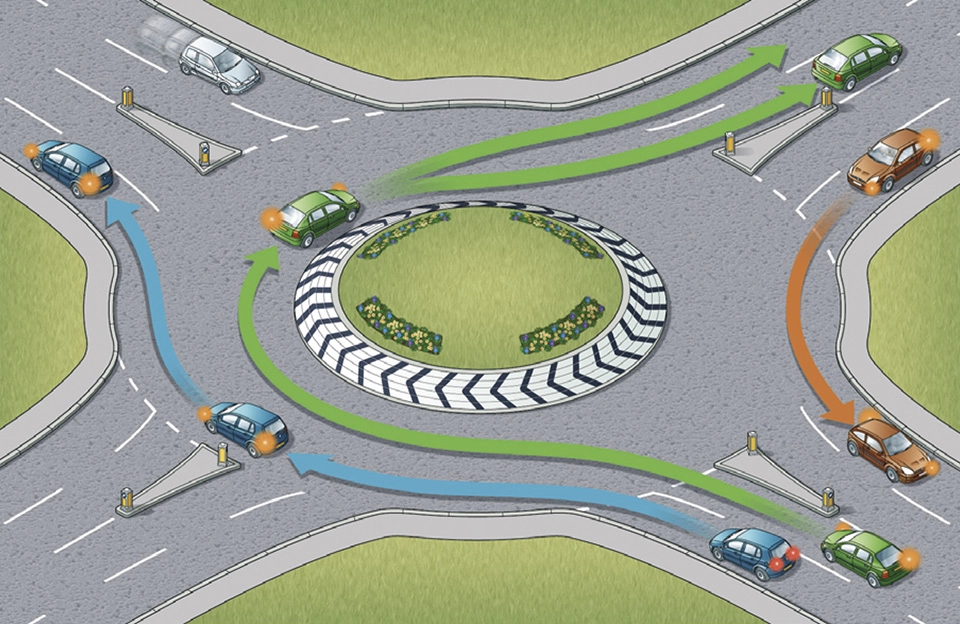
[Editor’s Note: For those unfamiliar with Milton Keynes, it may have the highest density of roundabouts of any town in the UK. It is built on a grid system, where the north-south and east-west roads cross; there is a roundabout].
IAM Skills development was based around developing “Thinking Riders.” There is the rule book (Motorcycle Roadcraft), and then there is the application of the techniques in the real world.
Conversely, I found RoSPA more attuned to perfecting the techniques described in the book so that they can be repeatedly and skilfully executed. Precision was the focus I was given when completing RoSPA.
For example, there is a known process for roundabouts, and if you execute it, you will benefit from the collective knowledge of thousands of motorcyclists. This isn’t an uncommon approach. Pilots use checklists to remove variation and ensure every detail is covered.
Whereas we can’t ride around reading checklists, the techniques are broken into smaller sequences, making them easier to memorise. Interpretation is still a key part of the RoSPA training, but each situation has a defined solution.
Both courses centre around the book Motorcycle Roadcraft: The Police Rider’s Handbook, so the content is the same. Perhaps the one and only difference between the two schemes is how the book’s content is taught.
Human Interaction
Whether they are called Observers, Tutors, Instructors, or anything else, the key (for me) to advanced motorcycle instruction has to be the person you are working with.
School teachers go through a two-year qualification to learn how to teach and impart information in different ways. This isn’t true for advanced motorcycle instructors.
Yes, there are standards and qualifications that an instructor must meet before being let loose, but the ability to communicate in a range of differing styles is more assumed than taught.
Not everyone learns in the same way, and if the person trusted to help you discover new ways of reading the road is more impressed with their position as the “expert” than imparting the knowledge in a way that makes it easy for you to absorb, then you are in for an uphill slog.
I’ve seen and endured these types over the years, and learning to manage them isn’t what an advanced roadcraft course should be about.
If you ask to switch instructors—politely, of course—they should understand. The objective is receiving the advanced training, and if their ego is bruised, well, that tells you everything you need to know.
Remember, though, that for a team to perform – that is what you and your instructor will become – you will have to go through the Forming, Storming, Norming, and Performing cycle. There is more on this dynamic at BiteSize Learning.
Instructor Training
If the core to enjoying Advanced Motorcycle training is your instructor, rather than which course you choose, how are the instructors trained?
As you might imagine, RoSPA takes a more formal approach, requiring its instructors to undertake a week-long course. Before starting, you must have passed the RoSPA course at the Gold Level. Within the RoSPA course, there is an element focusing on Adult Learning and Facilitation.
To become an IAM Local Observer, you must have passed the IAM Advanced Course before applying. The local IAM group then delivers the Observer training through a mixture of sessions with your Local Observer Assessor and supervised road sessions training an Associate.
If you wish to advance from a Local to a National Observer—an IMI-approved qualification—you must be assessed by the IAM Area Service Manager and repeat this assessment every three years.
To become an IAM Masters Mentor, you must have passed the IAM Masters Course, be qualified as a National Observer and then be formally assessed.
As I write this, the RoSPA Level 3 Award in Advanced Motorcycle Instructor Training costs £1,500 and takes a week. Although technically free, the IAM Local Area Observer qualification requires one-on-one training from a Local Observer Assessor until the trainee Observer qualifies by demonstrating the necessary teaching and riding skills.
Neither RoSPA nor IAM instructors do it for the money. Having been an Observer and Masters Mentor, I can tell you there isn’t any. We all do it – or, in my case, did it – because of a passion for motorcycles.
If you are asked to cover the cost of the instructor’s petrol and tea consumption during each session, that is all the monetary reward they will receive.
What Will It Cost?
Beyond feeding your Instructor’s tea and cake fetish, the two courses are once again different in how they charge.
The IAM goes straight in with one cost for the course: £215. This includes the admin, materials, and the test. Subsidies are often available, especially for riders under 25, so check with your local IAM Group.
RoSPA, in my case, charged me £15 to join the local group for a year, and the test was another £90. As I dealt exclusively with my local RoSPA group, I can’t say if other groups charge more or less to join. The test bookings are administered centrally, so the cost is the same everywhere.
Which is Best?
We will all have our preferences, and mine is based on the people I met along the way. Yes, I’ve met a few “interesting” characters that I’ve not overly warmed to, but I’m there for the information they share. Anything else is a bonus that makes the learning experience easier.
All of my examiners at all levels of Advanced Motorcycle Training have been serving or retired Class One Police Motorcyclists. Again, this establishes that there is little difference between the skills you must demonstrate to pass any of the courses.
RoSPA has a single test that is graded Bronze, Silver and Gold depending on the level of skill you demonstrate. The IAM splits the tests into two levels, Advanced and Masters, with different levels of passing grades within both tests.
Hopefully, by now, I’ve convinced you that neither course is better than the other. Which is right for you depends on your preferred learning style and how well your Observer, Tutor, or Instructor can present the information in the style that works best for you.
They are all volunteers, so you might need to work a little to extract the maximum benefit from them. The simple fact that you decided to investigate the dark art of reading the road and refining your riding skills is all the encouragement they needed to help you.
So, which is best? Start one and find out, but in the end, it will be down to the people you meet along the way.
Those who tell you their scheme is best … well … perhaps they met the wrong people, or perhaps they are the people you want to avoid.







One Response
Hiya Dave, from next year, 2025, the IAM level of Local Observer and L.O. Assessor will no longer exist. All Observers will be assessed at National level going forward. It should ensure a more consistent approach to the course delivery whoever your observer and whichever local group you go with.
Another great article, thank you.