Of course, it rained. As soon as I rode the 2024 Suzuki V-Strom off the Euro Tunnel Train in Calais, the skies opened, and it rained.
Add this to the 4:30am start to get the 170-mile ride to avoid the nightmare that is the morning commuter traffic that clogs up the roads in the southeast, and if it weren’t for motorcycles, it would have been a miserable day.
But when there is a V-Strom 1050 to ride across France, Luxembourg, Germany and back – in the company of a Suzuki GSX-S1000GX, but that is a different story you can read here – getting out of bed early and riding in the rain seems pleasurable.
Why The V-Strom 1050?
Three years ago, I did a similar trip on a V-Strom 1050XT. I have fond memories of that trip, especially when I was hiding from one of the Black Forest Region’s famous downpours under the same tree as an amenable gentleman on a GS.
We chatted for twenty minutes or so as the downpour went through, and we concluded that the only difference between us – other than nationality – was that he had paid a lot more for his bike than any V-Strom owner had. After all, we were both hiding from the same downpour.
Since that meeting, the V-Strom has undergone a few refinements; the models have been renamed, and a 21-inch front wheeled version – the 1050DE – has arrived, just as everyone else has copied what Suzuki had been doing for years and used a 19-inch front wheel on their adventure bike.
If – like me – you have an affinity for Adventure Bike styling but want a motorcycle with more road-focused handling, then the Suzuki V-Strom 1050 is the model to be chasing.
The same model split comes with the new 800cc parallel twin V-Stroms, but these models are called the DE and RE for some reason.
Not so with the road-biased version of the V-Strom. Suzuki is calling it the 1050. It has even lost the XT suffix.
Changes
Some people argue that the V-Strom 1050 isn’t any different from earlier models, which is true in one sense, but this is the Suzuki way. Build a solid and dependable heart and then refine it.
The famous K5 engine (the 1000cc 4-pot) is spoken about in hushed and revered tones, such is the engine’s reputation for power and reliability, and the V-Strom is no different. The 2024 model I’m riding is the latest evolution of what was already a dependable, well-sorted motorcycle.
 The most obvious change to this model is the new TFT display, which replaces the functional LCD display found on the 1050XT. The older display worked but looked like something from the 1980s. That said, it made no difference how the bike rode.
The new display is arguably the best there is. Sharp, clear, and well laid out, and it’s easy to find what you are looking for at first glance. Other manufacturers take note that start-up graphics and artistic rev counters are not why we turn the ignition key, and we won’t stop to admire the display when riding.
But perhaps the most significant change is the magic the Suzuki engineers have worked refining the power delivery and the flexibility of the motor.
The engine is the same basic design Suzuki has been using for ten or more years, but the version in the 2024 V-Strom 1050 is perfectly tuned for backroad riding.
The V-Strom will still propel you along a motorway at 130KPH (80mph) all day, every day without complaint, but riding the National Parks through Belgium, across Luxembourg and into the Palatinate Forest was where the V-Strom came alive.
The engine still produces 107BHP and 74lb/Ft of torque, but the rear sprocket has grown by four teeth to 45, and yet the V-Strom doesn’t feel over-geared.
There are no flat spots in the rev range, as you might expect with the higher gearing, but neither is the motor a highly strung screamer. I negotiated a few roundabouts in 1st gear – to see if I could – and the power delivery was smooth and the throttle connection linear.
And when the tree-lined twisties and rolling bends appeared. the V-Strom in 4th gear at <cough!> KPH is a highly addictive drug.
How Suzuki achieved this without changes to the gearbox or the final drive cog is something of a mystery. Only the fuel consumption suffered, but not dramatically. Motorways at 80MPH give a good distance covered for the fuel consumed. Get much over that, and the V-Strom can develop a thirst.
Dunlop TrailMax Meridians
The only change I made before departing on the three-thousand-mile European Road Test was to swap out the OE tyres for a set of Dunlop TrailMax Meridians.
The cast wheels on the 1050 – 19 inch front with a 17-inch rear – take tubeless tyres, and as my off-road skills only extend to a muddy car park or a gravel road, the road-biased Meridians are the perfect fit for my skills and the 1050’s road manners.
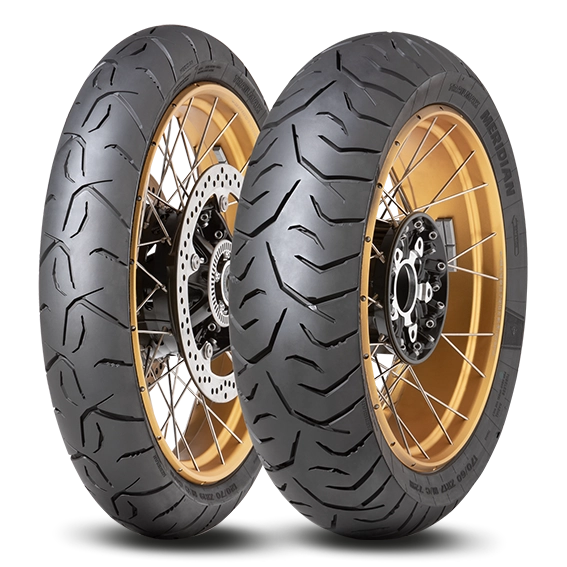 The tyres have been equally impressive in the dry, damp or rain, and when it is wet, the Meridians shift a lot of water. The rear end of the V-Strom and my SW-Motech Pro Rackpack bag are distinctly grubby after a day in the rain and some of the heavy showers we have ridden through.
The slender profile of the tyres (front:110/80/R19 & rear: 150/70/R17) keeps the V-Strom feeling eager, and even when loaded, it flicks quickly from side to side, which is incredibly satisfying when picking your way through the traffic.
Not all the roads we have ridden have been the ribbons of snooker table smooth tarmac that cover Luxembourg; some were downright shoddy, and I think one section was under repair and might have been closed (oops). However, the tyres have delivered that thing we covet the most – traction. No unwanted dramas, moments or moaning. The Meridians have just been there.
What Could Be Better?
The gearbox is showing its age. The bi-directional quick shifter is a welcome addition, but you need to be on the herbs to smooth out what is otherwise best described as a “tad industrial” box of cogs.
The gearbox does what you need it to do, and with some practice, you can work out how to get the best from it. Compare this to the gearbox in K5-derived motors … well stop there because you can’t compare them. There is a night and day difference in refinement.
Beyond that, I’m struggling to find fault with the V-Strom 1050. The foot pegs are still exactly where my leg wants to be when I stop in traffic, but it takes all of two minutes to adapt to their position.
Everyday Excellence
The mirrors are a delight, and one of the few bikes where the view behind doesn’t include a view of your elbows.
I’m six feet tall, and the screen is perfect for me in its tallest position. There is enough wind on my visor to clear the rain but no wind roar or buffeting to contend with.
The throttle feels natural despite being ride-by-wire, the fuelling smooth in all throttle modes, and the cruise control is kilometre-perfect.
There is an abundance of electronics that are useful rather than interfering. The Hill Hold is perhaps my favourite, and you might think it a gimmick until you discover how easy it is to apply. Then, you wonder why every bike doesn’t have it.

The Bottom Line
In some ways, the V-Strom 1050 marks the end of an era. Parallel Twins are the future, and Suzuki has the P-Twin 800, which it is already using in a few models. The life of the 1037cc V-twin motor must be coming to a close.
Short of a significant redesign, there is very little left to improve in the bomb-proof “1050” motor.
With a list price of £13,499 in the UK, the V-Strom is perhaps losing its “motorcycle for the financially savvy” label. It is still a lot of motorcycle for the money, when everything you could want is included in the price except for heated grips. USB socket in the display housing – Yes. 12-volt socket under the seat – Yes. Centre stand – Yes. Quick shifter – Yes. Handguards – Yes.
The list goes on and backed by Suzuki’s 7-year, 70,000-mile Service Activated Warranty, you can ride the wheels off the V-Strom knowing it will go the distance.
As for me, I’m going to indulge myself in the V-Strom’s virtues for around another thousand miles before giving it back to Suzuki and marking the end of an era. Damn, it is a good bike.
If only this model had the yellow and black paint scheme with the gold rim spoked and tubeless wheels.