A few weeks ago, I fitted SW-Motech riding lights and a HealTech Thunderbox to the Yamaha Tracer 9 GT. The darker nights were coming, and the idea of extra illumination always appeals to me. So, rather than wait for the darkness to arrive, I thought I get in early.
Having fitted the lights, I’d never found the inspiration to go for a ride across the Lincolnshire Wolds at midnight to see how good they were.
A couple of other riders had mentioned they were effective during day rides, but how well they lit up the road at night was unknown.
After an evening in the garage, changing the fluid and front brake pads, I couldn’t resist a late evening ride.
Having promised to let you know about how effective the SW-Motech lights are, and having now ridden at night … Here we go.
SW-Motech Riding Lights
It is tempting to start writing about the quality of the SW-Motech riding lights, but we have done that. Suffice to say, you can read about the excellent workmanship and flexibility of the design here. [See: Other Tracer Tweaks]
And having ridden around 1,500 miles with the lights installed, there has been nothing to do. I did have one pointing slightly too high, but that was my fault and had nothing to do with the lights.
The HealTech Thunderbox is the perfect way to power the lights. A few seconds after starting the bike, the lights come on, and the lights go out almost immediately after killing the engine.
In short – life is good.
Lumens
The official definition of the lumen is: “a unit of luminous flux in the International System of Units, that is equal to the amount of light given out through a solid angle by a source of one-candela intensity radiating equally in all directions.”
Which, in plain English, translates to a measurement of how bright something is.
Many (many!) years ago, when Cibie fog lights were all the rage, I remember the adverts talking about Watts as a measure of how bright they were.
This could be correct if the theory of consuming more power means the lights would be brighter, which isn’t necessarily true. Something can consume a high number of watts and be highly inefficient.
But as usual, I’m wandering off-topic. The short version is that lumens equal brightness. And watts do not. Not that watts are bad, but they measure energy use, not how bright the light is.
More Lumens
Being sure that – like horsepower – more Lumens is always the right answer, I’ve often fitted cheap LED lights to my Adventure bikes. Things got a little out of hand with the 9,000-lumen set I installed on my KTM, but that is a different saga. (See: LED Auxiliary Motorcycle Lights]
In comparison, the SW-Motech fog lights are 1050-lumens each, which, on paper, is a significant power reduction. However, riding at night for the first time in a while last night, the SW-Motech riding lights are deceptively bright.
Focus
On the front of the SW-Motech lights is a lens that focuses the 1050-lumens. I chose the “fog” light version of the SW-Motech riding lights. The “spot” light version, which is focused for longer distance illumination, only uses 800 lumens (per light) to illuminate the road.
The cheap led lights produce more power (and heat!) and are technically brighter, but the lack of focus, caused by only having a flat piece of glass protecting the LEDs, means that a lot of that light disperses in every direction except the one you want.
SW-Motech Riding lights might have fewer lumens, but with all of the lumens focused in the right direction, nothing is wasted.
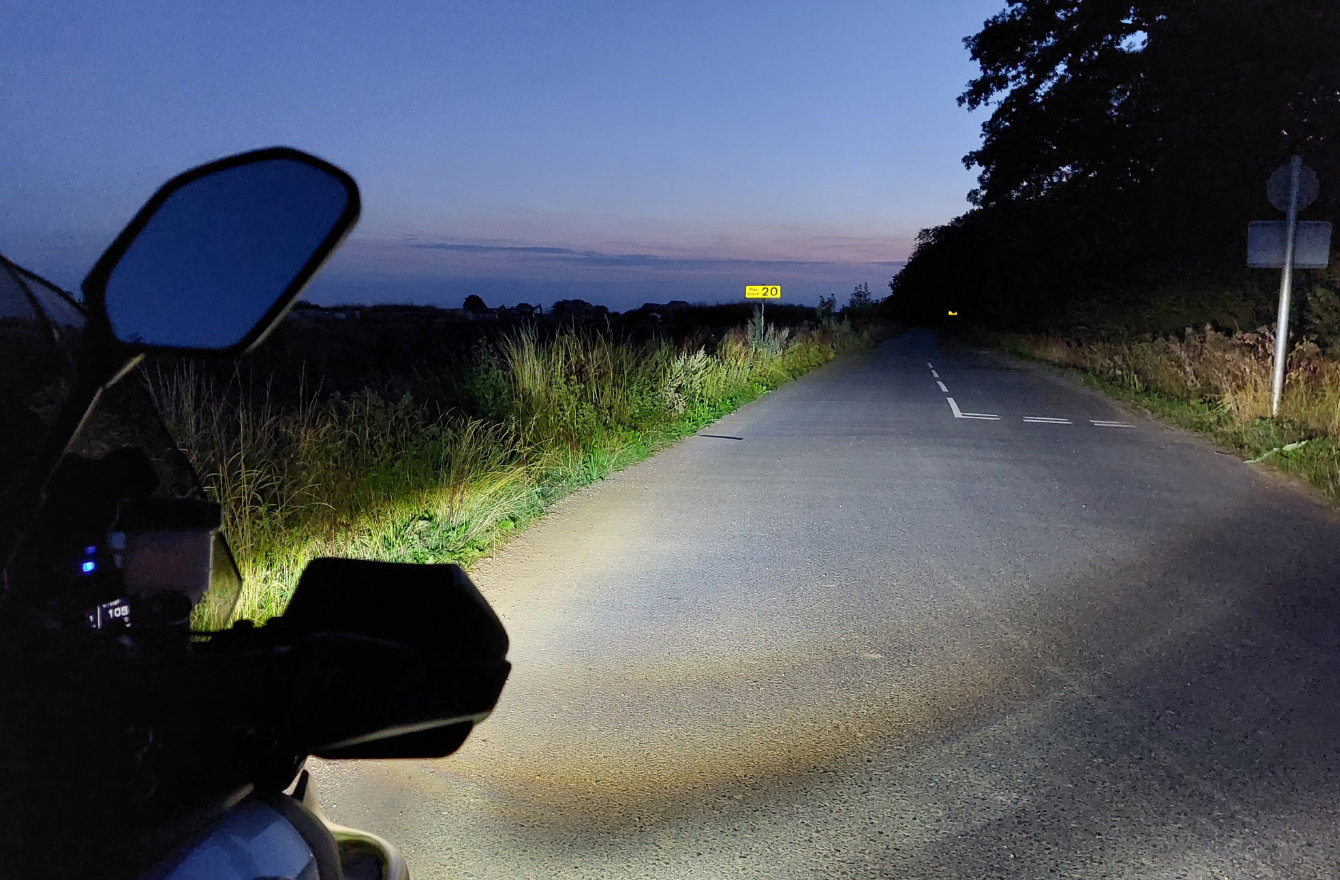
But Do They Work?
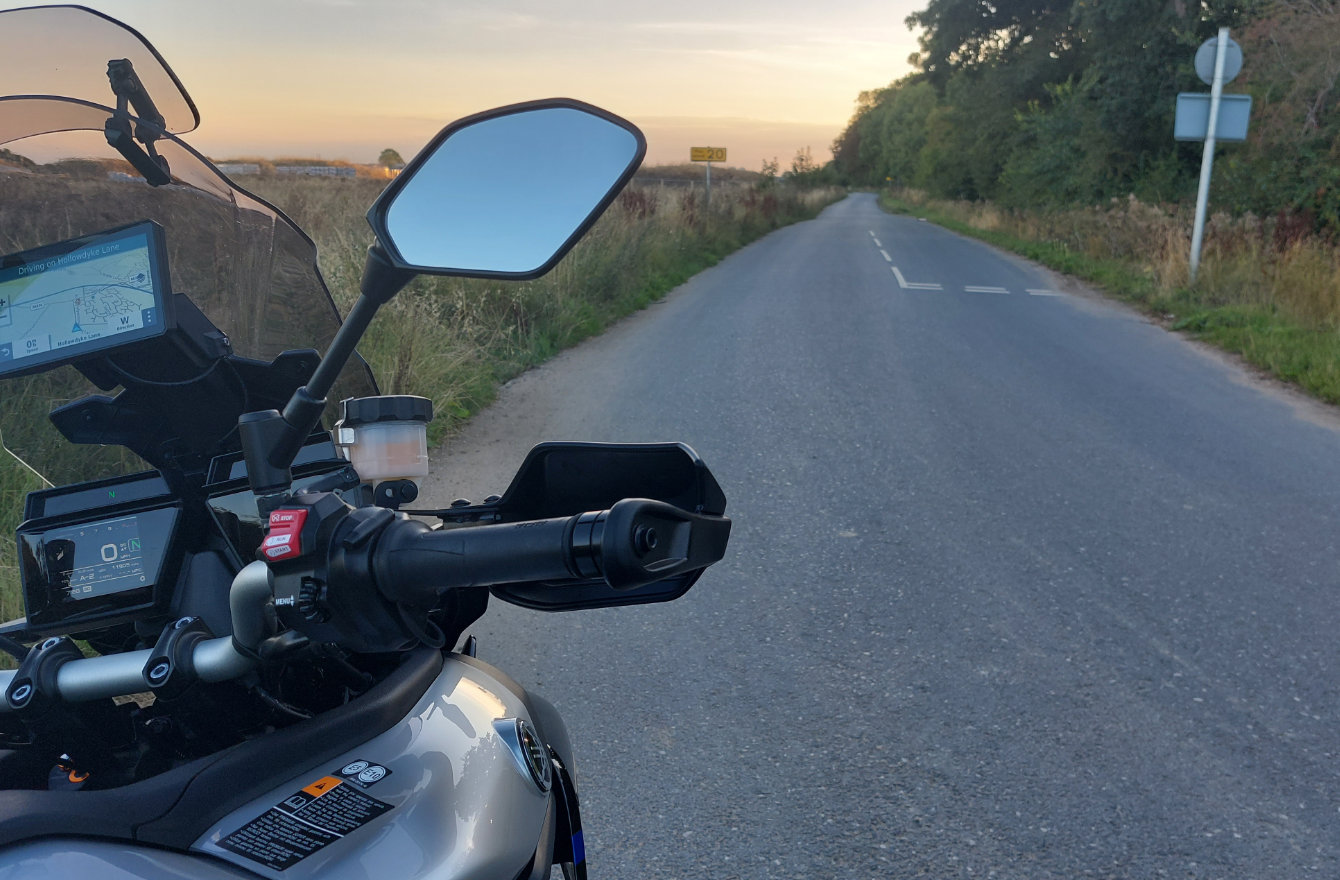
Photographing lights is tricky. The camera adjusts for the amount of light available, so the difference isn’t always noticeable. The photo above was taken at night, and for comparison, there is a photo of the same location taken in daylight.
Perhaps more importantly, though, is how I’ve noticed other road users reacting. Riding through built-up areas and passing parked cars on a curve is one of the higher-risk situations.
The road is narrow, our presence is masked by the parked cars, and the curve limits the forward view of an oncoming car driver, whose eye line is typically lower than ours. Make it at night, and not being seen becomes a distinct possibility.
Whereas lights are never a substitute for good road craft, I was quietly smug when I noticed that cars were much more aware of me than I would have expected, even in built-up areas. Perhaps they were all good drivers paying attention, or perhaps the SW-Motech riding lights were making me more visible.
That, I’ll let you decide.