Having traced the twitch on the Multistrada to stepping on the rear tyre, we need to talk about motorcycle tyres. Can you think of a more debated subject, than which tyres are best?
Like most motorcyclists, I have a preference. I’ve ridden on most makes over the years, yet I always come back to Dunlop TrailMax Meridians, Mutants or RoadSmarts.
The Ducati Multistrada DVT we bought recently is currently running Michelin Road 5s, and I’ve occasionally noticed a slight twitch from the rear. Nothing dramatic, but enough to get my attention.
Most of the time, I’ve put this down to not really knowing the Multistrada yet. Michelin makes a good tyre, and just because I prefer Dunlops doesn’t mean Michelins are rubbish.
Bridgestone A41 tyres squirm on wet white lines, but again, this doesn’t make them bad tyres. It is all personal preference.
I’ve tweaked the suspension on the Ducati, checked the pressures in the Michelins, and made sure everything is as it should be, which is how I found the stepping (sometimes called lipping) on the rear tyre and the cause of the occasional twitch.
Stepping
Stepping is a phenomenon caused by the mechanical grip of the tyre pushing the forwardmost part of the tread block “backwards”. Not dissimilar to constantly thumbing the corner of a magazine until the pages curl.
If you imagine looking across the tyre and along the tread groove, there would be tread walls to the left and right. As the tyre rotates, the tread block compresses, and the leading edge of the following block absorbs the rotational force. Over time, depending on the angle of the tyre to the road when the power is applied, the leading edge of the tread block can become stepped (raised).
Stepping can also occur on the front tyre, usually caused by the tyre being excessively loaded during heavy braking. For the rear, stepping typically comes as a result of hard acceleration.
The harder you brake and the greater your aggression in opening the throttle, the more likely you will see stepping on your tyres.
Naturally, the softer the tyre compound, the more prone the tyre will be to stepping, as softer compounds are designed to distort and compress more easily.
Soft Edges
Nearly all mainstream motorcycle tyres run a mix of compounds. The hardest compound will be in the centre, so the tyre gives good mileage.
As you move towards the edge of the tyre, the compound softens, sometimes once, occasionally twice. The softer compounds are used to give additional grip when cornering.
It all makes perfect sense, but depending on the tread pattern and your riding style, the softer edge compounds can encourage stepping.
This is what appears to have happened with the Michelin Road 5s. The edge of the tyre is flatteringly soft and will ruffle up with little provocation. Every other repetition in the tread pattern extends into the softer edge, and this is where the stepping is most pronounced.
Picking the bike up on the throttle coming out of a corner has stepped the edge of the tread pattern to the point where occasionally, it will twitch, especially if I’m being overly exuberant.
When Dunlop created the Trailmax Meridian, the tyre grooves and the compound transition were two key focus areas. Dunlop had seen large adventure bikes chew through a front tyre where the manufacturer hadn’t considered stepping, and Dunlop designed the Meridian to avoid this trap.
If someone tells you that tyres are black round things and they are all the same – Tell them they are full of it. There is a lot of thinking and development that goes into tyres, which perhaps we don’t always pay enough attention to when choosing our tyres.
Weight and Power
With 120BHP+ motorcycles fairly common, picking a tyre that suits your riding style is the easiest way to avoid stepping.
If your style is to always open the throttle hard when exiting corners, perhaps avoid a tyre where the tread noticeably extends into the softer edge.
Similarly, riders of heavier motorcycles – FJR1300, BMW 1200/1250RT – touring with luggage would be looking for a tyre built to support around 400kg all-up weight that is hard on the brakes into a Spanish hairpin.
Soft sports rubber might not be the best choice in that situation, even if they do stick like glue.
Dunlop Mutants
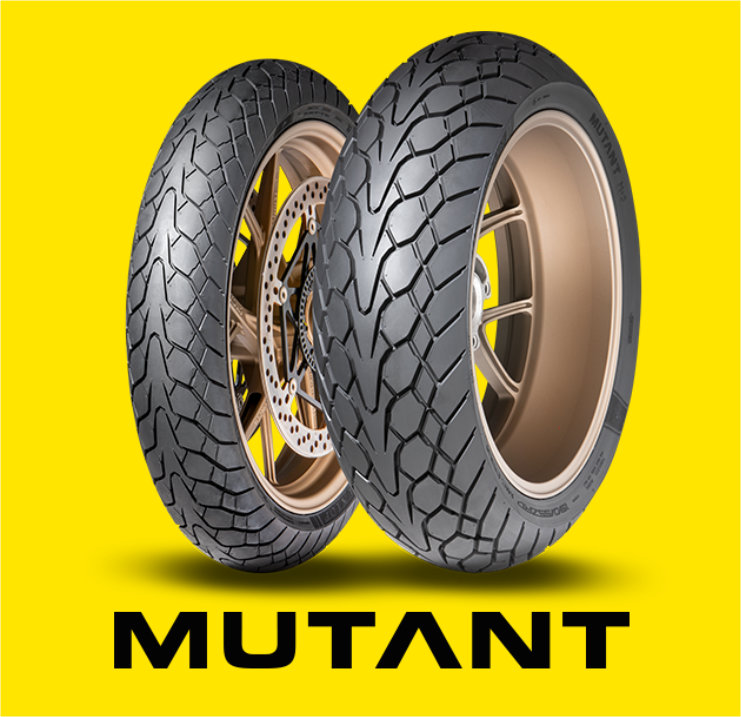 I’ve opted to put Dunlop Mutants on the Multistrada because of their proven ability to shift water.
Winter is coming, and the number of days I will likely be ragging it out of a corner for the next four or five months will (sadly) be limited.
The Roadsmart IV would have been my other choice. We have those on the Tracer 9GT and the GSX750, and they are cosmic.
But ultimately, it was the Mutants’ performance on the cold and wet roads last winter, coupled with riding on them through Spain and Portugal earlier this year that convinced me to put them on the Multistrada.
Mark, from the excellent Mobile-Bike-Tyres, is booked for early November, and until then, I’ll have to put up with the odd twitch from the Michelins.
I could, of course, adjust my riding style to compensate. But let’s be honest with each other, when would we not be tempted to open the throttle if we could?