The official definition of a microclimate reads … “Microclimates are atmospheric conditions in a small area that are different from the surrounding areas.”
Sounds simple enough, and then most research and metrological papers go on to talk about hillsides, large fields and even towns. Not exactly the scale that we motorcyclists might be concerned with.
Our scale is more about the next bend. We are interested in when the conditions suddenly differ from those we are currently experiencing. It might only be for a few meters, but to us, those few meters are vital.
A sudden reminder to look for microclimates came into sharp focus a few days back when taking the exit from a dual carriageway. I couldn’t count the number of times I’ve taken that exit. I know I can hold the legal limit until I move left to the slip road and then apply some firm but not excessive braking. Down three gears and tip it in. Easy. Done it plenty of times.
Shadows
I’d been riding into the low winter sunshine. It was a beautiful day, a tad chilly but still an excellent day for a ride. Looking into the lefthand bend to exit the dual carriageway, I noticed that the trees on the outside of the corner had the whole bend in dark shadow.
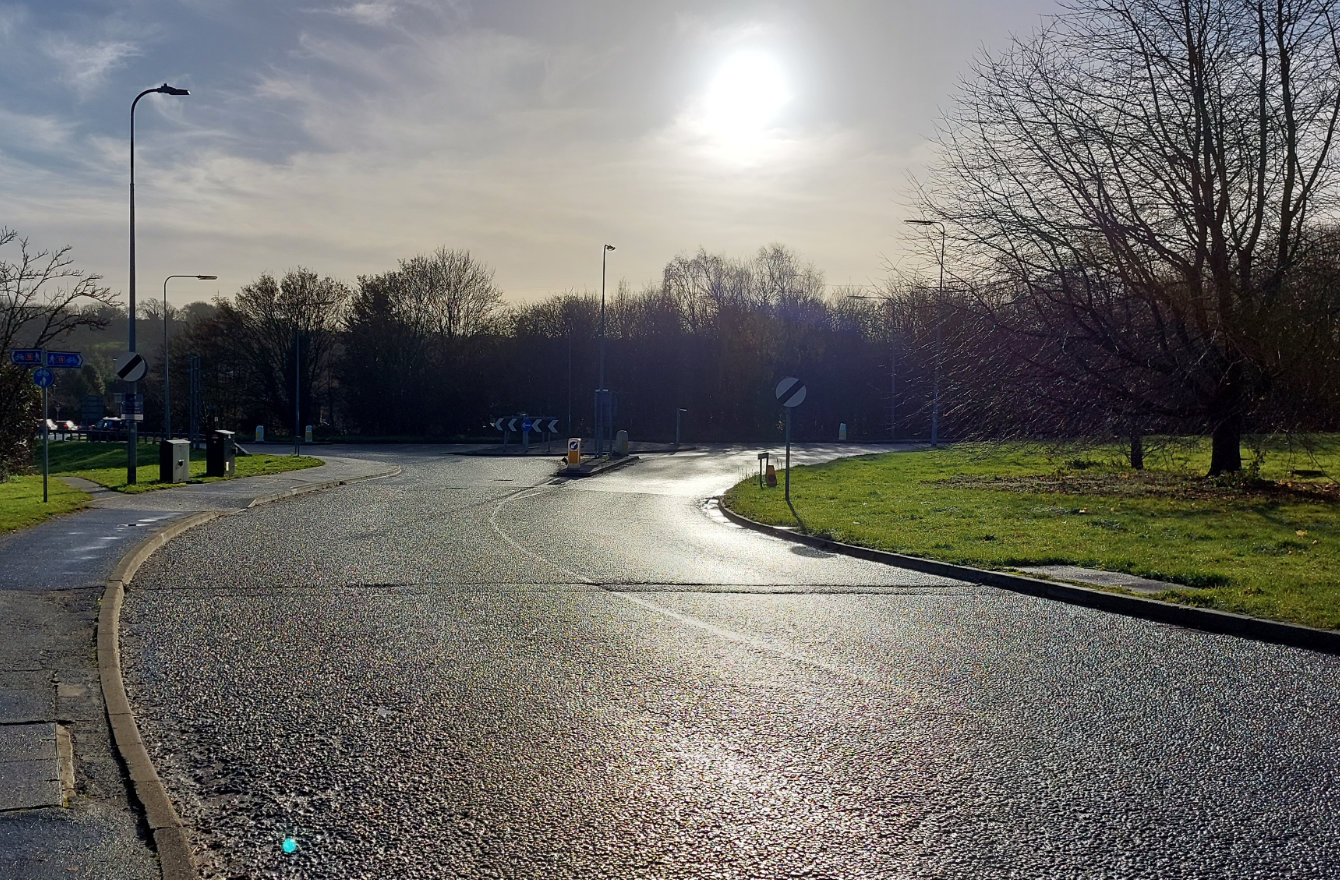
Three degrees air temperature, according to the bike’s dashboard, but that was in the sunshine. The roads were damp rather than wet, and all of this put the thought of frost or ice into my head.
Do I stay high on the slip road and aim for the curb at the apex to minimise the lean? Do I follow the most likely tyre tracks of previous vehicles?
Ultimately, it was a total non-event but was a stark reminder to look out for those extra factors winter riding brings.
Bridges
Anything where the air can flow over and under the road surface is worthy of a little more consideration when it is close to freezing.
As the cold air can flow over the top and underneath the road surface – over and under the bridge – the tarmac will be colder than the surrounding area.
If you are riding under a bridge, then part of the road surface will be in shadow and, therefore, colder than the tarmac you are on. Add in water, and ice becomes a possibility.
Valleys and Lowlands
The difference in temperature between ice and/or fog forming and a clear road can be minimal. The colder the air, the greater the density. The denser the air, the more it weighs for a given volume.
Pile all of that science together, and the coldest air is found in dips and valleys and can create pockets of dubious road conditions when dropping into a valley or just a dip between higher ground.
If the dip in the landscape contains a river or other water feature, then the problems can be multiplied.
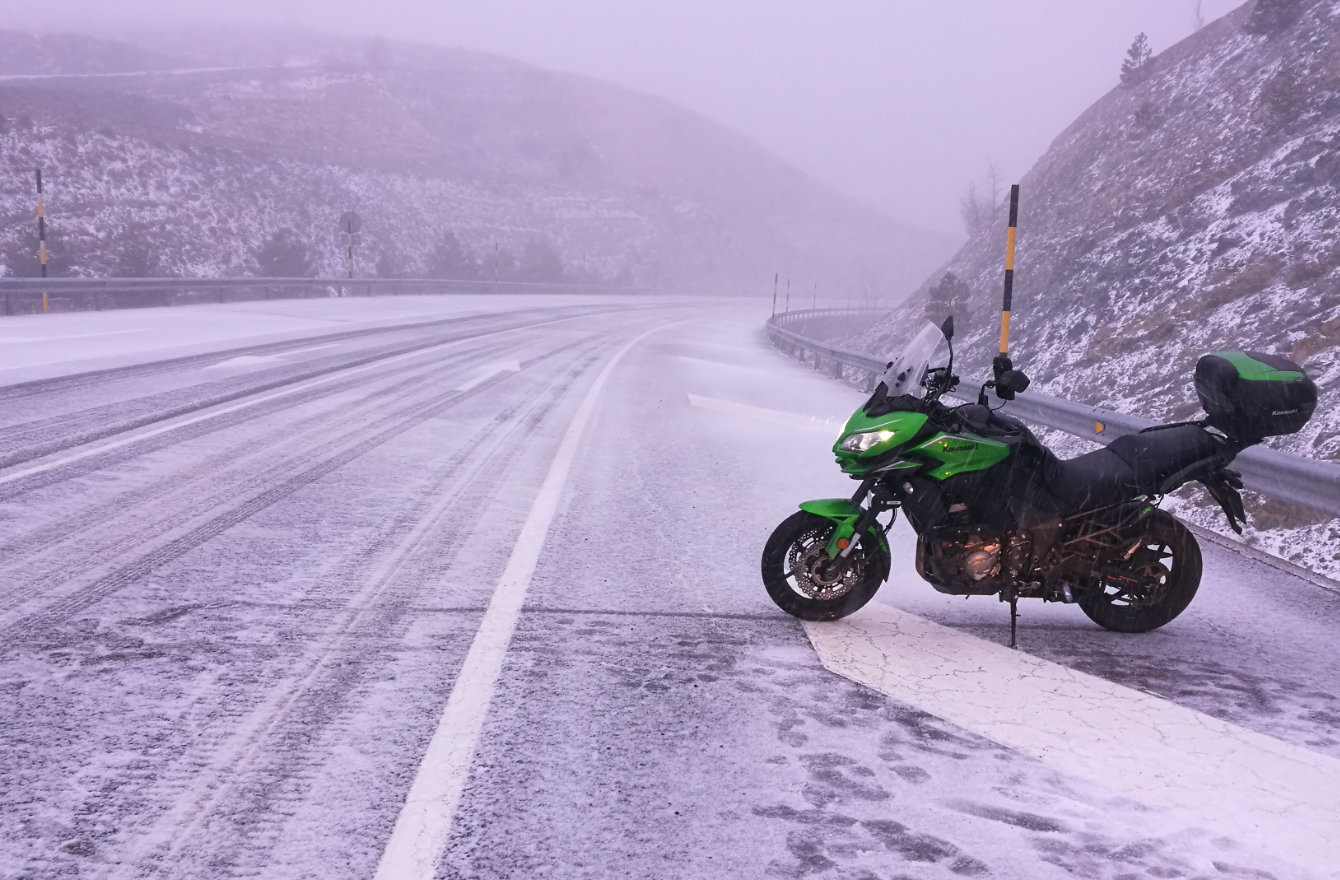
The photo below is from a day at the beach. It had been 15°C, warm and sunny. We rode back towards the hotel in the hills. Everything was going fine until a snowplough went the other way.
As it was May and we were in Spain, I paid no attention. Dropping into the next valley, the snow dumped on us. I fluffed a gear change and low-sided the Versys. My pride dented, we crawled out of the valley, through the next one and eventually back to the hotel.
Water
Water loses and gains heat slower than the surrounding land. Bodies of water, such as rivers and lakes, work as cooling sources for the surrounding area.
If a road follows the path of a river, then the air over that road will be colder than the air perhaps just a few hundred meters away.
Practical examples of this can be felt when riding near lakes and reservoirs. The water absorbs the radiation from the sun and, through evaporation and condensation, cools the air, and the air can then be cold enough to form fog or freeze a wet road surface.
One of my favourite roads runs near Rutland Water, and every time I ride that road in the colder months, I can feel the temperature difference.
Temperature Drop at Dawn
You can impress people by telling them this is due to the “latent heat of vapourisation”. The energy required to change the state of water – dew on the road surface or surrounding areas – is drawn directly from the air.
As the sunlight heats the surface, energy is taken from the air to turn the water into a gas, making things colder.
Eventually, the sun’s warmth exceeds the cooling effect caused by vapourisation, and the air warms up. With low winter sun, this process takes longer than in summer.
So, what might have been a few degrees above zero can suddenly drop to a few degrees below, just as we see the sun come up and think things are going to get warmer.
White Lines
Perhaps the smallest of all microclimates are white lines. The dark road surface will absorb heat from the sun, whereas white lines will reflect it.
Add in damp road conditions and near-freezing temperatures, and white lines can still be frozen when the tarmac is frost free.
White lines also mark boundaries or are in the middle of the road, where most four-wheeled vehicles will miss them, so traffic won’t have been running over them to erode any remaining ice.
Microclimates in the Real World
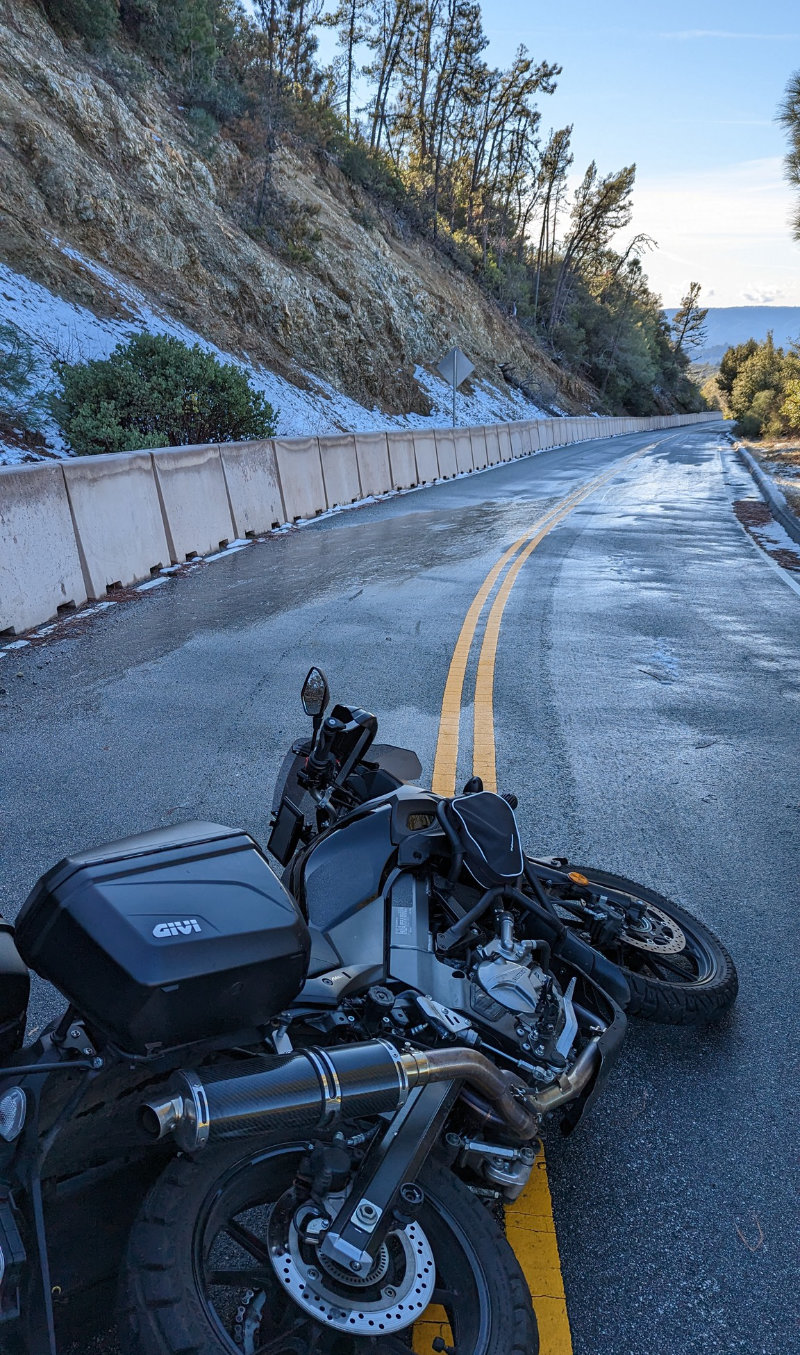 What follows happened in the hills around California. Some friends had been riding in the sunshine, with an air temperature of 42°F (5°C). They had ridden through numerous run-off streams that day without any issues.
The last one, sadly, had frozen on the road surface (black ice) and, at that moment in time, looked just like another stream of run-off water.
What actions any of us would have taken and if we would have avoided or predicted the situation is a question for you and your conscience. Nonetheless, a few microclimate clues in the photo are worthy of mentioning.
The hillside on the left is in shadow, with ice near the barrier. Any water running off the hill will pass through that ice. It is unlikely to be melting without sunlight. The flow of the stream – in this case, it is black ice – doesn’t follow the shape of the road.
The sunlight on the right hasn’t made it to the road surface, and it doesn’t look like it ever does at this time of year, as the snow/frost is also present on the right-hand side of the road.
In the top right of the photo is the edge of another tree, suggesting the road surface only sees sunlight when the sun is high.
Would I have noticed these and taken a different course of action? I’ve no idea. I wasn’t there at that moment in time, so anything else is pure conjecture.
Thankfully the rider is OK, and whereas the pannier took a beating, it prevented any significant damage to the bike.
Stay at Home
So am I advocating locking the bike away for the dark and colder months? No.
You may think I’m knutz, but riding in the winter months can be beautiful. Knock it back a little. Consider microclimates and keep muttering the mantra, Safety – Surface – Stability – View.
Naturally, there are limits, and where we set them is a personal choice. But without a doubt, riding the bike is always better than wishing we were riding it.
Clarity
The events and photos used here are done so having secured the owners’ permission and with our thanks.