As I have no off-road skills, you might wonder what I’m doing road testing the 2022 Aprilia Tuareg 660. You are not alone. Swinging my leg over the 860mm high seat – I had the same thought.
To date, my offroad conquests – if you exclude messing about on a field bike aged 14 – are a two-mile-long gravel road, a short section of the Black Forest on a hard-packed dry fire trail, and some concrete slab farm tracks that Lincolnshire calls B-roads.
I have no objection to road testing the Tuareg. It is a beautiful motorcycle, and I intend to keep it that way. My one rule for today will be to keep the Pirelli Scorpions on solid ground.
Tuareg 660
Aprilia’s marketing department has a lot to shout about when describing the Tuareg 660. Comparisons with the Tuono and RS660 are inevitable, but other than the engine coming from the same base platform, the parallels end there.
In the Tuareg 660, the 659cc, four valves per cylinder, liquid-cooled, parallel-twin produces 80HP at the top of the rev range and 70Nm of torque at 6,500rpm. The horsepower figure is 20HP down on the power produced by Aprilia’s RS660.
However, the Tuareg 660 is tuned to produce more torque than all the other engine variants and has more power for the same RPM than any of the other motors. The difference is that the Tuareg’s peak power is at 9,250rpm, much earlier than the others who don’t peak until 10,500.
The RPM reduction allows for extra value overlap which [I’m told by clever people] is how Aprilia created the extra torque.
The Tuareg’s floating double disc front brakes are 20mm smaller than on the RS660 at 300 mm diameter and are squeezed by Brembo floating callipers with dual opposing pistons.
As the Tuareg is off-road-focused, it isn’t surprising that the rear disc is 40mm larger than the RS660’s at 260 mm diameter, again squeezed by a Brembo calliper.
Electronics
There isn’t an IMU on the Tuareg, so none of the rider electronics are lean-sensitive, but considering you are expected to be off-road and backing the Aprilia into corners, it makes sense not to fit one.
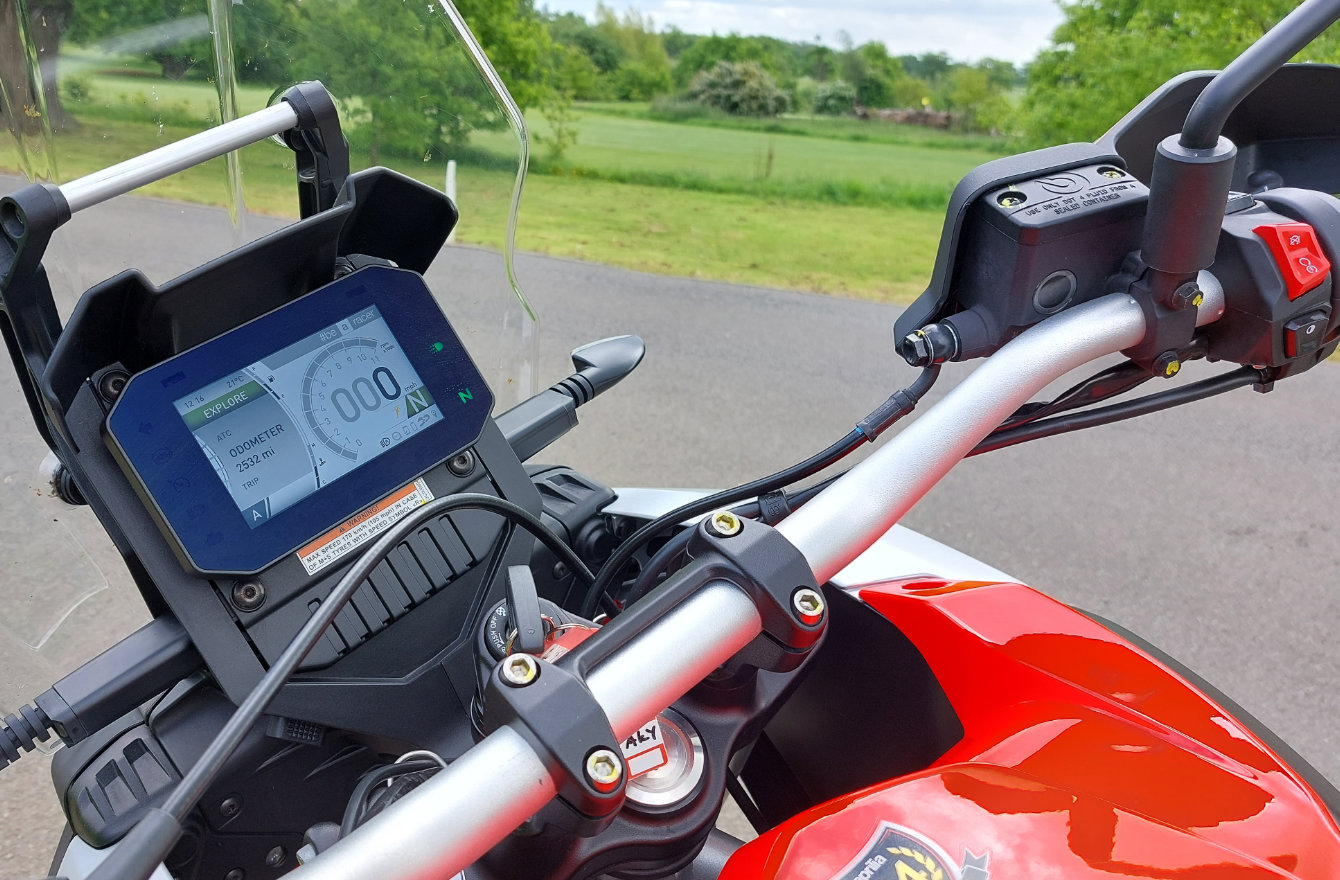
There is, however, control over traction control (ATC), engine braking (AEB), engine maps (AEM), cruise control (ACC) and four riding modes (two fixed and two customisable). Please note the absence of wheelie control (AWC) that you will find on the RS660.
And to control all of this, there is a 5” TFT colour screen that is sharp and clear even on a bright sunny day. Sadly, Aprilia did not make the most of the display space on the screen when selecting options. The traction control settings are just a selection of numbers that are meaningless unless you read the manual.
Wheels, Forks and Chassis
As you would expect, the front is a 21” and the rear 18” wheel. Both wheels are spoked and support tubeless tyres.
The front forks are 43mm fully adjustable Kayaba providing 240mm (9.5”) of wheel travel. The rear mono-shock is also Kayaba and has rebound, compression and spring pre-load adjustment.
And now, for the odd part. After the off-road bias in the other specifications, Aprilia opted for a steel tube frame with a built-in subframe. There must be a reason, but serious off-roaders are likely to stop at this point and look elsewhere, which is painful to think about as the rest of the motorcycle is excellent.
The Ride
For my six-foot frame, the ergonomics are flawless. My shoulders and elbows are relaxed, and the bars’ curve has my wrists in a natural position.
The seat is narrow where it begins to curve up, helping with me being almost flat-footed on both sides. The seat is firm, and I’d think about a Comfort Air seat pad for long distances. Or perhaps the seat needs a few more miles to break it in.

Push the button to start the parallel-twin, and the electronics blip the throttle as the motor sparks into life. First engages without any fuss or drama. The clutch is light, the bike well balanced, and I trickle out of the car park as if I’ve been riding the bike for years.
No sooner am I away from judging eyes than I’m possessed by a desire to stand up on the pegs. I’ve no idea why. There is no need, I’m on a tarmac road doing 20mph, yet the desire is there, and doing so is as natural as standing up from a chair.
My legs and back are straight, I’m upright, and the bars are perfectly placed. Although a peculiar feeling, no effort or compromise is required, so I change up to third while still standing and get going.
The novelty has worn off a mile later, and I sit back down. The Aprilia doesn’t appear to care which position I choose. My antics don’t unbalance or disturb the Tuareg, which feels to have a low centre of gravity. Odd for a motorcycle on long-travel suspension.
Having found a road with a chewed-up surface and a few potholes, the Kayaba suspension and the 21” front wheel do an excellent job of soaking up the bumps and smoothing out what would otherwise be an uncomfortable ride.
It is a delightful experience floating over the bumps and builds confidence to keep rolling on where you might otherwise be backing off to navigate the undulations. I’m not on dirt or even a fire trail, but for exploring the moors and green lanes, the Tuareg 660 is an excellent choice.
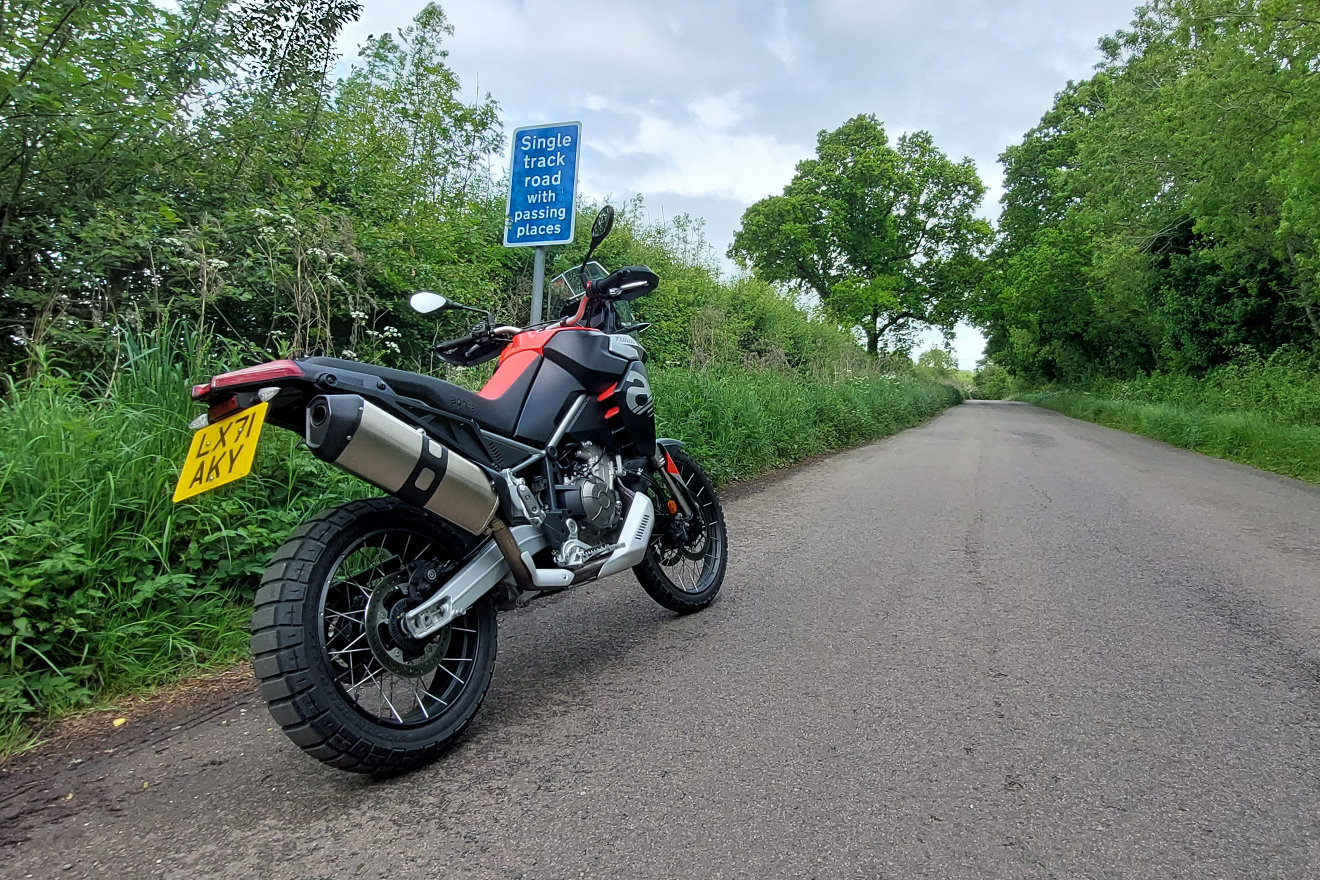
If I can ride gravel roads on a V-Strom 1050XT wearing road tyres, light off-roading, for people like me with no skills in that department, is going to come easily on the Tuareg. If anything, the Aprilia might encourage you to get into situations where you should have known better.
If I keep my ego in check, the Tuareg will open up a lot of different motorcycling destinations. The kind of places I wouldn’t want to take a road bike wearing an off-road frock.
Getting There
We don’t all live in the middle of the Kielder Forest or the Cairngorms. We have to travel to these beautiful places, even if they are 200-plus miles from where we live.
Thankfully, the Tuareg 660 has the on-road manners needed to slog along fast A-roads and motorways at 70mph.
The extra torque, responsive throttle and sharp steering make the Tuareg an excellent street bike. The standard – fixed position – screen gives reasonable protection from the wind and doesn’t create any helmet buffeting.
A slightly larger touring screen might be an option, but we are wandering off in the direction of a look-alike adventure bike at that point. The options catalogue includes a quick shifter, although, like a touring screen, I’m lost as to why you would want one.
There are options for an official Aprilia rack and panniers, but the prices are eye-wateringly high, and there will be better value alternatives available from aftermarket vendors (eventually).

The Bottom Line
The Tuareg 660 is arguably one of the best “Adventure” bikes there is. Even if, like me, you prefer riding on solid surfaces, swap the tyres for something with an adventure, rather than mud, bias – Dunlop Trailmax Mission – add some luggage, and you have everything you need.
The Aprilia will cover the motorway miles to your destination in relative comfort and allow you to take the road less travelled whenever the urge strikes.
That is the advantage you get from Aprilia’s Tuareg 660. It truly is an adventure bike, rather than an oversized wannabe.