After several chilly mornings and a rain-soaked ride to Motorcycle Live, my recent £240 investment in a pair of Oxford Stormland D2D membrane textile trousers proved they were worth the money.
It started, after what I think was four years and six months of faithful service, when one of the zips on my Oxford Mondial trousers gave up the ghost. Naturally, it was raining when the failure happened, and the first I knew of it was when one of the more sensitive parts of my anatomy became cold and damp.
As Oxford has just revamped the Mondial range, and given the years of faithful service, you would have thought I’d buy the updated version of the Mondial trousers, but “life” had other ideas.
I was part-way through researching motorcycle textile trousers at the time, mainly because jackets get all the promotional attention. Numerous articles and videos are produced about jackets, while the trousers get a passing mention if they are lucky.
Riding in trousers that are letting in the rain is bad enough. Add the wind chill factor that is freezing your nether regions, and your love for a good pair of laminated textile trousers will know no limits. All of which is a long-winded way of saying that I now own a pair of Oxford Stormland D2D Trilaminate Trousers, and I’m warm and dry once again.
Oxford Stormland Trousers
As I write this, the price difference is £40 (£240 Stormland Vs £200 Mondial 2.0), yet the difference in the Stormland’s fabric resilience and thickness feels much greater than the £40 would suggest. Perhaps that is why the Stormland is AA-rated compared to the Mondial’s A-rating.
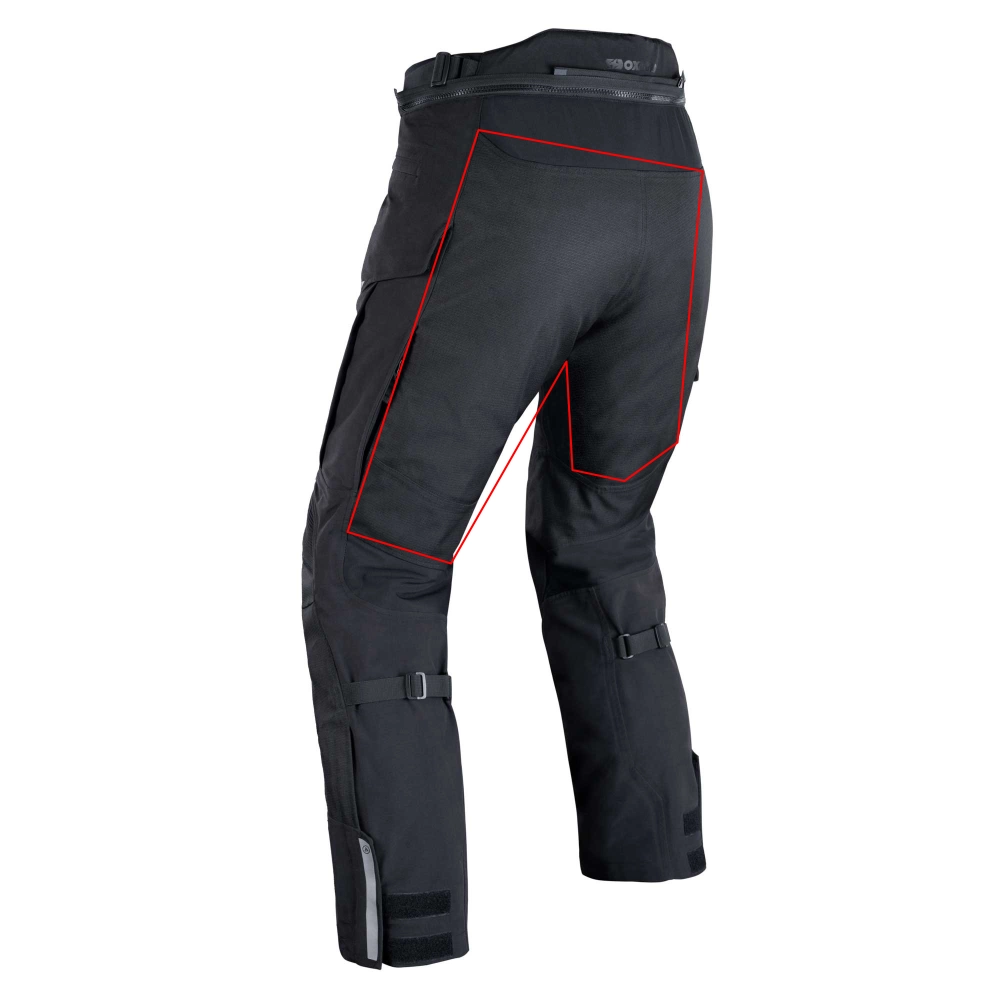 The Stormland trousers are constructed from a durable, high-tenacity nylon outer shell with an excellent strength-to-weight ratio. If, like me, you are wondering what high-tenacity nylon is … in scientific circles, the term tenacity refers to the longitudinal stress a substance can bear without tearing, so high-tenacity is a fancy way of saying “‘ bloody tough”.
Not satisfied with bloody tough nylon, the critical impact zones – across the backside and down the back of the leg to the knee, and at the front, from just above the knee down to the lower shin – are covered in ripstop nylon for increased abrasion resistance.
The knee and hip armour are Level 2 CE (EN 1621-1:2012) rated and flexible but reassuringly thick.
Having endured a few low sides over the years, I’ve always added hip armour to my trousers, as so many manufacturers ignore this. I’m told hip armour is required if an AA rating is what the manufacturer wants for their trousers. However it got there, it is most welcomed and good to see hip armour isn’t an additional cost.
Braces
My one complaint about the Oxford Mondial 1.0 trousers was the braces. Something in the geometry between where the braces connected to the trousers and the angle they took over my shoulders was wrong, and the braces would always fall off my shoulder.
Talking to a Swede while waiting for the Hook of Holland Ferry one day, I noticed he had an Ikea (of course) Bavara bag clip holding the brace straps together on his Oxford Mondial Trousers. It’s an ingenious solution, perhaps, but not the most comfortable.
With the Stormland trousers, Oxford has addressed this by redesigning the braces and placing a soft material web between the two brace straps, which sits between your shoulder blades. It might seem a trivial improvement, but small details often differentiate between something being excellent or annoying you.
Pockets
 The side pockets on my Mondial V1.0 trousers never got much use because I never understood why they were there. They are too small for anything other than change and in the wrong place for anything substantial, as they are where your hip bends.
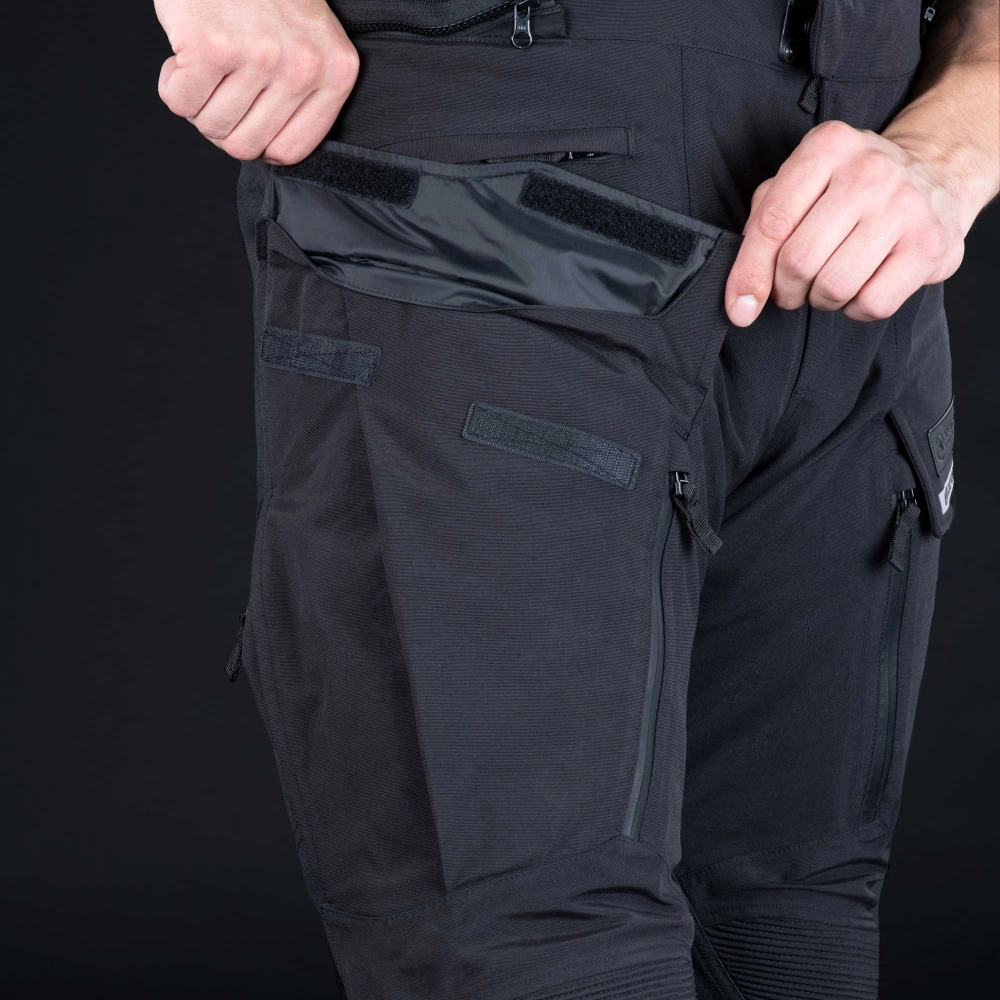
Although the Oxford Stormland has even smaller hip pockets, it also has two substantial patch pockets on what will be the top of your thigh when riding.
These pockets are large enough to get a gloved hand into them and are sealed with a large flap fastened down by Velcro. Perfect for a passport, paperwork or even your phone.
Thermal Liner
Both Oxford trousers have Oxford’s WarmDry™ removable thermal liners, with the Stormland getting the extra benefit of “Polartec® Power Grid” stretch thermal zones. Sounds impressive, but I had no idea what that actually was.
PolarTec is a patented grid construction knit that increases warmth and breathability while also reducing fabric mass – according to their website, anyway. In practical terms, this is a band of stretch thermal material at the point where we apply the most bend – the knee.
Does it work? Well, I’ve not had cold knees, and the trousers are comfortable on the bike, so something is working.
Venting
As it is winter, I’ve not done too much testing in this department. By Mark-One eyeball, the large patch that the Mondial has would let more air into the trousers.
 In comparison, the Stormland has waterproof zips that open to let air flow, but the surface area is nothing like the Mondial.
In four years of riding, I’ve only once been too hot in my Mondial trousers, and that was due to me leaving the thermal liner in because I was running late and didn’t take the time to remove it.
And, yes, I got a few strange looks as I stripped off my trousers at the side of the road to remove the liner.
Bottom Line
Looking back for my £40 extra, I got an AA rating, better pockets, ripstop nylon in the abrasion areas, redesigned comfortable braces and a better thermal liner, which sounded like an excellent deal and why I happily parted with the extra cash.
If I factor in the official Oxford Level 2 hip armour for the Mondial, which costs £10 to £20 depending on which model you choose, the price difference drops to £20. The Oxford Mondial 2.0 is an excellent laminated trouser, but for me, the Oxford Stormland is where you should be looking.
And now, we just have to hope that Oxford doesn’t read this and decide to put the price up before you invest in a pair. When you are getting so much more for the few extra quid, I wonder who came up with the pricing strategy?